Steam Traps on Two-Pipe Radiators
A steam trap on a two-pipe radiator lets air and condensed water drain into the return pipe but shuts against live steam, so the steam stays in the radiator until it gives up its heat.
Compiled by the Wet Return bench from makers' manuals and federal pages · how pages are checked · Checked again
Who owns what: Wet Return is run by the same people who own PlumbingSupplyAndMore, Central Plumbing & HVAC, SoftPro Water Systems and Quality Water Treatment, the businesses linked on this page. The text is written from boiler and vent makers' manuals and federal pages read in October 2026; what a business says about its own products is that business's claim. How these links are handled
On the tag
- Thermostatic radiator traps "stop flow of live steam, but open to drain condensate and air into the return" (Hoffman FHD-205, 1997).
- The trap's bellows or diaphragm expands when steam reaches it and closes the outlet (Hoffman TES-375A, 2013).
- A trap that is hot and blowing steam has a bad bellows or dirt on the seat; a cold trap that passes no water may have a ruptured bellows (TES-375A).
- Peerless's 2025 steam manual names a trap "failed open, allowing steam to enter returns" as a cause of water hammer.
- Weil-McLain's 2025 boiler manual lists faulty steam traps among the causes of excess make-up water.
- Two-pipe systems that return to a pump vent their air at the condensate receiver, not at each radiator (Hoffman HS-901A).
What does a steam trap on a radiator do?
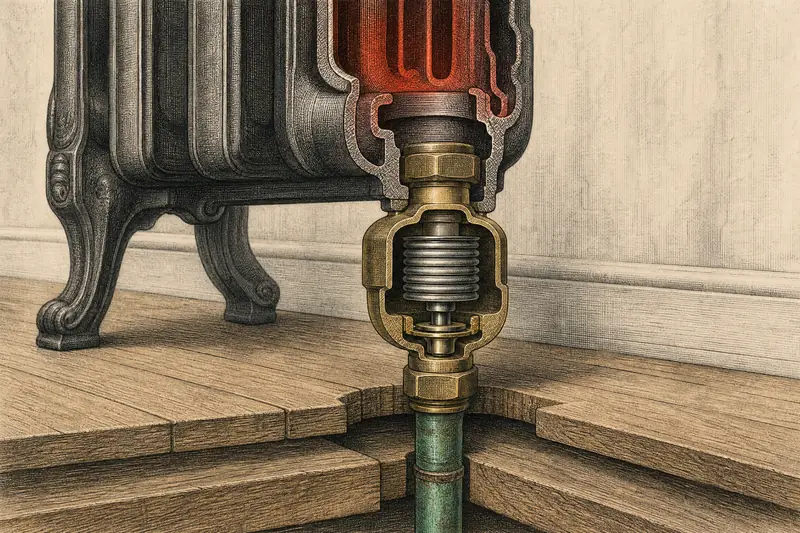
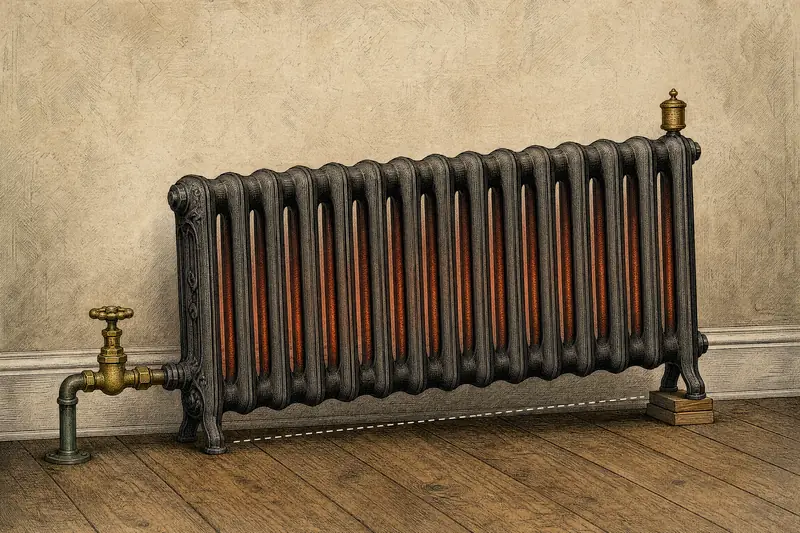
A steam trap on a two-pipe radiator lets air and condensate leave the radiator but blocks steam from passing straight through into the return. Hoffman's FHD-205 sheet on two-pipe steam equipment (1997) describes thermostatic radiator traps as devices that "stop flow of live steam, but open to drain condensate and air into the return." The trap screws onto the radiator's bottom outlet, at the end opposite the supply valve.
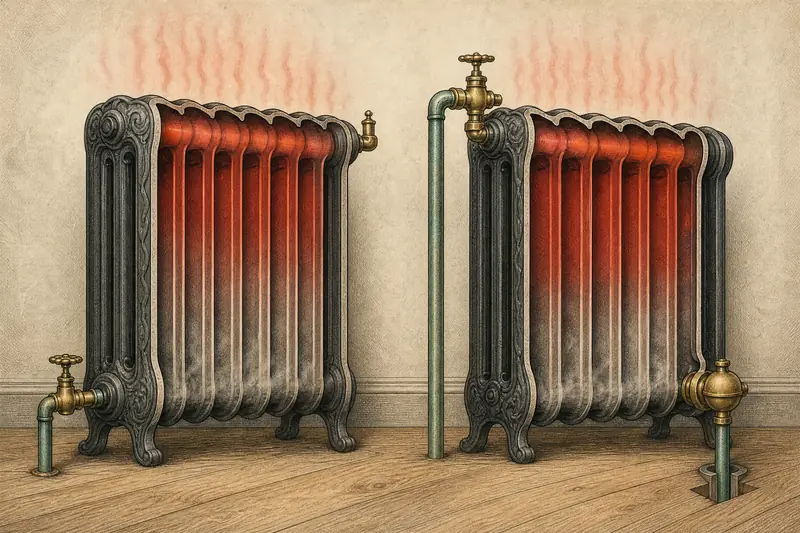
Two-pipe steam needs traps because it has separate pipes for supply and return, as the Hoffman HS-901A booklet explains. Without a working trap, steam could pass straight into the return line instead of condensing in the radiator, where the heat is wanted. One-pipe systems have no radiator traps at all; they use an air vent on each radiator, covered on the steam radiator air vent page.
How does a thermostatic radiator trap work?
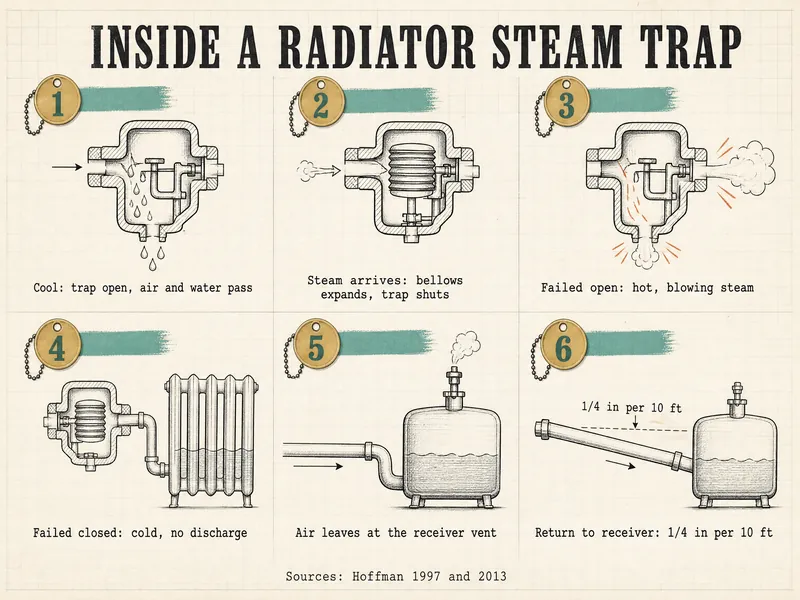
A thermostatic radiator trap works on temperature: it stays open while cool and closes when steam heats its element. Hoffman's technical manual TES-375A (2013) explains that when steam begins to pass through, "the operating bellows or diaphragm assembly expands, closing off the trap." As condensate collects and cools a little, the element contracts and the trap opens to let it drain.
TES-375A notes that the trap opens at a set number of degrees below the steam temperature for the pressure in the system, so the water leaving is slightly cooler than steam. Both bellows-type and balanced-pressure diaphragm-type elements are in use. When a trap is used as a drip at the end of a main, Hoffman's drawings show it after an uninsulated cooling leg at least 5 feet long, because a thermostatic trap needs the water to cool before it will open.
| Trap condition | What happens | What you may notice |
|---|---|---|
| Working | Opens for air and water, closes on steam | Radiator heats, returns stay quiet |
| Failed open (bad bellows) | Steam blows straight into the return | Banging or hissing in the returns, boiler needing more water |
| Failed closed (ruptured bellows) | Condensate and air stay in the radiator | Radiator stays cold |
| Dirt on the seat | Trap cannot close fully | Same signs as failed open |
What are the signs of a failed steam trap?
A failed steam trap shows up either as a cold radiator or as steam where it should not be. TES-375A's troubleshooting section gives both cases: "When the trap discharges continuously (trap hot, blowing steam), the bellows has gone bad or there is dirt on the seat," and "A cold trap which doesn't discharge condensate could have a ruptured bellows which causes the trap to remain closed."
From the living room, a trap that has failed closed looks like a radiator that stays cold while others heat. A trap that has failed open is harder to spot in the room itself, but it can show up as banging or hissing in the return lines, or a boiler that keeps needing water. Do not touch a trap or its pipes to test them; while the system runs they can be at steam temperature. Note which radiator, and when, and pass it on to a technician.
Trap facts in numbers
- 5 ftMinimum cooling leg ahead of a thermostatic drip trap in Hoffman's drawingsHoffman HS-901A
- 1/4 in per 10 ftMinimum fall of a two-pipe return main to the receiverHoffman TES-375A, 2013
- 2 psiTypical two-pipe systems need less than thisWeil-McLain SGO manual, 2025
Why can a failed steam trap heat the returns?
A trap that fails open lets live steam pass straight into the return pipes, which are meant to carry only air and water. The Peerless 211A steam boiler manual (2025) lists "Trap failed open, allowing steam to enter returns" among the causes of water hammer: the steam meets cooler condensate in the return and collapses into it. Hoffman's FHD-205 adds that water hammer is the major cause of damage to the floats and thermostatic elements in traps, so one failed trap can help ruin others.
Weil-McLain's EG boiler manual (2025) lists "faulty steam traps" among the causes of a steam system needing make-up water, which shortens boiler life through corrosion. If the boiler keeps needing water, see the sight glass and low-water cutoff page.
Who tests and rebuilds steam traps?
A heating technician who works on steam tests, rebuilds and replaces traps. Weil-McLain's SGO steam boiler manual (2025), in its owner troubleshooting table, says: "Contact service technician to check, repair or replace air vents and traps." The Department of Energy's 2011 renovation handbook lists "Check and replace sticking steam traps" in the steam tune-up done by an HVAC technician.
Some old traps can be rebuilt with a new element; others cannot. Hoffman's residential replacement parts list HS-800E (2022) says that "for Series 17A & 17D the entire trap must be replaced with a Series 17C trap." Matching the element to the trap body, and checking every trap on the system rather than one at a time, is the technician's job. If unsure whether a radiator's trouble is a trap, call a licensed heating technician.
PlumbingSupplyAndMore's steam vents and traps (run by Wet Return's owners) let you see what replacement traps and elements look like: the kind of part a technician fits.
Do two-pipe systems use vents too?
Yes, but not usually on each radiator. On a two-pipe system the air leaves each radiator through its trap, travels along the returns and escapes through a vent further down the line. HS-901A says that on pumped systems, air "discharges from the system through the open vent on the condensate pump receiver," and TES-375A describes radiator air vents as devices "used for the elimination of air from one-pipe steam systems." The steam mains on pumped two-pipe systems end in a float-and-thermostatic trap rather than a main vent.
Some large old two-pipe systems ran under vacuum, with their own pumps and controls; those are beyond this page. If a radiator on a two-pipe system has a one-pipe style vent screwed into it, or a trap has been removed, mention it to the technician at the next visit. For converting radiators to hot water, a 2024 guest post on U.S. Boiler's blog notes that the trap has to be dealt with as part of the job; the hot-water radiator page explains that system.
Other steam pages
 Folder: Steam heat in old houses, all topics
- Steam heat: How one-pipe and two-pipe steam work
 Steam heat: Why steam pipes bang
Proof stamp: where these figures come from
Sources read October 2026: Hoffman's FHD-205 two-pipe equipment sheet (1997), TES-375A technical manual (2013), HS-901A booklet and HS-800E parts list (2022); the Peerless 211A steam manual (2025); Weil-McLain's EG and SGO manuals (2025); DOE's 2011 renovation handbook; and a 2024 U.S. Boiler blog post on conversions. Left out: vacuum and vapor system details, trap capacity tables, and any homeowner steps for testing, opening or replacing a trap.
Questions from the boiler room
Is a steam trap the same as an air vent?
No. A one-pipe air vent lets air out to the room and closes on steam. A two-pipe radiator trap lets air and condensate into the return pipe and closes on steam. Both rely on heat to close.
Why is one radiator on my two-pipe system cold?
A trap stuck closed is one cause: Hoffman says a cold trap that passes no condensate may have a ruptured bellows. Weil-McLain's owner troubleshooting table also names clogged piping and closed radiator valves, so a technician checks all of them.
Can a failed trap make the boiler use more water?
Yes. A trap stuck open sends steam into the returns instead of keeping it in the radiator, and Weil-McLain lists faulty traps among the causes of make-up water, which brings corrosion. A technician can find which traps are passing steam.
How long do radiator traps last?
The sources read for this page give no set life for radiator trap elements. Hoffman's FHD-205 notes that water hammer is the main cause of damage to trap thermostats, so banging is worth fixing for the traps' sake too.
Should every trap be replaced at once?
That is a call for the technician after testing. Hoffman's parts list shows some old trap series take a new element while others must be replaced whole.
Does a two-pipe radiator need to slope?
It should sit level or drain toward its outlet, where the trap is. One-pipe radiators are the ones that slope back toward the supply valve.
Back up the riser: every steam and hot-water page on Wet Return