Combustion Air and Chimney Liners
A chimney liner protects an old masonry chimney from a boiler's flue gases, and makers call for one where codes require it or where a cold outside chimney could gather condensation.
Compiled by the Wet Return bench from makers' manuals and federal pages · how pages are checked · Checked again
Who owns what: Wet Return is run by the same people who own PlumbingSupplyAndMore, Central Plumbing & HVAC, SoftPro Water Systems and Quality Water Treatment, the businesses linked on this page. The text is written from boiler and vent makers' manuals and federal pages read in October 2026; what a business says about its own products is that business's claim. How these links are handled
On the tag
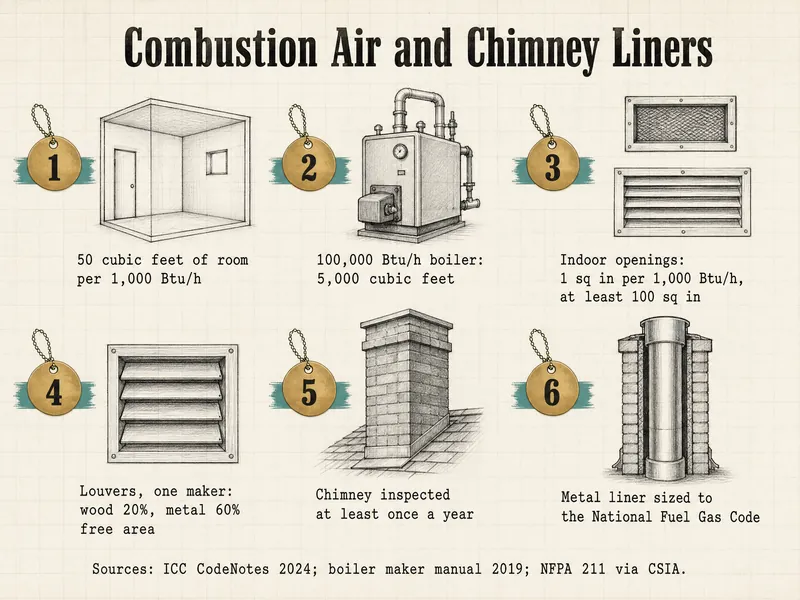
- Code's Standard Method asks for at least 50 cubic feet of room volume per 1,000 Btu/h of appliance input (ICC CodeNotes, 2024).
- Weil-McLain's worked example: a 100,000 Btu/h boiler needs a space of at least 5,000 cubic feet, about 625 sq ft at an 8-foot ceiling.
- Openings between indoor rooms need 1 sq in of free area per 1,000 Btu/h each, never less than 100 sq in (ICC).
- Weil-McLain prefers a lined chimney, requires one where codes do, and recommends a corrosion-resistant metal liner sized to NFPA 54 for cold outside chimneys.
- NFPA 211, as quoted by CSIA: chimneys, fireplaces and vents are inspected at least once a year.
- When an old boiler comes off a shared chimney, the installer must retest the appliances left on it (Weil-McLain, NFPA 54).
Why does a boiler need combustion air?
A boiler needs combustion air because its burner cannot burn fuel cleanly without a steady supply of oxygen, and the same air keeps the chimney drawing. The International Code Council's CodeNotes on indoor combustion air (2024, covering the 2021 IRC and IFGC) puts it plainly: combustion air ventilates and cools appliances and the rooms around them, and it plays an important role in producing and controlling draft in vents and chimneys.
The code's Standard Method sizes that air by room volume: at least 50 cubic feet for every 1,000 Btu/h of total appliance input in the space. Weil-McLain's CGa boiler manual (2019) works an example: 100,000 Btu/h of input needs 5,000 cubic feet, which at an 8-foot ceiling is about 625 sq ft of floor. A water heater in the same room adds its input to the total.
When the room is smaller than that, openings bring air in. Two openings to other indoor rooms each need 1 sq in of free area per 1,000 Btu/h and never less than 100 sq in (ICC). A single opening straight to the outdoors can be smaller, 1 sq in per 3,000 Btu/h, according to the Weil-McLain manual.
Combustion air and venting in numbers
- 50 cu ftRoom volume per 1,000 Btu/h of appliance input (Standard Method)ICC CodeNotes, 2024
- 100 sq inSmallest allowed free area for each of two indoor openingsICC CodeNotes, 2024
- 20% / 60%Free area to assume for wood and metal louvers without maker dataWeil-McLain CGa manual, 2019
- 1 per yearChimney, fireplace and vent inspections under NFPA 211CSIA
What happens when a boiler room is sealed up?
A sealed-up boiler room can starve the burner and pull flue gas back down the chimney. Old basements were often drafty enough on their own; new windows, a finished basement, weatherstripped doors or a closet built around the boiler can each cut the air supply below what the code numbers assume.
The ICC note adds a tight-house rule: if the house is known to leak 0.40 air changes per hour or less, the room-volume shortcut no longer applies and a different calculation is required. Weil-McLain says the appliance space "must never be under a negative pressure", which means a strong bath fan, range hood or clothes dryer pulling air out of the basement counts against the boiler.
Louvers matter too. With no louver data, the ICC CodeNotes default is 25% free area for wood louvers and 75% for metal; Weil-McLain's manual is more cautious and tells installers to assume 20% and 60%, so a decorative grille over an opening can shrink it a lot. Air quality counts as well: the maker's 2025 user manual says contaminated combustion air will damage the boiler, listing chlorine pool chemicals, paint removers and some spray cans, and says to call a technician for an outside air source if they cannot be moved.
Why might an old chimney need a chimney liner?
An old chimney may need a liner because a modern boiler's flue gas can cool and condense in a flue built for an older, larger appliance. Weil-McLain's CGa manual says a lined chimney is preferred and must be used when local, state or national codes require it. It warns that cold masonry chimneys, the ones on outside walls, can let condensation form, and that condensation can damage the masonry.
The maker's answer is to line the chimney with a corrosion-resistant metal liner, such as AL29-4C single-wall stainless steel or B-vent, sized under the National Fuel Gas Code (NFPA 54). The same manual says the existing chimney must be inspected before the boiler goes in, and that failing to clean or replace perforated pipe or tile lining can cause severe injury or death.
The Chimney Safety Institute of America makes the same point about oversized flues: modern furnaces can have many problems when vented through flues intended for older furnaces. CSIA adds that liners for gas and oil appliances do not need insulation to meet makers' requirements, though an exterior chimney performs better with it.
| Item | Rule | Source |
|---|---|---|
| Liner required | Preferred; mandatory where codes require | Weil-McLain CGa manual, 2019 |
| Liner material | Corrosion-resistant metal, such as AL29-4C stainless or B-vent | Weil-McLain CGa manual, 2019 |
| Liner size | Per the National Fuel Gas Code (NFPA 54) | Weil-McLain CGa manual, 2019 |
| Liner insulation | Not required for gas or oil appliances; helps on exterior chimneys | CSIA homeowner resources |
| Room air | 50 cu ft per 1,000 Btu/h, or openings | ICC CodeNotes, 2024 |
What happens to the chimney liner when a boiler is replaced?
When a boiler is replaced, the chimney and any liner are inspected, and every appliance still connected to that chimney is retested. Weil-McLain's manual spells out the installer's steps at removal of an existing boiler: inspect the venting system for proper size and pitch and for blockage, leakage or corrosion, then correct any problem so the installation meets NFPA 54, resizing the vent if needed.
The common case is a gas water heater that used to share a big flue with the old boiler. If the new boiler vents out through a wall instead, the small water heater is left alone in a flue sized for both. That is why the retest is the installer's job on every boiler change, as the replacement page explains.
A new liner is fitted by a chimney professional or the heating contractor. PlumbingSupplyAndMore's chimney liners (run by Wet Return's owners) show the kind of stainless liner and fittings a technician installs; sizing comes from NFPA 54 tables and the appliance maker, not from the shelf.
How often should a chimney and its liner be inspected?
A chimney and its liner should be inspected at least once a year. CSIA quotes NFPA 211: chimneys, fireplaces and vents shall be inspected at least once a year for soundness, freedom from deposits and correct clearances. CSIA stresses that gas appliances are included, and the CDC also says to have the chimney checked or cleaned every year.
The yearly boiler visit and the chimney inspection overlap. Weil-McLain's annual start-up list includes inspecting the flue gas vent system, and the annual boiler service page covers the rest of that list.
What can a homeowner check near the boiler?
A homeowner can look, without touching the boiler, at three things: the air openings, the vent pipe and what is stored nearby. Weil-McLain's daily owner check is to verify that combustion and ventilation air openings to the boiler room are open and unobstructed, and its manual says not to block air flow to the boiler.
- Keep louvers and grilles clear of boxes, laundry and dust.
- Look at the vent connector between boiler and chimney for rust, holes or joints pulling apart, and report any you see.
- Move paint strippers, pool chlorine and aerosol cans out of the boiler room.
- After a snowstorm, brush snow away from outside intake and exhaust pipes.
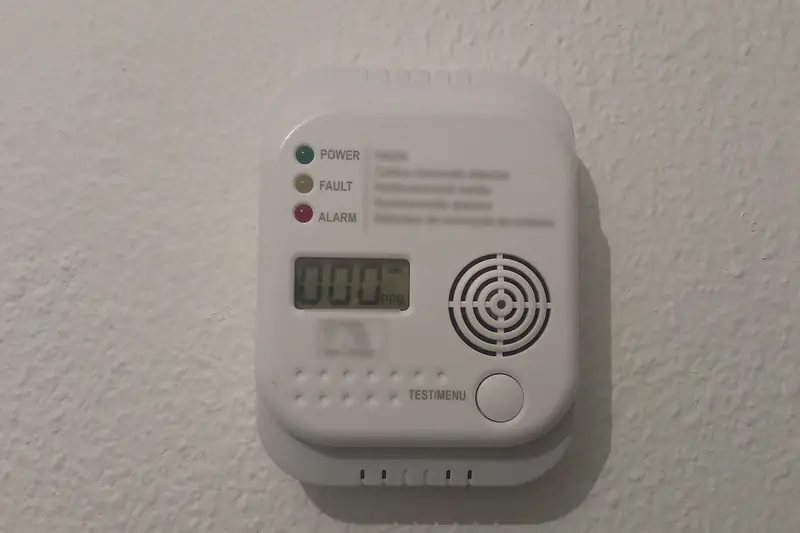
Anything wrong with venting can let carbon monoxide into the house. So NFPA's 2026 advice applies here: a CO alarm on each story of the house with the basement counted, one just outside each separate sleeping area, and one in each room where someone sleeps. If an alarm goes off, go outside first and then call 911; if you smell gas, leave and call 911 or the gas utility once outdoors, without using switches or phones inside. The carbon monoxide page has the details. If you are not sure what you are looking at, have a licensed heating technician look instead.
Proof stamp: where these figures come from
This page is based on the ICC's CodeNotes on indoor combustion air methods (2024, for the 2021 IRC and IFGC), Weil-McLain's CGa Series 2 boiler manual (2019) and gas boiler user manual (2025), CSIA's homeowner resources quoting NFPA 211, NFPA's 2026 Educational Messages for CO alarm wording, and the CDC's CO page, all read October 2026. The NFPA 54 and NFPA 211 texts themselves were not read; their rules come through the ICC summary, the maker manual and CSIA. Left out: draft or spillage test steps, liner sizing tables and any instruction to adjust a burner, damper or vent.
Questions from the boiler room
Does a condensing boiler need a chimney liner?
Not if it is vented out through a wall, as its maker's manual allows, because then the boiler does not use the chimney at all. The chimney may still need attention for a water heater left on it, which the installer must retest under NFPA 54.
Can a stainless liner go in a chimney with cracked tiles?
The Weil-McLain manual treats perforated pipe or tile lining as something to clean or replace before the boiler goes in, and recommends a metal liner sized per NFPA 54. A chimney professional decides whether a liner alone solves it after inspecting the masonry.
Does a boiler closet door need a louver?
Often, yes, if the closet is smaller than 50 cubic feet per 1,000 Btu/h of input. Code then calls for openings, and a louvered door counts only for its free area: 25% for wood and 75% for metal by the ICC default, or 20% and 60% by Weil-McLain's more cautious rule.
Can a basement bathroom fan affect the boiler?
It can. Weil-McLain says the appliance space must never be under negative pressure, and an exhaust fan pulling air out of a tight basement works against the chimney's draft. A heating technician can check draft with the fan running.
Why does an outside chimney matter more than an inside one?
A chimney on an outside wall stays colder, so flue gases cool and condensation forms more readily. Weil-McLain warns that this condensation can damage a masonry chimney, which is one reason it recommends a corrosion-resistant metal liner.
Who should install a chimney liner?
A chimney professional or the heating contractor fitting the boiler. The liner must be sized under NFPA 54 and the appliance maker's instructions, and the chimney inspected first, so it is not a homeowner job.
Related pages

Back up the riser: the five valve tags on the Wet Return home page