Combi Boilers in Old Houses
A combi boiler is one wall-hung condensing boiler that heats the radiator loop and also heats tap water on demand, so it saves a water heater but limits how much hot water flows at once.
Compiled by the Wet Return bench from makers' manuals and federal pages · how pages are checked · Checked again
Who owns what: Wet Return is run by the same people who own PlumbingSupplyAndMore, Central Plumbing & HVAC, SoftPro Water Systems and Quality Water Treatment, the businesses linked on this page. The text is written from boiler and vent makers' manuals and federal pages read in October 2026; what a business says about its own products is that business's claim. How these links are handled
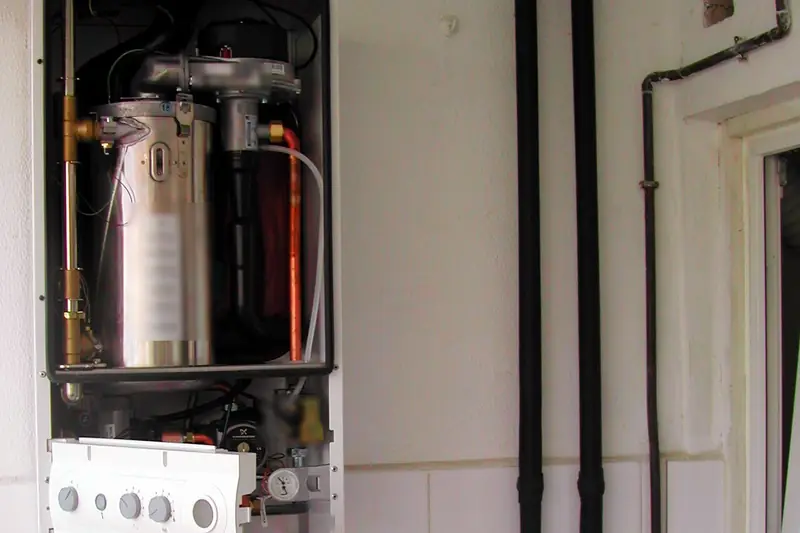
On the tag
- Navien's NCB-E combi line delivers 2.6 to 4.5 gpm of hot water at a 77°F temperature rise, depending on size (installation manual, 2019).
- Those combis are rated 95.0% AFUE and ENERGY STAR listed (Navien QuickFacts, 2025).
- Hardness limits differ by maker: Navien allows up to 12 grains per gallon; Weil-McLain's ECO Tec combi calls for softening above 50 ppm.
- Weil-McLain requires an ASSE 1070 mixing valve on its combi, set to no more than 120°F.
- A combi is a hot-water boiler, so it fits hot-water radiator systems, not one-pipe or two-pipe steam.
- Navien says flushing the domestic heat exchanger is a job for an authorized technician or licensed professional.
What is a combi boiler?
A combi boiler is a hot-water heating boiler with a second heat exchanger that heats domestic water as you use it, so one appliance replaces both the boiler and the tank water heater. Navien's NCB-E QuickFacts (2025) lists the parts: an integrated boiler pump, a primary stainless steel heat exchanger for the heating loop, and a stainless flat-plate heat exchanger for domestic hot water.
Both makers cited here build their combis as condensing boilers. The Navien NCB-E models are rated 95.0% AFUE and ENERGY STAR listed, well above the 84% federal floor for gas hot-water boilers covered on the boiler types and AFUE page. Weil-McLain sells the same idea as the combi version of its ECO Tec.
Because a combi heats water, not steam, it only suits houses with a hot-water (hydronic) radiator system. A steam house would need its whole system converted first, a bigger job discussed on the replacement page.
How does a combi boiler make hot water?
A combi boiler makes hot water by firing its burner when a tap opens and passing cold supply water through the plate heat exchanger on the way to the faucet. There is no stored tank of hot water; water is heated as it flows.
The domestic side gets a much bigger burner than the heating side. Navien's largest NCB-E, the 240E, heats the radiator loop at 18,000 to 120,000 Btu/h but fires up to 199,900 Btu/h for domestic hot water, per the 2025 QuickFacts. That extra firing rate is what lets a small wall-hung boiler heat running water in real time.
The heating loop works like any modern hot-water boiler: Navien's installation manual gives a typical cold fill pressure of 12 psi for a residential system, rising as the water heats, with a 30 psi relief valve. The boiler pressure gauge page explains those readings.
How much hot water can a combi boiler supply?
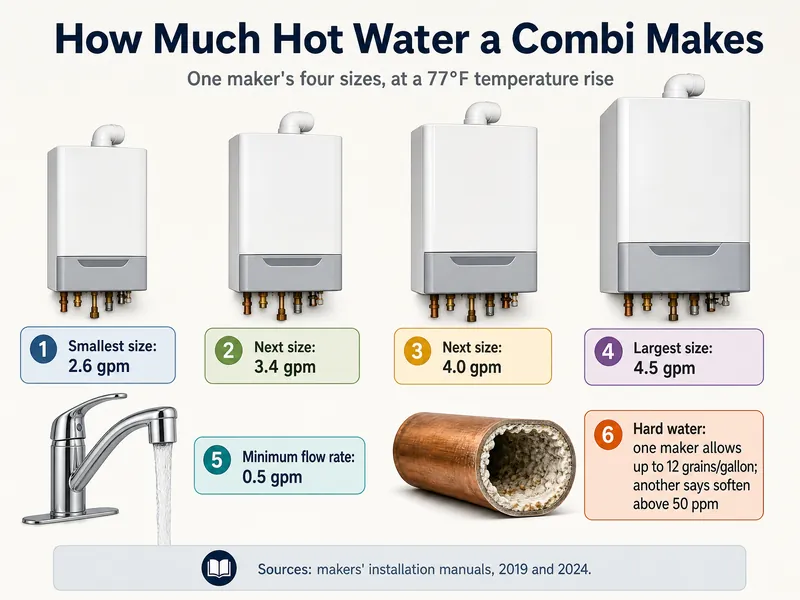
A combi boiler supplies only as much hot water as its burner can heat in real time, which for Navien's NCB-E range is 2.6 to 4.5 gpm at a 77°F temperature rise. The Navien installation manual (version 7.0, 2019) lists the four sizes in its domestic hot water table, along with a minimum flow rate of 0.5 gpm.
| Model | Flow at a 77°F rise | Factory flow restrictor |
|---|---|---|
| NCB-150E | 2.6 gpm | 2.6 gpm |
| NCB-180E | 3.4 gpm | 4.0 gpm |
| NCB-210E | 4.0 gpm | 5.0 gpm |
| NCB-240E | 4.5 gpm | 5.6 gpm |
The 77°F rise matters. Colder incoming water in winter needs a bigger temperature rise, so the same burner delivers fewer gallons per minute. Navien also ships color-coded flow restrictors, pre-installed, that cap flow (2.6 to 5.6 gpm, factory tested at 56 psi) so the boiler is not asked for more than it can heat.
To judge fit, a heating contractor adds up the fixtures that run at the same time in your house and compares that flow to the model's rating at your winter water temperature. The Navien video on this page ends with the same point: sizing and installation belong to a qualified contractor.
Combi limits in numbers
- 2.6–4.5 gpmHot-water flow at a 77°F rise across Navien's four NCB-E sizesNavien installation manual, 2019
- 12 gpgNavien's maximum total hardness for domestic water (200 mg/l)Navien installation manual, 2019
- 50 ppmHardness above which Weil-McLain says to soften water for its ECO Tec combiWeil-McLain ECO Tec Series 2 manual, 2024
- 120°FHighest setting Weil-McLain allows on the required ASSE 1070 mixing valveWeil-McLain ECO Tec manual, 2024
Can a combi boiler run old cast-iron radiators?
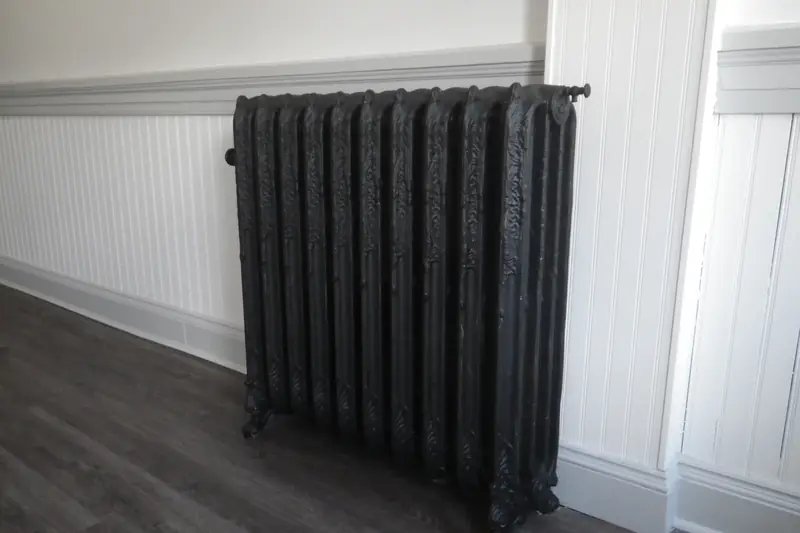
A combi boiler can run old cast-iron hot-water radiators, as long as the house's heat loss fits the heating side of the boiler and the radiators can do their job at the water temperatures it supplies. Weil-McLain's ECO Tec manual (2024), which covers its combi models, has a system preset for cast-iron radiators that targets 120°F at its lowest and 180°F at its highest, with outdoor reset in between.
Condensing efficiency depends on cool return water. The DOE's Building America condensing boiler measure guideline (2014) says flue vapor condenses only if the water coming back is cold enough to chill the exchanger surface under the exhaust's dew point. Big cast-iron radiators help, because they can heat a room with cooler water for much of the season.
Two cautions apply to old systems. A converted gravity system holds a large volume of water and was built to circulate without a pump, so the combi's built-in pump and the piping need checking by the installer. And the heating input of a combi is smaller than its hot-water input; on the NCB-240E it tops out at 120,000 Btu/h. A room-by-room heat-loss calculation, not the old boiler's size, decides whether that is enough; see radiator sizing and EDR.
Does hard water matter for combi boilers?
Hard water matters a great deal for combi boilers, because scale builds up in the small passages of the domestic plate heat exchanger. Each maker sets its own limit. Navien's installation manual allows total hardness up to 200 mg/l (12 grains per gallon), and states that damage from poor water quality is not covered under warranty and that Navien is not responsible for scaling of the domestic system.
Weil-McLain is stricter for its ECO Tec combi: domestic water harder than 50 ppm as calcium carbonate (about 2.9 grains per gallon, converted) must be treated with a water softener before it enters the boiler. The same manual recommends a 25-micron or finer domestic filter, plus isolation and drain valves so the domestic heat exchanger can be flushed and cleaned, which it calls a maintenance requirement.
A whole-house softener, such as the SoftPro Elite (run by Wet Return's owners), is one way owners deal with hard water on the domestic side. A salt-free SoftPro conditioner (Quality Water Treatment, run by Wet Return's owners) is another approach some owners use, but Weil-McLain's wording names a water softener, so check what the boiler maker's manual accepts before relying on a conditioner. Descaling the heat exchanger itself stays with a technician: Navien's user manual calls flushing "a somewhat complicated procedure" and points owners to an authorized technician or licensed professional.
When is a boiler with a separate tank better?
A boiler with a separate hot-water tank is better when the house regularly runs more hot water at once than a combi's rating, or when the water is hard and treating it is not practical. A stored tank delivers a burst of hot water at whatever rate the pipes allow, while a combi is capped by its burner and flow restrictor.
Other points that favor a separate tank: a large old house whose heat loss is bigger than a combi's heating input, a steam system (a combi cannot serve one), or an owner who would rather not depend on one appliance for both heat and showers. Weil-McLain's ECO Tec comes in a heat-only version for exactly that pairing.
Points that favor a combi: hot-water use at any one moment that fits inside the rating, soft or treated water, and no room for a tank. Either way, Weil-McLain's scald rule applies to the domestic side: an ASSE 1070 mixing valve set no higher than 120°F, with the manual noting that the CPSC and some states recommend 130°F or less. PlumbingSupplyAndMore's boilers category shows combi and heat-only boilers side by side, the kind of equipment a licensed heating contractor sizes and installs.
Proof stamp: where these figures come from
This page is based on Navien's NCB-E installation and operation manual (version 7.0, 2019), user's information manual (2019) and QuickFacts (2025); Weil-McLain's ECO Tec Series 2 boiler manual (2024); and the DOE Building America measure guideline on condensing boilers (2014), all read October 2026. The 2.9 grains per gallon figure is a unit conversion of Weil-McLain's 50 ppm, not a number printed in the manual. Left out: shower and faucet flow figures, cost comparisons and any instruction to flush or descale a heat exchanger.
Questions from the boiler room
Does a combi boiler give endless hot water?
It gives continuous hot water only up to its rated flow. Navien's NCB-E sizes range from 2.6 to 4.5 gpm at a 77°F rise; open more taps than that and the water arriving at each one gets cooler or weaker.
Why does a combi need a minimum flow to make hot water?
The burner fires only when enough water flows through the domestic side. Navien lists a minimum flow rate of 0.5 gpm, so a barely open tap may not start the boiler.
Can a combi boiler replace a steam boiler?
Not directly. A combi is a hot-water boiler, and one-pipe or two-pipe steam radiators and piping work differently. Converting a steam house to hot water is a separate design job for a licensed heating contractor.
How often should a combi boiler be serviced?
Navien's user manual says the boiler must be inspected every year, preferably at the start of the heating season, by a qualified service technician. Its list includes cleaning the condensate trap and, when performance shows a need, flushing the heat exchanger and cleaning the inlet water filter.
What water temperature should a combi deliver to taps?
Weil-McLain requires an ASSE 1070 mixing valve set to no more than 120°F on its ECO Tec combi, and its manual notes that the CPSC and some states recommend 130°F or less.
Is a softener required for every combi boiler?
No single rule applies. Navien accepts water up to 12 grains per gallon; Weil-McLain calls for softening above 50 ppm. Test your water and follow the maker's manual for the boiler you are buying.
Who flushes a combi's domestic heat exchanger?
A technician. Navien's user manual calls flushing a somewhat complicated procedure and says improper maintenance can void the warranty, and Weil-McLain asks installers to fit isolation and drain valves so the job can be done. If the old water heater is removed and the chimney changes use, the chimney liner page covers the venting retest.
Related pages

Back up the riser: radiator heat in old houses, system by system