Radiator Covers and Reflectors
Radiator covers cut heat output by 20% or more when they box a radiator in, while a foil reflector on an outside wall saved up to 6% of a room's heating energy in one test.
Compiled by the Wet Return bench from makers' manuals and federal pages · how pages are checked · Checked again
On the tag
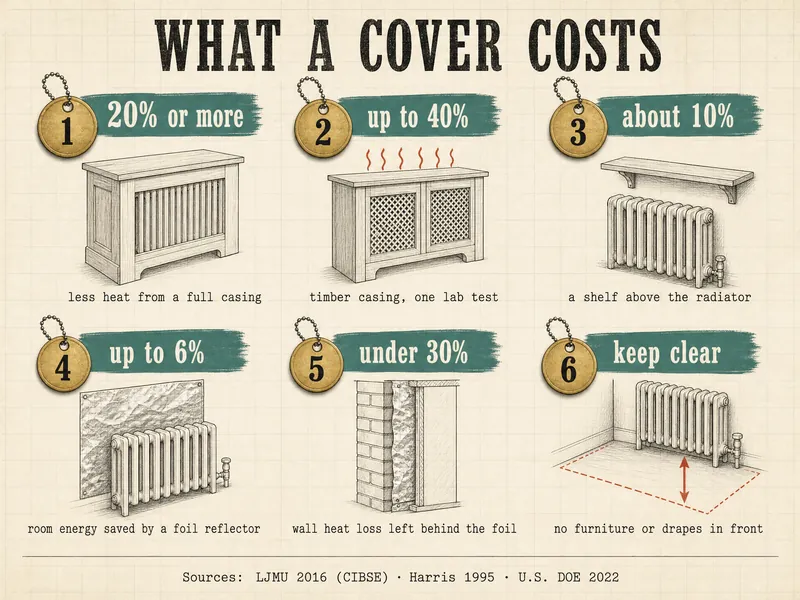
- CIBSE, the UK building-services engineers' body, says encasing a radiator reduces heat output by 20% or more, as cited in a 2016 Liverpool John Moores University study.
- The same study measured losses reaching 40% with a traditional timber casing on a hot-water panel radiator.
- A shelf above a radiator costs about 10% of its output, by the same CIBSE figure.
- Foil behind a radiator cut a room's energy use by up to 6% in a 1995 environmental-chamber test (D.J. Harris, Applied Energy).
- DOE recommends heat-resistant reflectors between exterior walls and radiators (Energy Saver booklet, 2022).
- On one-pipe steam, an air vent hidden inside a cover still has to stay unpainted and free to vent (DOE steam study, 2013).
Do radiator covers reduce heat output?
Yes. A cover that boxes a radiator in reduces its heat output by about a fifth or more. The 2016 LJMU study quotes CIBSE's design handbook: encasing radiators "reduces heat output by 20% or more", and a shelf about 10%. In its own lab runs, the loss "reached up to 40%" with a timber casing.
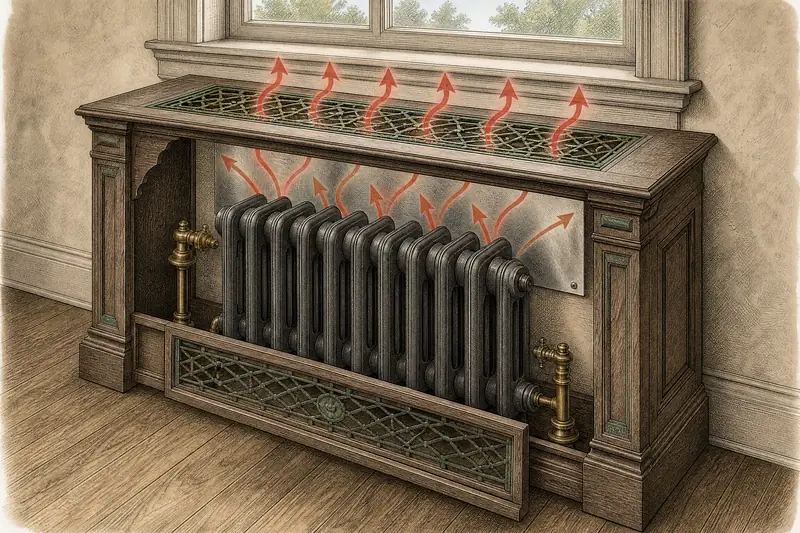
The reason is convection. A radiator warms a room mostly by heating the air that touches it, which rises and pulls cooler air in from below. The study found the main cause of the wooden cover's poor showing was "reduced convection in front of the cover surface", because the cover's face runs cooler than the radiator would. The wooden casing also pushed more heat into the outside wall behind it.
Two cautions on these numbers. They come from UK tests on low-pressure hot-water panel radiators, not American cast-iron column radiators on steam. And the study was carried out with the cooperation of a cover maker. Treat the figures as the right size of the effect, not a forecast for your own radiator.
What covers and reflectors do to radiator output
- 20% or moreoutput lost when a radiator is encased (CIBSE)LJMU study, 2016
- up to 40%loss measured with a timber casingLJMU study, 2016
- about 10%loss from a shelf above the radiator (CIBSE)LJMU study, 2016
- up to 6%cut in the test room's total energy use, foil fitted behind the radiatorD.J. Harris (1995)
What makes a radiator cover work better?
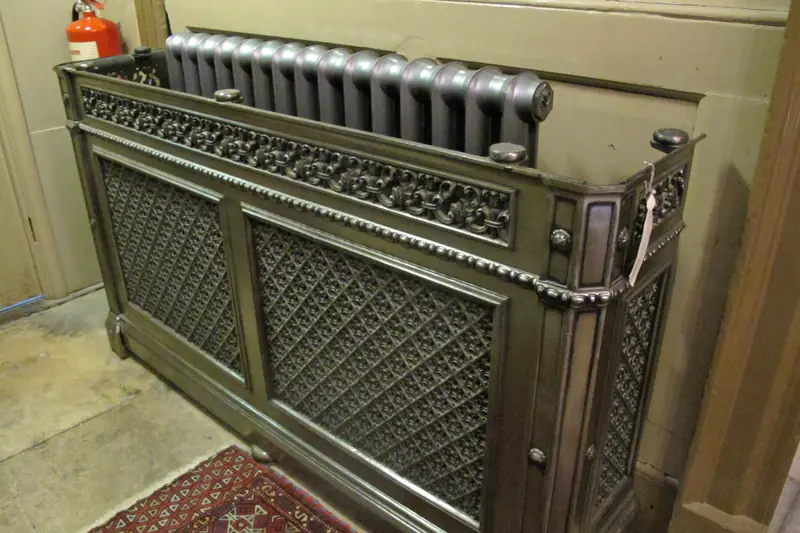
A radiator cover costs less heat the less it encloses. CIBSE's two figures show the pattern: a shelf, which leaves the front and much of the top open, is put at about 10%, while full encasing is put at 20% or more. Since the loss comes from choked convection, a cover with an open grille along the top and an open or grilled front gives warm air a path out and cool air a path in. That is an inference from the study's explanation, not a measured rating for any cover design.
Before buying or building a cover, look at the radiator it will hide. On one-pipe steam, the air vent on the far end must breathe and stay free of paint; the DOE steam study calls painting over vents "a common oversight" with "a serious effect on the heating." On hot-water radiators, the bleed screw near the top needs to stay reachable, because the DOE's Energy Saver booklet (2022) suggests clearing air once or twice a season. On both, the valve should be reachable without dismantling the cover.
| Treatment | Effect on heat | Source and setting |
|---|---|---|
| Full casing (encased radiator) | 20% or more less output | CIBSE, as cited by LJMU, 2016 |
| Traditional timber casing | Up to 40% less output in one test | LJMU lab test, hot-water panel radiator, 2016 |
| Shelf above the radiator | About 10% less output | CIBSE, as cited by LJMU, 2016 |
| Foil reflector on the wall behind | Up to 6% of room heating energy saved | Harris chamber test, 1995 |
| Clear front (no furniture or drapes) | Recommended, no figure given | DOE Energy Saver booklet, 2022 |
Do radiator reflectors save energy?
Yes, a little, mostly where a radiator sits against an outside wall. In D.J. Harris's 1995 environmental-chamber test (Applied Energy, volume 52), foil behind a radiator cut the room's overall energy use by up to 6%. Heat lost through the wall right behind the radiator fell to under 30% of its original value.
Government advice agrees on where they go. The DOE's Energy Saver booklet says to "place heat-resistant radiator reflectors between exterior walls and the radiators." Natural Resources Canada (2012, revised 2014) suggests foil-covered insulation board between radiators and exterior walls to reflect heat back into the room.
The gain is likely largest on an uninsulated outside wall, where the most heat leaks through; that follows from how a reflector works rather than from a measured figure. A 2001 study by Beck and colleagues found a reflective wall does reduce heat lost through the wall, but a plain dark wall can raise a panel radiator's convective output. A reflector, then, trims wall loss rather than adding heat. No source read for this page supports bigger savings than the 6% chamber result.
Are radiator covers safer for children?
No source read for this site measured it, so Wet Return makes no safety claim for covers. The LJMU study mentions lower touch temperature as one reason people fit covers, but it did not test burns or surface temperatures for safety. If a hot radiator worries you, the lower-cost step is to ask a licensed heating technician about the system's operating temperature, rather than relying on a cover.
On hot-water systems, a modern boiler control may already lower water temperature in mild weather; see the hot-water heat section for how outdoor reset works on the loop. On steam, radiator temperature follows steam temperature, which is why the steam heat section stresses low pressure.
Can you paint radiators without losing heat?
Radiators can be repainted, but no primary source read for this page measured how much a paint finish changes the output of a cast-iron radiator, so there is no percentage here. The Beck study often quoted on this point measured the color of the wall behind panel radiators, not paint on the radiator itself.
What is sourced is where paint must not go. On one-pipe steam, the air vent must never be painted over; the DOE steam study shows painted vents as a cause of cold apartments. On hot water, keep the bleed screw clean so it still turns. If a vent is already painted over, a technician replaces it. If unsure, call a licensed heating technician.
Where should furniture and curtains go?
Keep furniture, carpet and long drapes off the front of radiators. The DOE's Energy Saver booklet (2022) says to make sure radiators are "not blocked by furniture, carpeting, or drapes." A sofa pushed against a radiator acts like a cover with a closed front.
Curtains are the usual problem under windows, where many radiators sit: a full-length drape that falls in front of the radiator blocks it the way DOE describes. Tying drapes back or keeping them above the radiator during the heating season keeps the front clear. If a room still feels cold with the radiator clear, the problem is elsewhere; the cold radiators page lists the steam and hot-water causes, and the radiator sizing page explains whether a radiator was big enough to begin with. Both sit in the radiators section.
The National Park Service's Preservation Brief 24 (1991) encourages owners of historic buildings to reuse radiator systems with new boilers, so a cover that keeps an old radiator in service without smothering it is worth getting right.
Proof stamp: where these figures come from
Based on Brady and colleagues' study of decorative covers on hot-water radiators (Liverpool John Moores University, Energy and Buildings, 2016), which cites CIBSE's design handbook (2005); D.J. Harris's reflector chamber test (Applied Energy, 1995, abstract); Beck, Blakey and Chung on wall emissivity (2001, abstract); the DOE Energy Saver booklet (2022); Natural Resources Canada's Keeping the Heat In (2012, revised 2014); and the DOE Building America steam balancing study (2013), all read October 2026. Left out: child-safety and burn-temperature claims, paint-loss percentages, and reflector savings from product-funded tests or blogs, because no primary source supports them.
Questions from the boiler room
Do radiator covers make a room colder?
They can, because a full casing reduces the heat a radiator gives off by 20% or more by CIBSE's figure. A room that was just warm enough before may fall short with a closed-front cover.
Is a radiator shelf better than a full cover?
By CIBSE's figures, a shelf costs about 10% of output against 20% or more for full encasing. A shelf leaves the front open, so more air can move past the radiator.
Do radiator reflectors work on inside walls?
There is little to gain there. Reflectors cut heat lost into the wall behind the radiator, and an inside wall loses that heat to another heated room. DOE and Natural Resources Canada both place them on exterior walls.
Can aluminum foil from the kitchen be used as a reflector?
DOE's wording is "heat-resistant radiator reflectors," and Natural Resources Canada suggests foil-covered insulation board. Wet Return found no source testing kitchen foil on its own, so no figure is given for it.
Does a radiator cover hide a steam vent problem?
It can. A vent that spits water or hisses steam inside a cover is easy to miss, and a cover that blocks the vent's air outlet can slow venting. Check the vent with the cover off at the start of each season.
Do covers change how steam radiators heat up?
The cover studies tested hot-water panel radiators, not steam. The convection effect is the same in principle, so expect a covered steam radiator to give off less heat once full.
Should a cover be removed before a technician visits?
It helps. Technicians need to see the valve, the vent or bleed screw, and on one-pipe steam the slope of the radiator toward its valve.
Back up the riser: the five valve tags on the Wet Return home page