High-Velocity Air Conditioning
High-velocity air conditioning pushes cooled air at high speed through flexible tubes about 2 inches wide, so central air reaches old rooms through small round outlets instead of big ducts.
Compiled by the Wet Return bench from makers' manuals and federal pages · how pages are checked · Checked again
Who owns what: Wet Return is run by the same people who own PlumbingSupplyAndMore, Central Plumbing & HVAC, SoftPro Water Systems and Quality Water Treatment, the businesses linked on this page. The text is written from boiler and vent makers' manuals and federal pages read in October 2026; what a business says about its own products is that business's claim. How these links are handled

On the tag
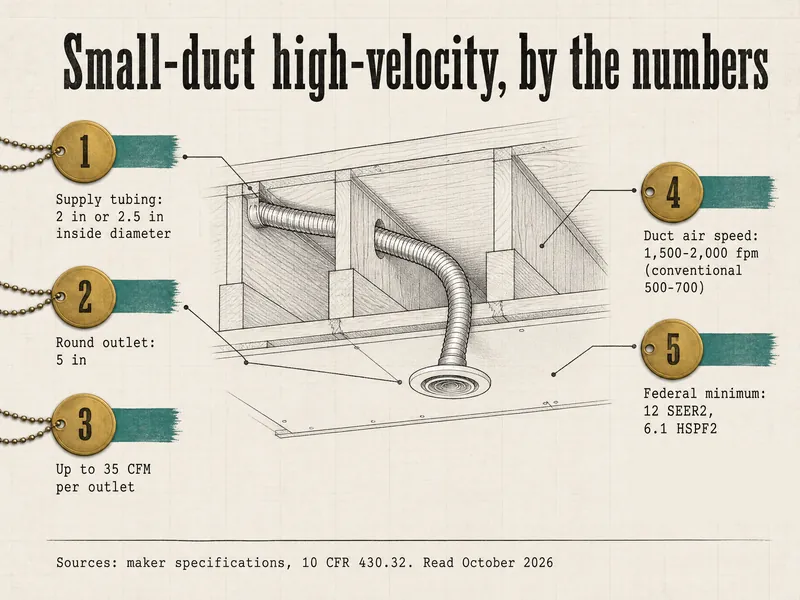
- Unico says its supply tubing is 2 or 2.5 inches inside diameter; SpacePak describes 2-inch flexible ducts and 5-inch round vents (Unico FAQ, read October 2026).
- Federal rules put small-duct high-velocity equipment in a class of its own, floored at 12 SEER2 (and 6.1 HSPF2 for heat pumps) under 10 CFR 430.32.
- Unico gives supply-duct air speeds of 1,500 to 2,000 feet per minute, against 500 to 700 for a conventional duct system.
- Unico and SpacePak each claim about 30% more moisture removal than conventional central air; neither page gives a test method.
- SpacePak lists homes "heated by hot water, steam, or radiant heat" as ideal applications (SpacePak).
- Refrigerant work on the outdoor unit is for Section 608 certified technicians only (EPA).
What is high-velocity air conditioning?
High-velocity air conditioning is a central system that sends cooled air through small, insulated, flexible tubes at high pressure. The federal efficiency rules call it a "small-duct, high-velocity" system and treat it as a separate product class from ordinary split air conditioners.
The parts are an outdoor condensing unit or heat pump, a compact air handler in an attic, closet or basement, a main plenum, and many short tube runs ending in outlets. Unico's FAQ says the return side "is like a conventional system," so one or more ordinary return grilles bring air back to the air handler.
This page draws on two makers' own pages, Unico's and SpacePak's, and labels each of their figures as that maker's claim.
How do small ducts fit into an old house?
The tubes are small enough to snake through wall and floor cavities, between joists and down closets, where a sheet-metal duct would need a soffit. SpacePak describes "2'' flexible ductwork that fits discretely inside wall and floor cavities," and Unico describes supply tubing of 2 or 2.5 inches inside diameter with insulation.
Unico says runs should stay short: "there will be reduced heating and cooling capacity in runs longer than 10 feet." It recommends at least 6 outlets per nominal ton and rates each outlet at up to 35 CFM, about 1,500 Btu/h of cooling. A house that needs 3 tons of cooling therefore needs about 18 outlets or more, each with its own tube.
Outlets are 5-inch round or half-inch by 8-inch slots, per Unico's advantages page, and can sit in a ceiling, wall or floor. In a house with plaster cornices and deep moldings, that is the whole appeal: the outlets are small, and the plaster stays mostly intact.
| Item | Unico says | SpacePak says |
|---|---|---|
| Supply tube size | 2 or 2.5 in inside diameter, insulated | 2-inch flexible ducts |
| Outlet | 5-inch round or ½ × 8-inch slot | 5-inch round vents |
| Moisture removal | Up to 30% more than conventional HVAC | 30% more than conventional central air |
| Sound | "Comparable to a soft whisper" | "Virtually no detectable sound" with sound attenuators |
| Heating | Hot-water coil, heat pump with auxiliary heat, or electric duct heater | Heating and cooling models |
Is high-velocity air conditioning noisy?
High-velocity air conditioning is quiet, by the makers' accounts, when it is built with sound-attenuating tubing at the outlets. Unico's FAQ says "the sound attenuator must be used if the outlet sound level is important," and SpacePak says its system "operates with virtually no detectable sound through the use of sound attenuators."
Neither maker publishes a decibel figure on those pages, so treat "soft whisper" as marketing until you hear a working system. Ask the contractor where the air handler will sit and how it is mounted; Unico says its air handler is engineered to reduce noise and vibration.
The air leaves at speed, according to Unico's FAQ: 1,000 to 2,000 feet per minute at the outlet, with the duct at about 1.5 inches of water column against 0.1 to 0.2 for a conventional system. Both makers describe "aspiration," where the jet draws room air along with it to mix the room without a cold draft.
High-velocity numbers
- 2 inSupply tube inside diameter (also 2.5 in)Unico FAQ
- 35 CFMMost air one outlet delivers, about 1,500 Btu/h coolingUnico advantages page
- 1,500–2,000 fpmSupply-duct air speed, against 500–700 conventionalUnico FAQ
- 12 SEER2Lowest rating allowed for this equipment class10 CFR 430.32 on eCFR
How well does high-velocity air conditioning remove humidity?
High-velocity air conditioning removes more moisture per pass, by the makers' own account, because less air crosses a colder coil. Unico's FAQ says its system is "designed and tested at 250 cfm per ton" and elsewhere contrasts that with 400, and its advantages page claims "up to 30% more humidity" removal than conventional HVAC.
SpacePak's central air page says it "removes 30% more humidity than conventional central air systems." Neither page states a test method, so these are maker claims, not measured results. SpacePak adds that drier air lets you set the thermostat a few degrees higher while still feeling cooler.
Can a high-velocity system also heat?
Yes, Unico lists three ways to heat with its system: a hydronic (hot water) coil, a heat pump with auxiliary heat, or an electric duct heater. A hot-water coil means the system can be designed to take heat from a boiler, which matters in a house that already has one; see how hot-water radiators work for that side of the house.
Owners can also keep the radiators for winter and use the small ducts only for cooling. Unico's list names a hot-water coil, not a steam coil, so in a house with the system described in how steam heat works, ask a heating contractor what is possible.
SpacePak says zoning is possible with dampers in the small ducts, and that a certified contractor does a room-by-room load calculation to size the system.
High-velocity or mini-splits: how do they compare?
High-velocity systems hide almost everything but small outlets; mini-splits in radiator homes put a visible head on each room's wall, with a line set through the wall instead of tubes inside it. The choice is mostly about how much opening of ceilings and closets a house can take, and how much visible equipment the owner will accept.
Efficiency ratings are not directly comparable. Small-duct high-velocity systems have a federal minimum of 12 SEER2 (6.1 HSPF2 for heat pumps), while ordinary split air conditioners must reach 13.4 SEER2, and split heat pumps 14.3 SEER2 and 7.5 HSPF2. Compare a high-velocity quote with other high-velocity quotes.
Flexible duct is one of the parts these jobs use. PlumbingSupplyAndMore's flex duct (run by Wet Return's owners) category shows what flexible duct looks like, though high-velocity systems use each maker's own tubing, fitted by a technician. Central Plumbing & HVAC, a Pennsylvania company with the same owners, lists the air conditioning work (run by Wet Return's owners) a full-service shop handles; elsewhere, look for a local contractor offering the same.

What a homeowner does with a working system is short: keep the return grille and outlets unblocked, change or clean the filter as the maker's manual says, keep shrubs back from the outdoor unit, and set the thermostat. Refrigerant, tubing and air handler work belong to a licensed contractor; SpacePak "strongly recommends" professional installation. If unsure, call a licensed heating technician before touching anything.
Proof stamp: where these figures come from
Based on Unico's FAQ and advantages pages, SpacePak's central air and resources pages, 10 CFR 430.32 on eCFR, and EPA's Section 608 pages, all read October 2026. Maker figures are labelled as maker claims. Left out: decibel figures (none published on those pages), Unico's older refrigerant list, duct-leakage percentages from maker videos, and prices.
Questions from the boiler room
How big a hole does a high-velocity outlet need?
Unico and SpacePak both list a 5-inch round outlet, and Unico also offers a half-inch by 8-inch slot. The tube behind it is about 2 inches across.
Can high-velocity tubes run inside plaster walls?
SpacePak says its ducts fit inside wall and floor cavities without gutting walls. Whether a given wall works is for the installer to check before anything is cut.
How many outlets does a room need?
Unico recommends at least 6 outlets per nominal ton overall and rates each outlet at about 1,500 Btu/h of cooling. A load calculation sets the count room by room.
Does a high-velocity system need a return in every room?
No. Unico says the return side works like a conventional system and can use a single return or several, depending on the house.
Why is the efficiency minimum lower than for a mini-split?
Federal rules treat small-duct high-velocity equipment as its own class, set at 12 SEER2. Unico's FAQ explains that its higher duct pressure lowers airflow per watt.
Can a high-velocity air handler use the boiler for heat?
Unico offers a hot-water coil, so a system can be designed to draw heat from a hot-water boiler. A heating contractor decides whether the boiler and piping suit it.
Will the outlets drip in summer?
Unico's FAQ describes its sound attenuator tubing as insulated, with a Mylar jacket that acts as a vapor barrier. Ask the installer how the air handler's condensate drains and where.
Other ways to cool a radiator house
Back up the riser: the start page for radiator homes