Mini-Splits in Radiator Homes
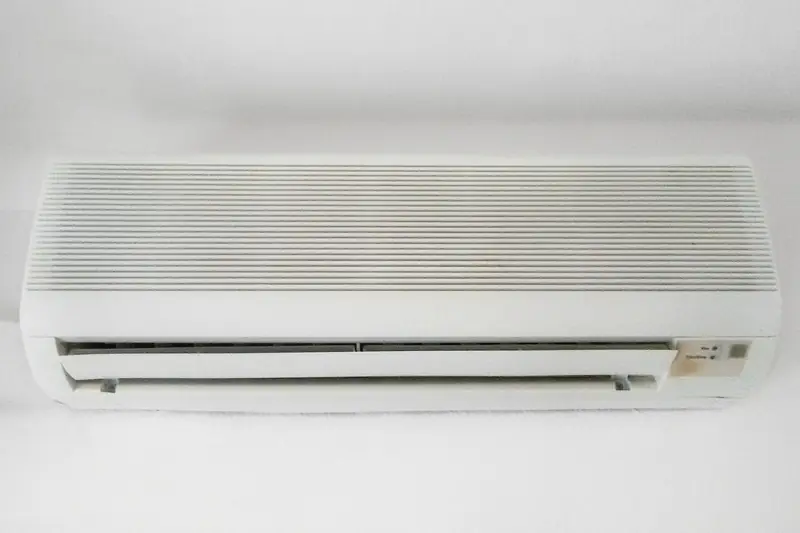
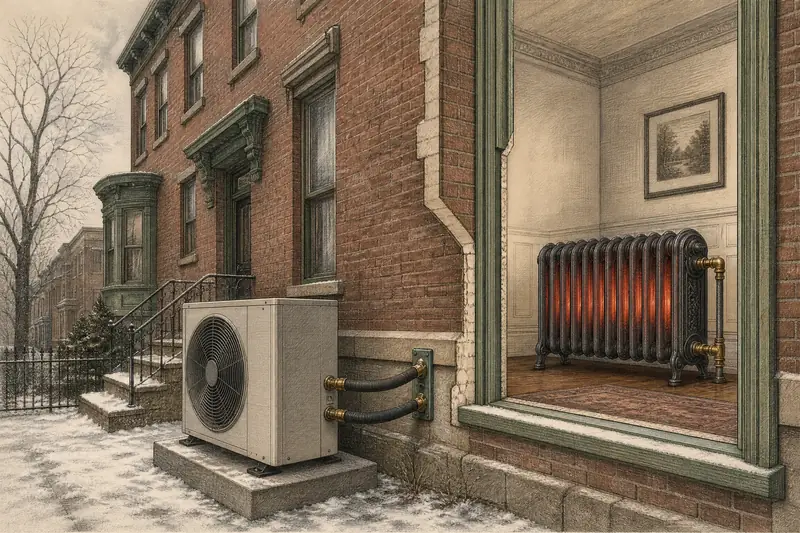
Mini-splits cool a radiator house without ducts: a wall head in each room links to an outdoor unit through a small line set, and the boiler and radiators stay as they are.
Compiled by the Wet Return bench from makers' manuals and federal pages · how pages are checked · Checked again
Who owns what: Wet Return is run by the same people who own PlumbingSupplyAndMore, Central Plumbing & HVAC, SoftPro Water Systems and Quality Water Treatment, the businesses linked on this page. The text is written from boiler and vent makers' manuals and federal pages read in October 2026; what a business says about its own products is that business's claim. How these links are handled
On the tag
- ENERGY STAR names "older homes with no existing ductwork (e.g., radiators or baseboard heat)" as a good fit for mini-splits.
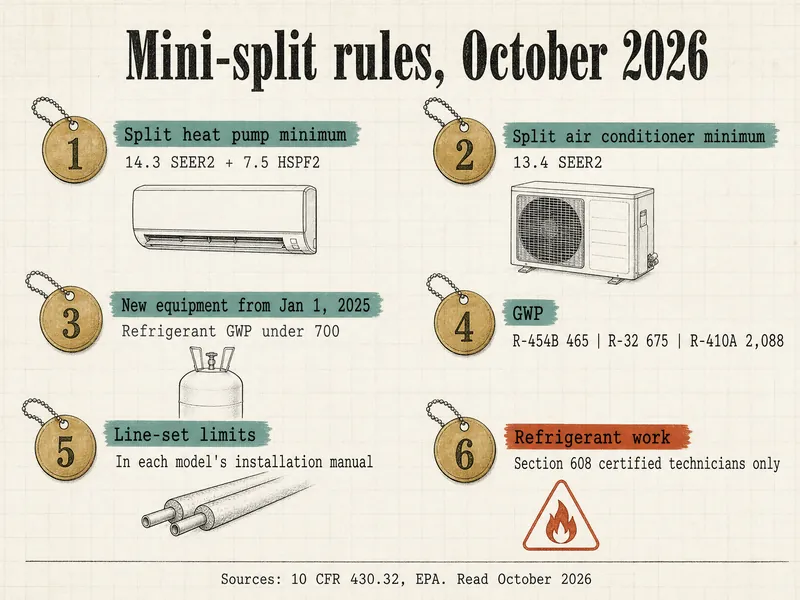
- A split heat pump made on or after January 1, 2023 must reach at least 14.3 SEER2 and 7.5 HSPF2 under 10 CFR 430.32 (eCFR, read October 2026).
- New mini-splits made from January 1, 2025 use refrigerant with a global warming potential under 700, such as R-454B (465) or R-32 (675), per EPA.
- Line-set limits differ by model: one Mitsubishi installation manual allows 100 feet of pipe and 50 feet of height difference.
- Only a Section 608 certified technician may buy refrigerant for this equipment, per EPA, so charging and line-set work are never homeowner jobs.
- The federal 25C credit ended for heat pumps placed in service after December 31, 2025 (IRS, read October 2026).
Why do mini-splits suit radiator homes?
Mini-splits suit radiator homes because they need no ductwork, and a house heated by steam or hot water usually has none. ENERGY STAR's ductless heating and cooling page lists older homes with radiators that "have never had central air conditioning before" as a typical use, and calls ductless units "a replacement for window units for cooling."
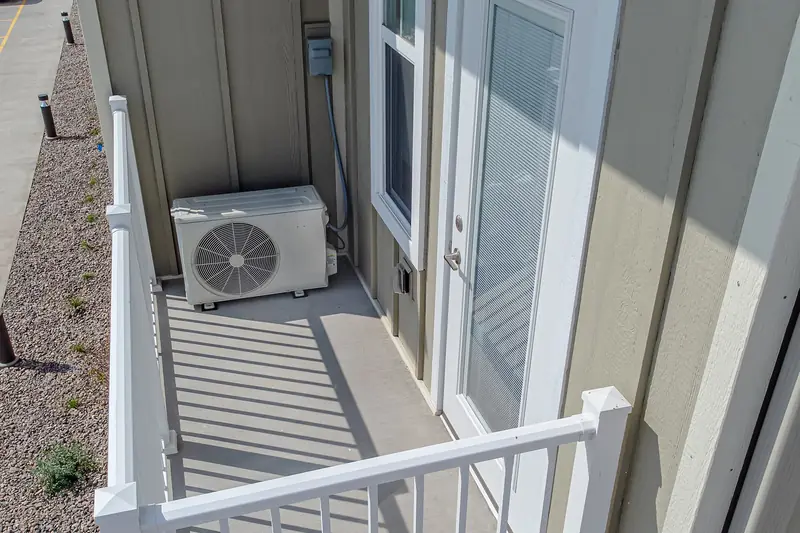
Each indoor head is its own small air handler. It connects to an outdoor unit by a line set: two insulated refrigerant pipes, a control cable and a condensate drain. The radiators, the boiler and the piping described in how hot-water radiators work or how steam heat works are left alone.
Most mini-splits sold today are heat pumps, so the same heads can also heat. That is what makes them more than a window-unit swap, and it is why the efficiency rules below use heat pump ratings.
Where do mini-split heads go in an old house?
Heads go high on an inside or outside wall of each room that needs cooling, placed where their air can reach the space. ENERGY STAR reminds buyers that "heat rises and cool air sinks," that open spaces are easier to condition, and that air cannot move through a closed door, so one head rarely cools a whole floor of small rooms.
In a house with plaster walls, deep window casings and radiators under the windows, the useful spots are often limited. A contractor sizes the heads with a Manual J calculation; ENERGY STAR says "your contractor should verify the proper size system for your home" that way. Oversized heads cool fast but remove less moisture.
| Choice | What it means | Who decides |
|---|---|---|
| Wall head | The common type, mounted high on a wall | Contractor, after a Manual J load calculation |
| One outdoor unit per head | Simple, each room separate | Contractor, by load and wall space |
| One outdoor unit for several heads | Fewer boxes outside, longer piping | Contractor, within the maker's line-set limits |
| Heat pump model | Cools and heats | Owner and contractor, by climate and backup heat |
| Cooling-only model | Summer use only; radiators keep all the heating | Owner and contractor |
How are line sets routed in an old house?
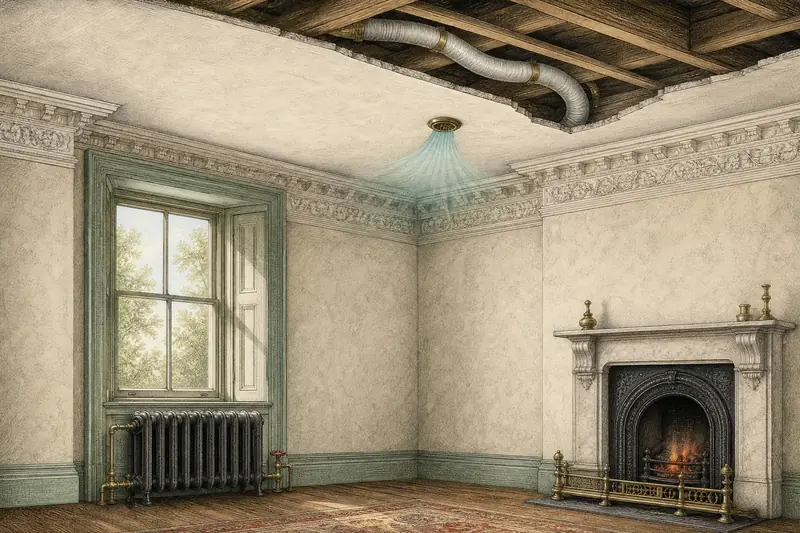
Line sets usually run straight out the back of the head through the wall, or down through closets, stairways, basements or attics. ENERGY STAR suggests routing the line set "through closets, basement/attic stairways, attached garages, basements, crawlspaces, or attics" to limit patching and painting. On the outside, a line-set cover hides the pipes; PlumbingSupplyAndMore's line sets and covers (run by Wet Return's owners) show what these parts look like, the kind of part a technician fits.
Length and height are set by each model's installation manual, not by a general rule. The Mitsubishi MSZ-GS18NA installation manual, for one R-410A model, lists 100 feet of pipe, 50 feet of height difference and 10 bends at most, and requires extra refrigerant once the run passes 25 feet. That manual also says the units "should be installed by licensed contractor according to local code requirements."
The same manual tells the installer to run the drain hose below the refrigerant pipes and never let it rise, sag into a pool or end in standing water. A drain that runs uphill can leak water down a plaster wall, so ask how the condensate leaves each head before the holes are drilled.
Can mini-splits share the heating with the radiators?
Yes: ENERGY STAR says mini-splits can heat a whole home "but are also a great fit to supplement your existing HVAC system." In a radiator house that means the heads take the mild spring and fall days, and the boiler carries the coldest weeks.
ENERGY STAR's savings tips go further: "If you have both, you should use your heat pump year-round," pick one steady temperature, avoid Auto mode and use the auto fan setting. For cold places, it says a cold-climate model keeps working below 5°F but heats most efficiently paired with a backup source in the coldest weather. The existing boiler can be that backup.
To earn ENERGY STAR's cold-climate label, a heat pump must reach a COP of at least 1.75 at 5°F and keep at least 70% of its 47°F heating capacity at 5°F, per the key product criteria. Ask for that label if the heads will carry real winter heating.
What refrigerant and efficiency rules apply in 2026?
Two federal rule sets apply: DOE efficiency minimums and EPA refrigerant limits. Under 10 CFR 430.32, a split heat pump made on or after January 1, 2023 needs at least 14.3 SEER2 and 7.5 HSPF2, and a cooling-only split needs 13.4 SEER2 (14.3 SEER2 below 45,000 Btu/h in the Southeast and Southwest).
EPA's technology transitions table caps refrigerant at a global warming potential of 700 for mini-splits made or imported from January 1, 2025. EPA's reference table gives R-454B 465, R-32 675 and R-410A 2,088. A final rule published May 26, 2026 and effective July 27, 2026 removed the January 1, 2026 installation deadline, so leftover R-410A equipment made before 2025 may still be installed (as of October 2026).
EPA also warns that mildly flammable refrigerants such as R-454B and R-32 must never go into systems not designed for them. Under Section 608, venting refrigerant is illegal and the technicians who service this equipment must be certified.
Mini-split numbers, October 2026
- 14.3 SEER2Cooling minimum for split heat pumps built from 202310 CFR 430.32 (eCFR)
- 7.5 HSPF2Heating minimum for split heat pumps10 CFR 430.32 (eCFR)
- 700GWP cap for new mini-splits made from 2025EPA technology transitions
- 100 ftPipe limit on one Mitsubishi model; others differMitsubishi MSZ-GS18NA installation manual
What should a mini-split quote cover?
A good quote names every head, its room and capacity, the outdoor unit or units, the refrigerant, the SEER2 and HSPF2 ratings, and how each line set and drain will run. Ask for the Manual J result, because sizing decides comfort and moisture control.
PlumbingSupplyAndMore's mini-splits (run by Wet Return's owners) category shows the range of heads and outdoor units a contractor may propose. Compare quotes on the same rooms and ratings, not on box count.
Money rules changed in 2026. The federal 25C credit, which once allowed up to $2,000 a year for qualifying heat pumps, does not apply to equipment placed in service after December 31, 2025. DOE says Home Energy Rebates are state-run and "now available in select states" (DOE, read October 2026), so check your state energy office.
Your own jobs afterwards are small: clean the filters when they look dirty or the filter light comes on (one Mitsubishi parts catalog says every 2 weeks; check your model's manual), keep shrubs and snow clear of the outdoor unit, and keep settings steady. Leave refrigerant, line sets, wiring and moving a head to a licensed contractor; clear a drain line only if your manual describes how. If unsure, call a licensed heating technician.
Proof stamp: where these figures come from
Written from ENERGY STAR's ductless heating and cooling page and key product criteria, 10 CFR 430.32 on eCFR, EPA's technology transitions tables, its HFC questions page and its May 2026 final rule, EPA's Section 608 pages, the IRS page on the 2025 law, DOE's Home Energy Rebates page, and the Mitsubishi MSZ-GS18NA installation manual and MSZ-JP09WA parts catalog, all read October 2026. Left out: Energy Saver figures from energy.gov (those pages returned errors in October 2026), line-set lengths for other brands, prices and any homeowner refrigerant work.
Questions from the boiler room
Can a mini-split go in a room that has a steam radiator?
Yes. The head mounts high on a wall and the radiator stays where it is; the two do not connect. Keep the head's airflow clear of curtains and tall furniture.
How many heads does a two-story radiator house need?
There is no fixed count. A Manual J calculation room by room decides it, and closed doors and small rooms usually mean more heads than an open plan.
Will the outdoor unit work under a window?
ENERGY STAR advises against placing it near doors and windows, because outdoor units release water when they defrost in winter and that water can form icy patches.
Does a new mini-split still use R-410A?
Most equipment made since January 1, 2025 uses a lower-GWP refrigerant such as R-454B or R-32. Leftover R-410A units made before 2025 may still be installed under EPA's May 2026 rule (as of October 2026).
Can I install a mini-split kit myself?
Maker manuals call for a licensed contractor, and only Section 608 certified technicians may buy refrigerant for these systems. Charging, brazing and evacuating line sets are technician work.
Is there still a federal tax credit for a mini-split in 2026?
No. The IRS says the 25C credit is not allowed for property placed in service after December 31, 2025. Some states run rebates; check your state energy office.
Should the radiators be turned off when the heads heat?
ENERGY STAR suggests using the heat pump year-round when a house has both. A heating contractor can set the boiler's thermostat so it takes over only when the heads cannot keep up.
More on cooling a radiator house

Back up the riser: radiator heat in old houses, system by system