How to Bleed a Radiator
To bleed a radiator on a hot-water system, turn the heat off, let the radiators cool, open the bleed screw a quarter to half turn until water appears, close it, then check the boiler gauge.
Compiled by the Wet Return bench from makers' manuals and federal pages · how pages are checked · Checked again
On the tag
- Weil-McLain's 2025 user manual names "air in system" as a cause of radiators that do not heat or are noisy, and the fix is bleeding the radiator vents.
- Boiler maker Vaillant says to switch the heating off and wait about 1 hour, or 2 to be cautious, so the radiators are cold.
- A quarter to half turn of the key is enough to let air out, per Vaillant.
- With radiators on more than one floor, Vaillant's order is the lowest floor first.
- DOE's Energy Saver book (2022) suggests doing this once or twice a season.
- Afterwards the gauge should still read near the typical 12 psi cold fill (Navien, 2019); if it reads low, a technician takes it from there.
- Steam radiators are never bled: their air vent does that job automatically.
How do you bleed a radiator?
You bleed a hot-water radiator by letting the air trapped at its top escape through the small bleed screw, with the heating switched off and the radiators cool. Here is the order of work, drawn from boiler maker Vaillant's homeowner how-to page (read October 2026) and Weil-McLain's user manual (2025):
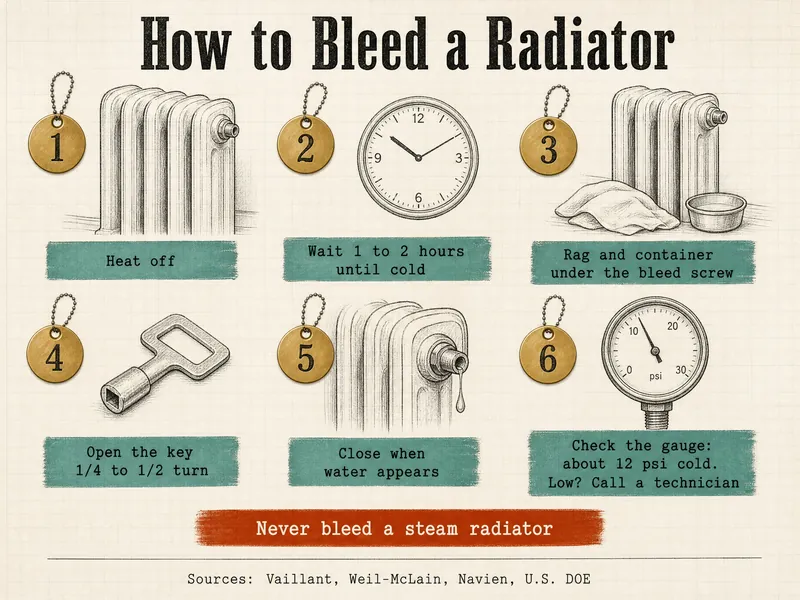
- Turn the thermostat down and the heating off, so the circulator stops pushing water and air around.
- Wait about an hour, or two to be safe, until every radiator is cold to the touch.
- Hold a rag and a small container under the bleed screw at the top corner of the radiator.
- Fit the key and turn it counterclockwise a quarter to half a turn. You should hear air hiss.
- When water starts to come out instead of air, close the screw. Snug is enough; do not force it.
- Move to the next radiator. In a house with radiators upstairs and down, finish the lowest floor first.
- Go to the boiler and read the pressure gauge before turning the heat back on.
If the gauge is low, leave the heat off and call a heating technician rather than adding water yourself. If unsure, call a licensed heating technician.
How do you know a radiator needs bleeding?
A radiator that is cooler at the top than at the bottom, or that rattles and clanks as it warms, probably has air in it. Vaillant tells owners to run the heating, then feel each radiator's surface, "particularly towards the top of the radiator where the air is likely to end up lodged," and to listen for noise as the water starts moving. Air is lighter than water, so it collects in the top sections and blocks hot water from filling them.
Weil-McLain's troubleshooting table says the same in fewer words: some radiators do not heat or are noisy, cause "air in system", remedy "bleed air from system through air vents in radiators or baseboard units." If a radiator stays cold all over, air may not be the cause; a closed valve or a zone that is not calling are also possible, as the cold radiators page explains.
Should the heat be off when you bleed a radiator?
Yes. Bleed only with the system off and cooled. Vaillant gives two reasons: turning the heating off stops the circulation pump from moving water and air through the pipes, and waiting until the radiators are cold "prevents you from getting burned in case hot water or steam leaks." At the 180°F supply temperature that Weil-McLain's ECO Tec manual (2024) gives as typical on the coldest days, a spray from a bleed screw can scald.
With the pump stopped, the air also has time to float to the top of each radiator, where the bleed screw sits. That is why the cooling wait matters more than the exact order of radiators.
Bleeding by the numbers
- 1-2 hoursWait after switching off so radiators are coldVaillant homeowner how-to, read October 2026
- 1/4-1/2 turnHow far to open the bleed screwVaillant homeowner how-to, read October 2026
- 1-2 timesBleeding sessions per heating seasonU.S. DOE Energy Saver book, 2022
- 12 psiTypical cold fill pressure to compare againstNavien NCB-E installation manual, 2019
What do you need to bleed a radiator?
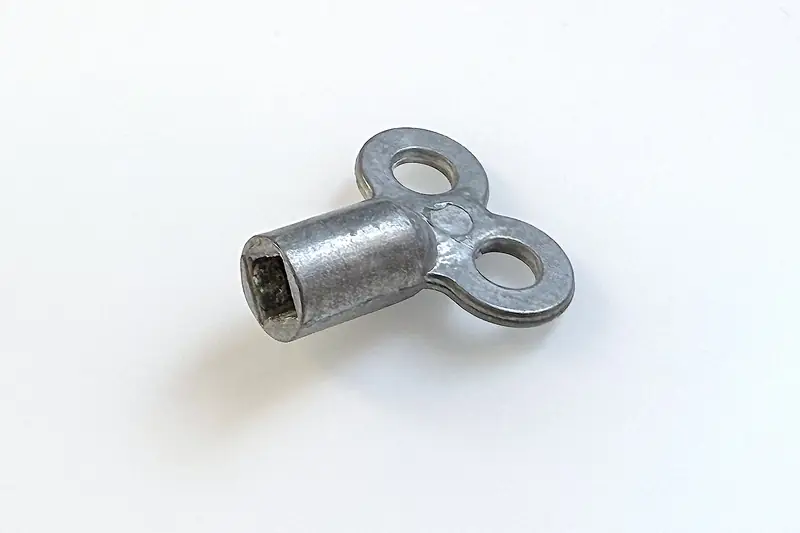
You need a radiator bleed key, a rag or cloth, and a small container to catch drips. Vaillant lists a radiator key, "a bucket & cloth" and gloves. The key fits over the small square stem of the bleed screw, like the one shown above.
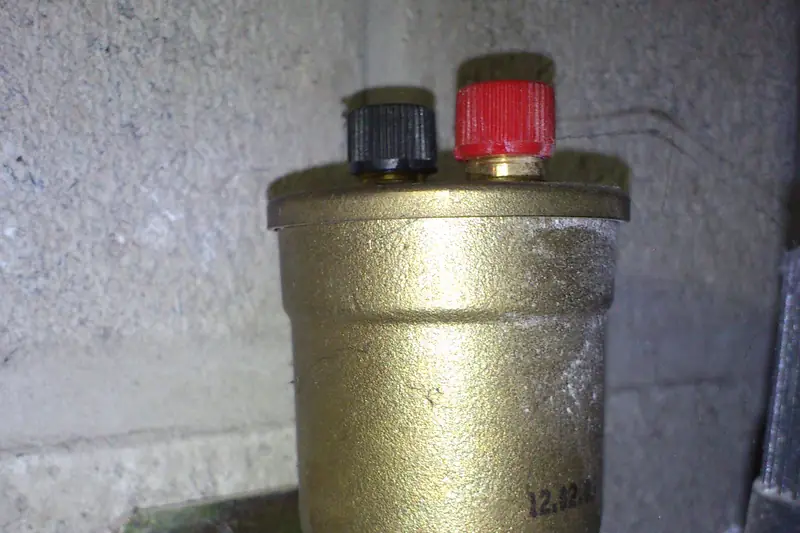
You do not need any tool for the boiler itself. The only thing to do there is read the gauge. Some systems also have automatic air vents on the piping near the boiler, like the brass one below; Weil-McLain's CGa manual (2019) lists "air vents and air elimination" among the items a technician checks at each yearly start-up, so leave those to the service visit.
| Task | Who | Why |
|---|---|---|
| Switch heating off, wait 1-2 hours | Homeowner | Stops the pump and avoids scalds |
| Crack the bleed screw a quarter to half turn | Homeowner | Lets trapped air out of the top sections |
| Read the boiler gauge afterwards | Homeowner | Bleeding releases some water |
| Restore low pressure | Heating technician | Makeup water and leaks need checking |
| Check automatic air vents and air separators | Heating technician | Part of the makers' yearly start-up list |
| Find why air keeps coming back | Heating technician | Repeated air can mean a fault |
What should the boiler pressure read after bleeding?
It should still read close to the system's normal cold pressure, which for a typical home is about 12 psi. Navien's NCB-E installation manual (2019) says "the typical cold water fill pressure for a residential system is 12 psi," and Weil-McLain uses the same figure. Each bleed lets out a little water with the air, so the needle can drop.
A reading well below where it normally sits, or one that keeps falling over the next days, means water is leaving the system. Weil-McLain's user manual warns that a steady diet of fresh makeup water shortens boiler life, and it sends leaks to a qualified service technician. The boiler pressure gauge page explains both needles on the dial.
If you find yourself bleeding the same radiators again and again, Vaillant says to raise it with the installer at the next service, because "there may be an underlying problem." A failing expansion tank or a slow leak are two things a technician will look at.
Why should you never bleed a steam radiator?
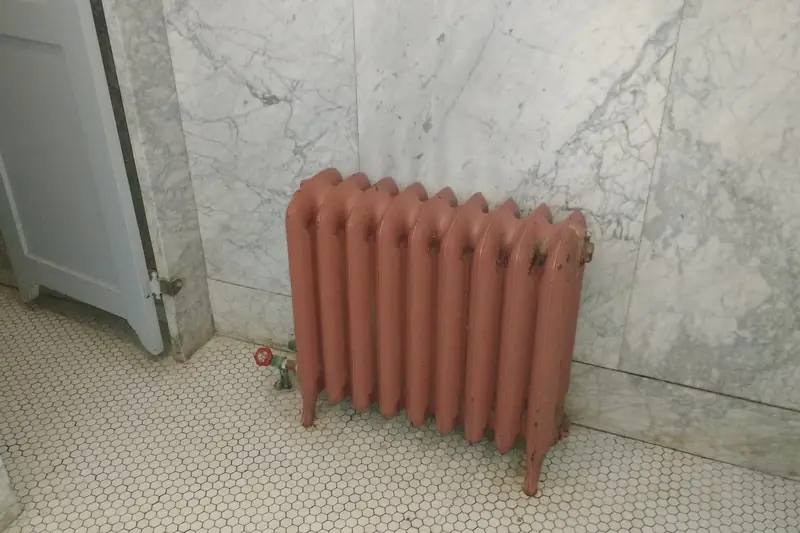
There is no bleed screw on a steam radiator, because the air vent on its end releases air on its own each time the boiler fires. Xylem's Hoffman steam heating manual TES-375A (2013) says thermostatic air vents "must be installed on each radiator and at the end of each steam main." The vent stays open to let air out and closes when steam or water reaches it.
Opening anything on a working steam radiator risks a burst of live steam; radiator ratings assume steam at 215°F. Steam radiators of the one-pipe kind carry one pipe at the valve end and an air vent on the opposite end, not a small square bleed screw at the top corner. If a steam radiator stays cold, the vent may be clogged or painted over; a technician replaces vents. Read more on steam radiator air vents, or go back to the hot-water heat overview.
Proof stamp: where these figures come from
Written from Vaillant's homeowner page on bleeding radiators (UK, undated, read October 2026; its pressure figures in bar are not used), Weil-McLain's gas boiler user manual (2025), CGa boiler manual (2019) and ECO Tec manual (2024), Navien's NCB-E installation manual (2019), DOE's Energy Saver book (2022) and Xylem's Hoffman TES-375A steam manual (2013), all read October 2026. Left out on purpose: any step for adding water or raising boiler pressure, which this site leaves to a heating technician.
Questions from the boiler room
Which radiator should I bleed first?
If radiators are on more than one floor, Vaillant's order is the lowest floor first, then upstairs. On a single floor the order matters little, as long as the system is off and cooled.
Why does my radiator spit water but no air as soon as the bleed screw opens?
That radiator had no trapped air, so close the screw. Vaillant says that if a radiator does not hiss when opened, it does not need bleeding.
What if the bleed screw will not turn?
Do not force it with pliers, since a damaged screw may not seal again. Ask a heating technician to free or replace it at the next visit.
Can I bleed radiators with the heat on to make it faster?
No. The running pump keeps air moving through the pipes, and hot water from the screw can scald. Turn the heat off and wait until the radiators are cold.
Do baseboard heaters need bleeding too?
Some do. Weil-McLain's manual tells owners to bleed air through vents in radiators or baseboard units, but many baseboard systems vent only at automatic vents near the boiler, which a technician checks.
How often should hot-water radiators be bled?
DOE's Energy Saver book suggests once or twice a season. Needing it far more often points to a fault worth reporting to a technician.
Is it normal for the gauge to drop after bleeding?
A small drop is expected, since a little water leaves with the air. A reading far below the usual cold figure, or one that keeps falling, needs a technician.
Back up the riser: radiator heat in old houses, system by system