Tag No. 2 · 5 pages
Hot-Water Radiator Heat
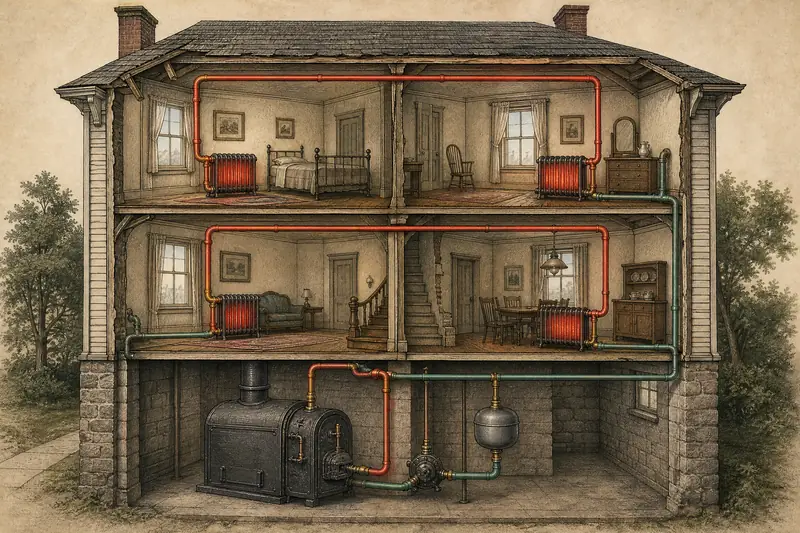
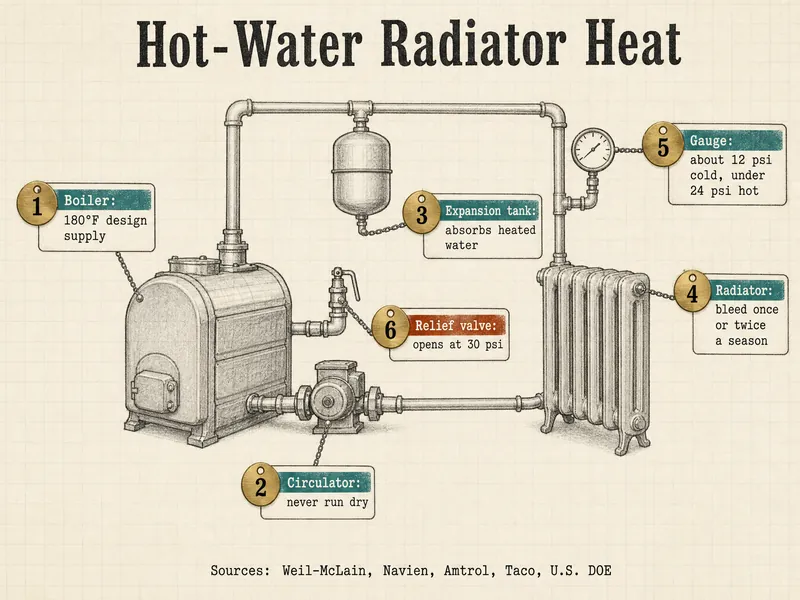
Hot-water radiator heat moves boiler-warmed water, often near 180°F on the coldest days, through a closed loop of pipes and radiators at about 12 psi, then returns it to be reheated.
Compiled by the Wet Return bench from makers' manuals and federal pages · how pages are checked · Checked again
On the tag
- Under 10 CFR 430.2, a hot-water boiler tops out at 160 psig and 250°F; houses sit far lower.
- A typical home loop is filled to about 12 psi cold, per the Navien and Weil-McLain installation manuals.
- Weil-McLain says operating pressure should stay under about 24 psi hot, below the 30 psi relief valve setting.
- 180°F is the classic supply temperature at the coldest outdoor design condition (Weil-McLain ECO Tec manual, 2024).
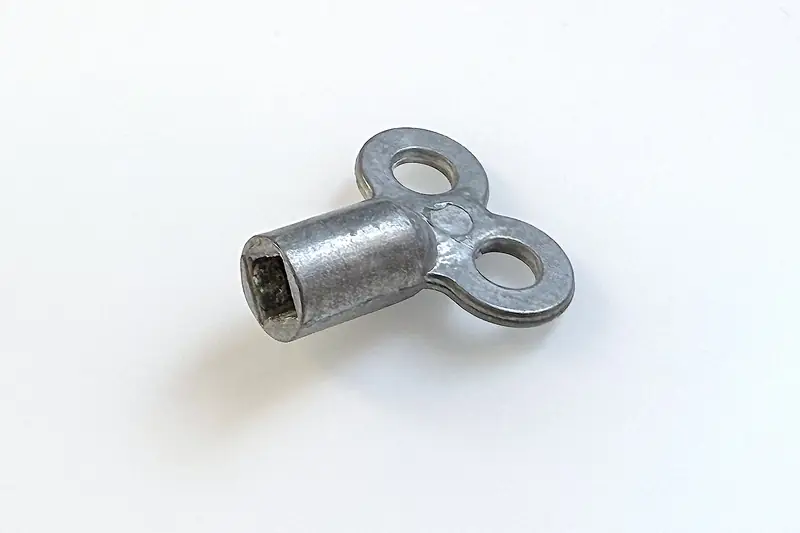
- The U.S. Department of Energy's Energy Saver book says hot-water radiators should be bled of trapped air once or twice a season.
- Expansion tanks, zone valves, circulators and relief valves are technician parts; the homeowner's tools are the gauge, the thermostat and a bleed key.
How does hot-water radiator heat work?
A boiler heats water, a circulator pump pushes it out through supply pipes to each radiator, and the cooled water comes back on a return pipe to be heated again. The loop is sealed, so the same water goes round season after season. Many older houses began as gravity systems with no pump; Weil-McLain's CGa boiler manual (2019) calls them converted gravity systems once a circulator is added.
The water never boils. On a boiler with outdoor reset, DOE's condensing boiler measure guideline (2014) shows the supply dropping from 180°F when it is 5°F outside to 120°F when it is 50°F. The full walk-through is on how hot-water radiators work.
Is it hot-water radiator heat or steam?
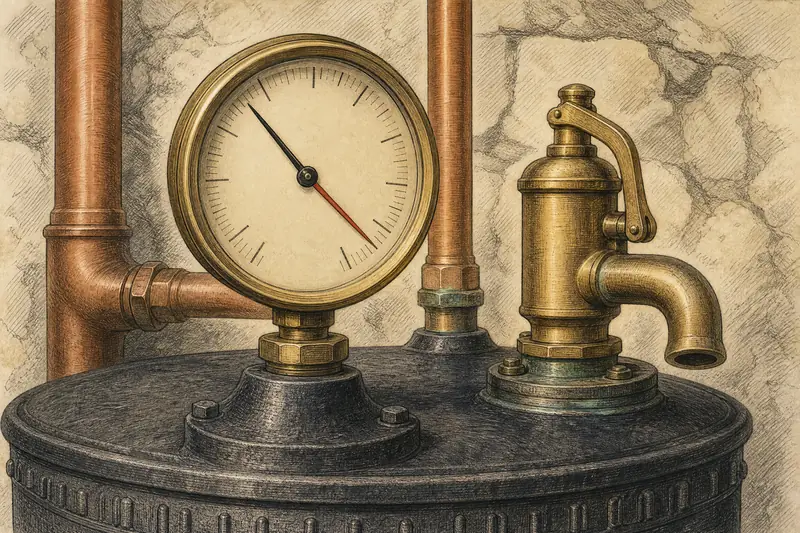
Look at the radiator's pipes first. On U.S. Boiler's radiator data sheet, water radiators carry two pipe connections plus a bleed fitting high up, while one-pipe steam radiators have a single pipe with an air vent at the opposite end. The boiler tells you too: one round dial reading both psi and °F means hot water, while a pressure gauge beside a glass water-level tube means steam. If yours is steam, start at the steam heat section instead, because the upkeep rules are different.
What upkeep does hot-water radiator heat need?
The routine homeowner job is letting trapped air out of radiators, with the system off and cooled. Weil-McLain's 2025 user manual lists "air in system" as a cause of radiators that do not heat or are noisy. Beyond that, the makers call for a yearly start-up by a qualified technician, who checks fill and operating pressures, air vents, the expansion tank and the relief valve.
Bleeding lets a little water out, so look at the gauge afterwards. If it reads low, or keeps falling, that is a call to a technician, not a reason to add water yourself. If unsure, call a licensed heating technician.
What does the expansion tank do?
The expansion tank gives heated water somewhere to go. Amtrol's Extrol product page says the tank "accepts expanded water as system temperature rises and returns it to the system as the temperature drops." Most newer tanks hold a rubber diaphragm between an air cushion and the water; older houses may still have a plain steel tank where air and water touch.
When a tank fails, pressure climbs on every heating cycle and the relief valve may weep. Amtrol's 2025 instructions say only a licensed professional installs, inspects or re-pressurizes the tank. Read more on boiler expansion tanks.
How do zone valves and circulators share the heat?
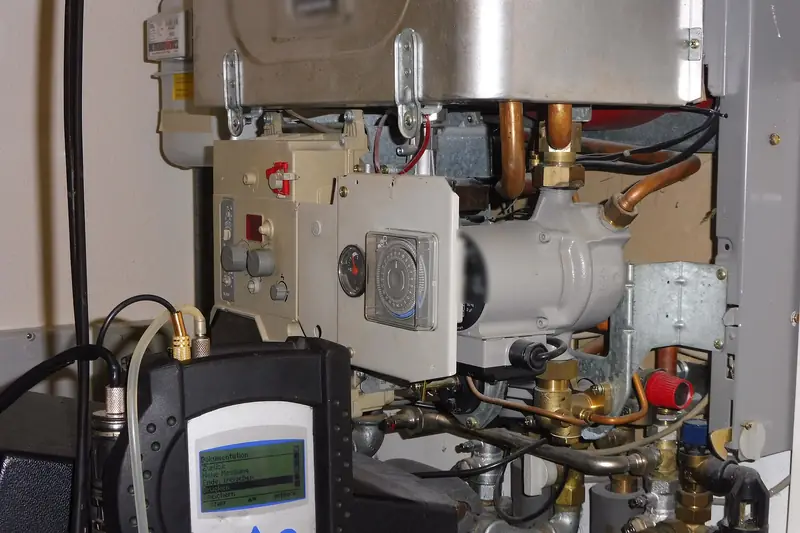
A zoned system splits the house into areas, each with its own thermostat that opens a motorized valve or starts its own pump. In Resideo's V8043 installation instructions (2019), the valve opens on a call for heat and a built-in end switch then starts the circulator or boiler. Taco's switching relays do the same job with one circulator per zone, and Taco's catalog lists relays for 1 to 6 zones.
Circulators are lubricated by the system water and must never run dry, according to Taco's cartridge circulator sheet (2015). See zone valves and circulators.
What should the boiler pressure gauge read?
About 12 psi when the water is cold, rising as it heats, and under about 24 psi when hot, per Weil-McLain. The relief valve on a residential boiler opens at 30 psi. A gauge near 30 psi or a dripping relief valve means it is time to call a technician. The temperature needle on the same dial shows the water heading out to the radiators. Details are on reading the boiler pressure gauge.
Hot-water numbers worth knowing
- 12 psiTypical cold fill pressure for a home systemNavien NCB-E installation manual, 2019
- 24 psiWeil-McLain's upper operating pressure for water boilersWeil-McLain user manual, 2025
- 30 psiRelief valve setting on residential boilersWeil-McLain ECO Tec manual, 2024
- 180°FClassic supply temperature on the coldest daysWeil-McLain ECO Tec manual, 2024
- 3 yearsLongest gap between licensed relief valve inspectionsAmtrol Extrol Pro instructions, 2025
| Part | What it does | Homeowner's part | Technician's part |
|---|---|---|---|
| Radiator bleed valve | Lets trapped air out at the top of a radiator | Bleed with the system off and cooled | Finds why air keeps returning |
| Pressure/temperature gauge | Shows loop pressure and water temperature | Read it cold and hot | Sets fill pressure |
| Expansion tank | Absorbs the swell of heated water | Watch for rising pressure | Checks the air charge, replaces the tank |
| Zone valve | Opens or closes one zone's loop | Check the thermostat and breaker | Replaces powerheads and valve parts |
| Circulator | Pushes water round the loop | Listen for unusual noise | Repairs or replaces it |
| Relief valve | Opens at 30 psi to protect the boiler | Look for drips at its discharge pipe | Inspects at least every 3 years |
Proof stamp: where these figures come from
This hub condenses the five hot-water pages. Their sources: three Weil-McLain manuals (CGa 2019, user manual 2025, ECO Tec 2024), Navien's NCB-E installation manual (2019), Amtrol's Extrol Pro instructions (2025), Taco circulator and switching relay literature (2015 and 2020), Resideo's V8043 zone valve documents (2019 and 2020), DOE's Energy Saver book (2022) and 10 CFR 430.2; every one was read in October 2026. Not included here: UK pressure figures in bar, any instruction to add water to a boiler, and tank recharging steps.
Questions from the boiler room
Is hot-water radiator heat the same as radiant floor heat?
Both are hydronic, meaning water carries the heat, but radiant floors run much cooler water through tubing in the floor. Weil-McLain groups radiant systems with converted gravity systems as ones where low return water must be kept away from a non-condensing cast-iron boiler.
Do hot-water radiators need a pump?
Most do today. Gravity systems were designed to circulate by natural convection, and many were converted later by adding a circulator, which Weil-McLain calls a "converted gravity system".
Why does my hot-water system gurgle when it starts?
Air in the loop is the usual reason, and Weil-McLain's user manual lists it as a cause of noisy radiators. Bleed the radiators with the system off and cooled, then check the gauge.
Can a hot-water system use the old cast-iron radiators with a new boiler?
Often, yes. Weil-McLain's condensing ECO Tec control has a "Cast Iron Radiators" preset with a 180°F maximum and a 120°F minimum target, but a heat-loss and radiator check decides it. See radiator sizing.
How long do expansion tanks last?
No maker gives a year count. Amtrol says a corroded or damaged tank is replaced, not recharged, and that a licensed professional should inspect it periodically.
Who should I call for a hot-water heating problem?
A licensed heating contractor who works on hydronic systems. Bring the gauge readings, which rooms are cold, and whether the relief valve has dripped.
Back up the riser: the five valve tags on the Wet Return home page