Air-to-Water Heat Pumps for Radiators
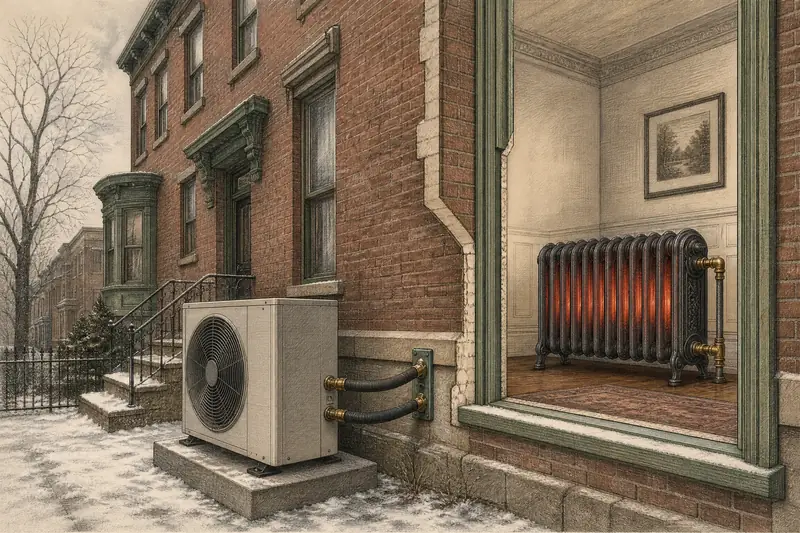
An air-to-water heat pump heats the water in a hot-water radiator loop with an outdoor electric unit; it works best when the radiators can heat the house with water well below boiler temperature.
Compiled by the Wet Return bench from makers' manuals and federal pages · how pages are checked · Checked again
Who owns what: Wet Return is run by the same people who own PlumbingSupplyAndMore, Central Plumbing & HVAC, SoftPro Water Systems and Quality Water Treatment, the businesses linked on this page. The text is written from boiler and vent makers' manuals and federal pages read in October 2026; what a business says about its own products is that business's claim. How these links are handled
On the tag
- Caleffi says systems that deliver full heat with supply water no hotter than 120°F let most air-to-water heat pumps perform reasonably well (Caleffi idronics, July 2020).
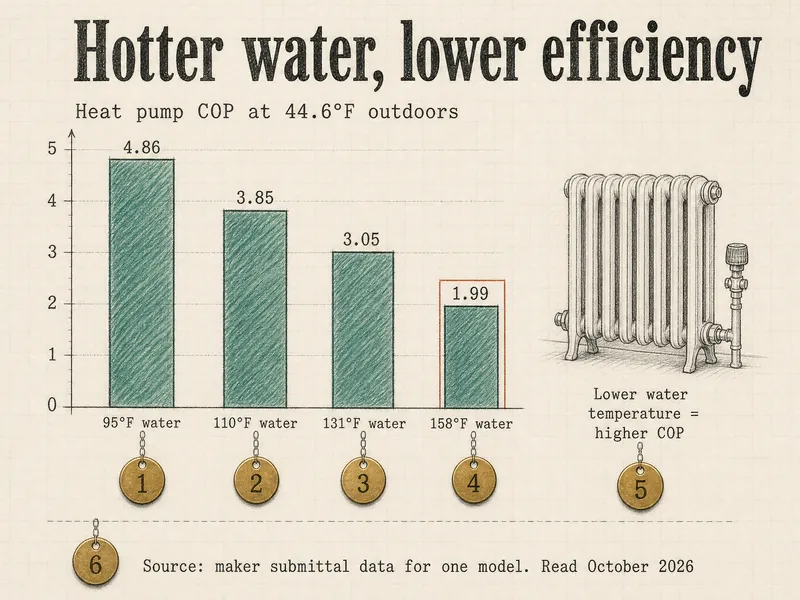
- In Daikin's submittal data for one model at 44.6°F outdoors, COP falls from 4.86 with 95°F water to 1.99 with 158°F water.
- Many models top out between about 120°F and 160°F leaving water; check the model's data at your design outdoor temperature.
- Classic hot-water radiator systems were designed around water near 180°F (DOE Building America, 2014), so radiator output at heat-pump temperatures has to be checked room by room.
- Caleffi warns that radiators and baseboard must not be used for cooling, because summer indoor dewpoints in the low to mid 70s °F sit above chilled water at 45 to 60°F.
- No federal 25C credit applies to a heat pump put in service in 2026; the IRS lists December 31, 2025 as the end (read October 2026).
What is an air-to-water heat pump?
An air-to-water heat pump is an outdoor electric unit that pulls heat from outside air and puts it into water, which then circulates through radiators, baseboard, radiant floors or fan coils. It does the boiler's job in a hot-water system, using a refrigerant cycle instead of a flame.
In monobloc designs the refrigerant stays sealed in the outdoor unit and only water enters the house. Daikin's submittal data for its ALTHERMA 3 H HT lists "no refrigerant inside the home," and SpacePak describes its Solstice units the same way. Inside, the water side looks like any hydronic loop, with a circulator, an expansion tank and controls, as on the page about zone valves and circulators.
This applies to hot-water (hydronic) radiators only. No source used here covers feeding a one-pipe or two-pipe steam system from an air-to-water heat pump, and steam radiators are a different machine; see how steam heat works.
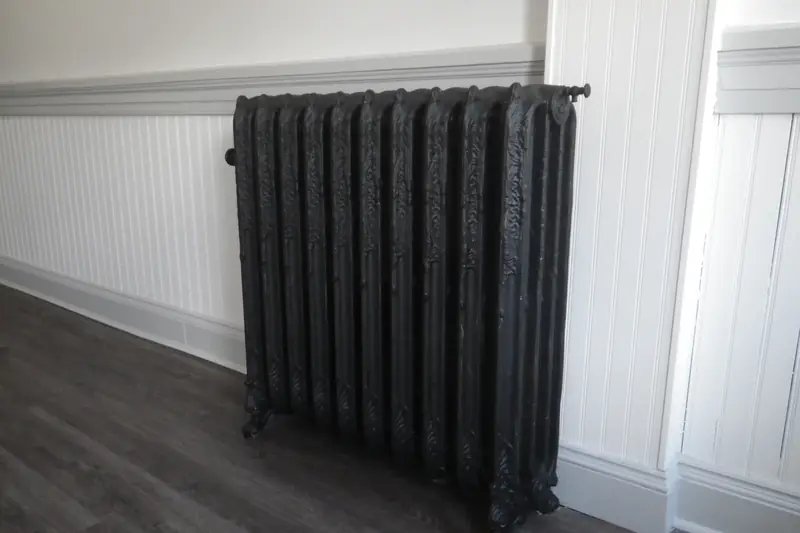
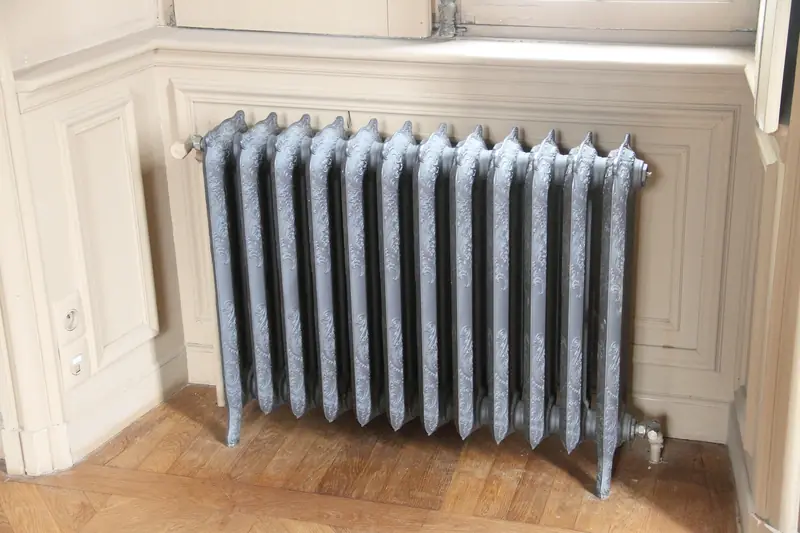
Can an air-to-water heat pump run old radiators?
An air-to-water heat pump can run old cast-iron radiators when they are big enough for the house at a lower water temperature, and only a heat-loss calculation shows that. Radiator output drops sharply as water temperature falls. In Caleffi's example, a panel radiator at 110°F average water in a 70°F room gives about 27% of what it gives at 180°F.
The good news for old houses, per Caleffi: radiators sized for an uninsulated building may now need "only a fraction of the heat output for which they were originally sized" if the walls, windows or air leaks have since been fixed. That can let them run at a much lower water temperature. Radiator output can be estimated from type and size, as in radiator sizing and EDR, where a square foot of EDR gives 150 Btu/h at 170°F average water.
Where some rooms fall short, a New York City technical primer lists "more baseboard heaters, larger radiators, or panel radiators" as options, and fan coils are another (NYC Accelerator primer, 2019).
What water temperature do air-to-water heat pumps make?
Many models top out between about 120°F and 160°F leaving water, and the exact limit depends on the model and the outdoor temperature. There is no single number, so ask for the maker's table at your area's design outdoor temperature.
| Model or series | Highest leaving water stated | Condition or note |
|---|---|---|
| Daikin ALTHERMA 3 H HT | 158°F (70°C) | Uses R-32; operates down to -18°F outdoors |
| SpacePak Solstice R454B Series | 150°F | At 14°F outdoors; 120°F at -22°F |
| Arctic 060ZA-R32 spec sheet | 122°F (50°C) | Spec page; Arctic's R32 page says up to 140°F |
Hotter water costs efficiency. COP is heat delivered divided by electricity used, and Daikin's submittal for the ALTHERMA 3 H HT shows it at 44.6°F outdoors: 4.86 with 95°F water, 3.85 at 110°F, 3.05 at 131°F and 1.99 at 158°F. At 5°F outdoors with 158°F water it drops to 1.50.
That is why Caleffi's 120°F target matters. A house that can stay warm on 120°F water lets the heat pump spend most of the winter in its efficient range.
Heat pump water numbers
- 4.86COP at 95°F water, 44.6°F outdoors, one modelDaikin submittal data
- 1.99COP at 158°F water, same model and outdoor temperatureDaikin submittal data
- 120°FSupply water target for good heat pump performanceCaleffi idronics, 2020
- 27%Panel radiator output at 110°F against 180°F average waterCaleffi idronics, 2020
Does an air-to-water heat pump need backup heat?
Backup heat is worth planning for the coldest days. ENERGY STAR says a cold-climate heat pump keeps working below 5°F but heats most efficiently paired with a backup source when it gets colder (ENERGY STAR). The Daikin unit above has a 6 kW electric backup heater built into its indoor unit.
In a radiator house, the existing boiler can stay as that backup, piped and controlled so the two do not fight. That design is a heating contractor's job, along with deciding when the boiler takes over. If the boiler is near the end of its life anyway, the page on replacing an old boiler covers what that choice involves.
Can an air-to-water heat pump cool the house?
An air-to-water heat pump can make chilled water for cooling, but cast-iron radiators cannot use it. Caleffi explains that on humid days the indoor dewpoint can reach the low to mid 70s °F, well above the 45 to 60°F chilled water these units often make, so water condenses on radiators, baseboard and radiant panels, causing "water stains, corrosion, mold."
The emitter that can heat and cool is "a fan-coil equipped with a condensate drip pan," per Caleffi; it cools only through fan coils like that. Daikin lists cooling capacity with 64.4°F water, and SpacePak offers hydronic fan coils and a high-velocity hydronic air handler for its units. Chilled-water radiant floors or ceilings need the water held above the room's dewpoint at all times.
For cooling without new water piping, compare mini-splits in radiator homes and high-velocity small-duct systems.
What should you ask before switching?
Ask for a room-by-room heat-loss calculation and a radiator-by-radiator output check at the proposed water temperature. ENERGY STAR says a contractor should size equipment with a Manual J calculation, and Caleffi's numbers show why each radiator matters.
Then ask which model, its leaving-water limit and COP at your design temperature, where the outdoor unit goes, what backup is planned, and whether any radiators need replacing or adding. Every hot-water loop moves water with a pump; PlumbingSupplyAndMore's circulators (run by Wet Return's owners) show the kind of part a technician fits on these systems.
Money changed in 2026. The 25C credit, which once allowed up to $2,000 a year for qualifying heat pumps, does not cover heat pumps put in service in 2026 or later. Home Energy Rebates run through the states, and DOE's program page says they are open in select states only (read October 2026); ask your state energy office.
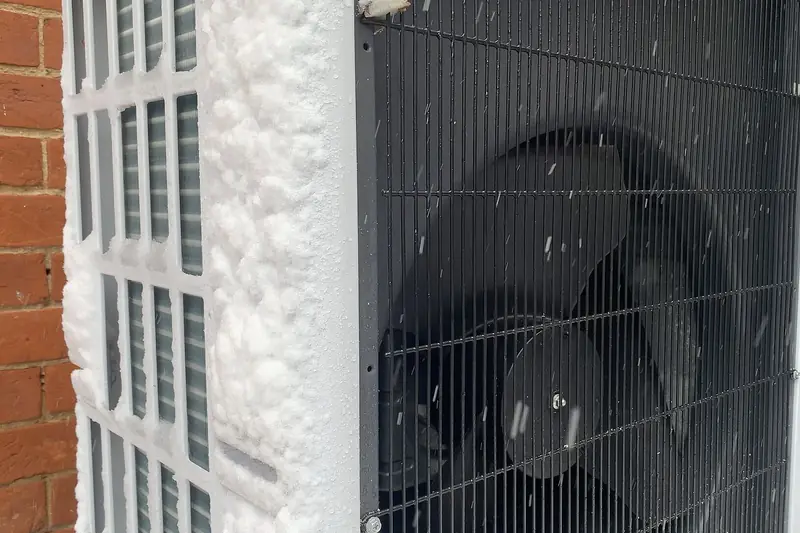
Once installed, your part is keeping snow, leaves and shrubs clear of the outdoor unit and reading the loop's pressure gauge, if it has one, as you would on a boiler. Leave refrigerant, wiring and water-side repairs to licensed technicians; refrigerant work requires Section 608 certification. If unsure, call a licensed heating technician.
Proof stamp: where these figures come from
Based on Caleffi's idronics article on heat emitters for air-to-water heat pumps (July 2020), Daikin's ALTHERMA 3 H HT submittal data and April 2026 press release, SpacePak's Solstice pages, Arctic's specification and R32 pages, the City of New York's 2019 hydronic upgrade primer, ENERGY STAR's ductless page, plus IRS, DOE rebate and EPA Section 608 pages, all read October 2026. Left out: any steam conversion advice, cast-iron output percentages from forums, Ecodan specifications (no US maker page was found) and prices.
Questions from the boiler room
Can an air-to-water heat pump replace a steam boiler?
No source used here supports it. Air-to-water heat pumps make hot water for hydronic systems; a steam system would need a separate design study by a heating contractor.
Will my radiators feel cooler with a heat pump?
The radiator surface runs cooler because the water is cooler. Whether rooms stay warm depends on each radiator's output at that water temperature.
What COP is good for an air-to-water heat pump?
COP depends on outdoor and water temperature. In one maker's data, the same unit ranged from 4.86 with 95°F water down to 1.50 at 5°F outdoors with 158°F water.
Does an air-to-water heat pump make domestic hot water too?
Some models do. Daikin says the ALTHERMA 3 H HT provides space heating and optional domestic hot water even at -18°F outdoors.
Can the old boiler stay in place?
It can, as backup heat for the coldest days. A heating contractor designs the piping and controls so the boiler starts only when the heat pump cannot keep up.
Is there a refrigerant line into the house?
Not with monobloc units. Daikin and SpacePak both describe the refrigerant staying sealed in the outdoor unit, with only water piped indoors.
Can I cool through radiant floors?
Caleffi says chilled-water radiant cooling works only if the water stays above the indoor air's dewpoint. That calls for a dewpoint control, set up by the installer.
More on cooling and radiators
Back up the riser: radiator heat in old houses, system by system