Boiler Types and AFUE
Boiler types and AFUE come down to this: a new gas hot-water boiler must reach at least 84% AFUE, a gas steam boiler 82%, and only hot-water boilers can condense their way past 90%.
Compiled by the Wet Return bench from makers' manuals and federal pages · how pages are checked · Checked again
Who owns what: Wet Return is run by the same people who own PlumbingSupplyAndMore, Central Plumbing & HVAC, SoftPro Water Systems and Quality Water Treatment, the businesses linked on this page. The text is written from boiler and vent makers' manuals and federal pages read in October 2026; what a business says about its own products is that business's claim. How these links are handled
On the tag
- AFUE is the ratio of a year's heat output to a year's fuel input, and it leaves out the boiler's electricity use (ENERGY STAR Boilers Version 3.0).
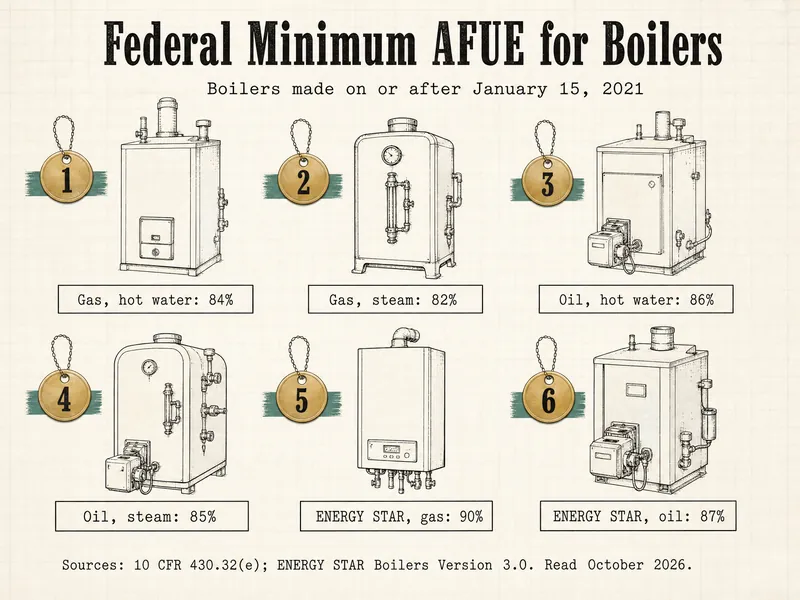
- Federal minimums for boilers made on or after January 15, 2021: gas hot water 84%, gas steam 82%, oil hot water 86%, oil steam 85% (10 CFR 430.32(e), eCFR read October 2026).
- ENERGY STAR boilers need at least 90% AFUE on gas and 87% on oil.
- Condensing only happens when return water cools the heat exchanger below the flue gas dew point (DOE Building America, 2014).
- Weil-McLain's condensing control has a cast-iron radiator setting that runs from 120°F to 180°F supply water.
- A DOE-funded steam study states a steam boiler "cannot have a rated efficiency > 83%."
Which boiler types heat radiator homes?
Radiator homes are heated by two families of boiler: steam boilers, which boil water and send steam to the radiators, and hot-water boilers, which heat water that a circulator pushes through the loop. Federal rules in 10 CFR 430.2 define a boiler as a gas, oil or electric appliance supplying low-pressure steam or hot water for space heating; a low-pressure steam boiler runs at or below 15 psig.
Within those families, the common types in old houses are:
- Cast-iron steam boilers, floor-standing, for one-pipe and two-pipe steam systems. See how steam heat works.
- Cast-iron hot-water boilers, non-condensing, often replacing an older boiler on a converted gravity system.
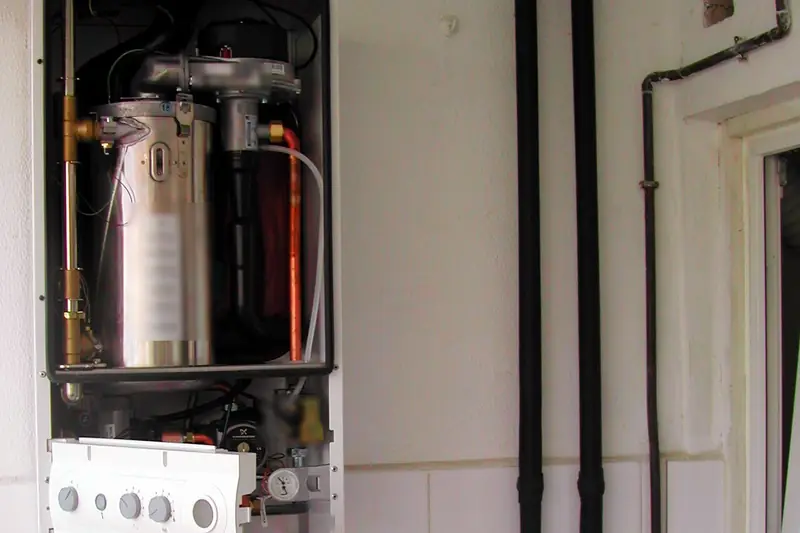
- Condensing hot-water boilers, often wall-hung like the one in the photo above.
- Combi boilers, condensing hot-water boilers that also make domestic hot water on demand. The combi boiler page covers them.
The type is fixed mostly by the system already in the house. A steam house needs a steam boiler unless the whole system is converted, which the replacement page discusses.
What does a boiler's AFUE rating measure?
A boiler's AFUE rating measures how much of a year's fuel ends up as heat in the house. ENERGY STAR's Boilers Version 3.0 specification (revised January 2024) defines it as the ratio of annual output energy to annual input energy, including any off-season pilot loss and, for gas or oil boilers, not including electric energy.
So an 84% AFUE boiler turns about 84 of every 100 units of fuel energy into usable heat over a typical year, and the rest goes up the flue or out through the jacket. The federal test assumes the boiler sits inside the heated space (10 CFR 430.2). Pumps, fans and controls run on electricity that AFUE does not count.
AFUE is a lab rating, not a promise for your basement. The DOE's Building America measure guideline on condensing boilers (2014) warns that if the system is not set up correctly, a condensing boiler performs no better than a non-condensing one.
What are the federal minimum AFUE ratings for boilers?
For residential boilers made on or after January 15, 2021, the federal floor is 84% AFUE on a gas-fired hot-water boiler and 82% on gas-fired steam; oil-fired boilers need 86% (hot water) and 85% (steam). They are set in 10 CFR 430.32(e), which the eCFR showed as current when read in October 2026. Electric boilers have no AFUE minimum.
The same table adds design rules: gas hot-water and gas steam boilers may not have a constant-burning pilot, and hot-water boilers need an automatic way to adjust water temperature, except boilers with a tankless domestic hot-water coil.
| Boiler type | Made Sept 1, 2012 to Jan 14, 2021 | Made on or after Jan 15, 2021 | ENERGY STAR |
|---|---|---|---|
| Gas, hot water | 82% | 84% | 90% |
| Gas, steam | 80% | 82% | 90% |
| Oil, hot water | 84% | 86% | 87% |
| Oil, steam | 82% | 85% | 87% |
| Electric | No AFUE minimum | No AFUE minimum | Not covered |
ENERGY STAR's boiler page sets the higher bar: 90% or greater for gas and 87% or greater for oil, for residential boilers under 300,000 Btu/h. ENERGY STAR estimates a certified gas boiler saves about $780 over its lifetime and an oil boiler about $200; those are the program's own estimates.
AFUE numbers that matter
- 84%Federal minimum AFUE, gas hot-water boiler made since January 15, 202110 CFR 430.32(e), eCFR
- 82%Federal minimum AFUE, gas steam boiler made since January 15, 202110 CFR 430.32(e), eCFR
- 90%ENERGY STAR minimum AFUE for gas boilersENERGY STAR Boilers V3.0
- 95.0%Rated AFUE of Navien's NCB-E condensing combi modelsNavien QuickFacts, 2025
Do condensing boilers suit old radiators?
Condensing boilers can suit old cast-iron radiators, but they only reach their rated efficiency when the water coming back from the radiators is cool. The DOE guideline explains that condensing happens only when the heat exchanger surface is below the flue gas dew point, which takes return water that is low enough in temperature.
On the coldest design day, an old hot-water radiator loop typically ran at about 180°F. The 2024 ECO Tec condensing boiler manual from Weil-McLain lists a system setting named for cast-iron radiators that aims no higher than 180°F and no lower than 120°F, and the boiler's outdoor reset lowers the water temperature as the weather warms. The DOE's example of outdoor reset is 180°F supply at 5°F outside and 120°F at 50°F outside.
That is good news for big cast-iron radiators. Much of the heating season is mild, so the water can run cooler and the boiler condenses more of the time. On the coldest days it may run hot and condense less. Weil-McLain's non-condensing CGa manual sets the flip side: an older-style cast-iron boiler needs its return water kept at 130°F or warmer, or its sections and burners can corrode. The radiator sizing page shows how radiator size sets the water temperature a house needs.
Why are steam boilers never condensing?
Steam boilers are never condensing because the water inside them is boiling, so it can never cool the flue gas below its dew point. Steam in a house system sits at about 215°F, the temperature the standard EDR rating uses, far above the cool return water that condensing needs.
That shows up in the rules. The federal table has a separate, lower minimum for steam (82% gas, 85% oil), and the DOE Building America steam balancing guideline (2013) states that a steam boiler cannot have a rated efficiency above 83%. That is the guideline's statement, not a federal standard, and it matches the federal table giving steam its own lower floor.
For a steam house, efficiency gains come from the system instead: insulated mains, working main vents and a boiler sized to the radiators rather than oversized. The steam section covers those parts.
Gas, oil or electric boiler: what changes?
Fuel changes the federal minimum, the venting and the service list. Oil boilers carry slightly higher minimums than gas (86% versus 84% for hot water), while ENERGY STAR's bar for oil is lower (87% versus 90%).
Gas and oil boilers both burn fuel, so both need combustion air, a sound chimney or vent, yearly service and carbon monoxide alarms; the combustion air page covers the venting side. NFPA's 2026 placement for those alarms: every bedroom, the area outside each group of bedrooms, and every story including the basement. A sounding alarm means leaving the house, then calling 911 from outdoors; a gas smell means going outside, with no light switches or phones used on the way, before calling 911 or the gas utility. Electric boilers burn nothing and have no federal AFUE minimum, and their running cost depends on what electricity costs where you live.
PlumbingSupplyAndMore's boilers category (run by Wet Return's owners) shows the range of cast-iron, condensing and combi boilers a heating contractor chooses from. Which one fits is a sizing and venting decision for a licensed heating contractor.
Proof stamp: where these figures come from
This page is based on 10 CFR 430.2 and 430.32(e) (eCFR, current when read October 2026), ENERGY STAR's Boilers Version 3.0 specification (revised January 2024) and boiler product page, the DOE Building America measure guidelines on condensing boilers (2014) and steam system balancing (2013), Weil-McLain's CGa (2019) and ECO Tec (2024) manuals, and Navien's NCB-E QuickFacts (2025), all read October 2026. Left out: savings percentages for condensing boilers, a single dew-point number, and any DOE Energy Saver figures, because none was confirmed in a primary source read here.
Questions from the boiler room
Is a 95% AFUE boiler always better than an 84% one?
Only if the system lets it condense. The DOE's 2014 guideline says a condensing boiler that is not properly set up performs no better than a non-condensing one. Low return water temperature is what earns the higher number.
Can an old boiler's AFUE be read off its nameplate?
Often not on very old boilers. Federal minimums apply by date of manufacture: boilers made before September 1, 2012 had to reach 80%, or 75% for gas steam. A boiler older than that rule may sit below today's floor.
Does AFUE include the circulator pump's electricity?
No. ENERGY STAR's definition says AFUE does not include electric energy for gas or oil boilers. Pumps, fans and controls are extra.
Why is the steam minimum lower than the hot-water minimum?
Steam boilers cannot condense and run hotter, so federal rules set separate classes: 82% for gas steam against 84% for gas hot water, and 85% for oil steam against 86% for oil hot water.
Do condensing boilers work with baseboard and radiators together?
They can, with the water temperature set by whichever emitter needs the hottest water. Weil-McLain's ECO Tec manual notes fin-tube baseboard is typically designed for 180°F, while cast-iron radiators may run cooler. A heat-loss and radiator survey decides the setting.
Is a standing pilot still allowed on a new gas boiler?
No. The federal design requirements in 10 CFR 430.32(e) say a constant-burning pilot is not permitted on gas hot-water or gas steam boilers.
Related pages

Back up the riser: every steam and hot-water page on Wet Return