Tag No. 5 · 3 pages
Air Conditioning for Radiator Homes
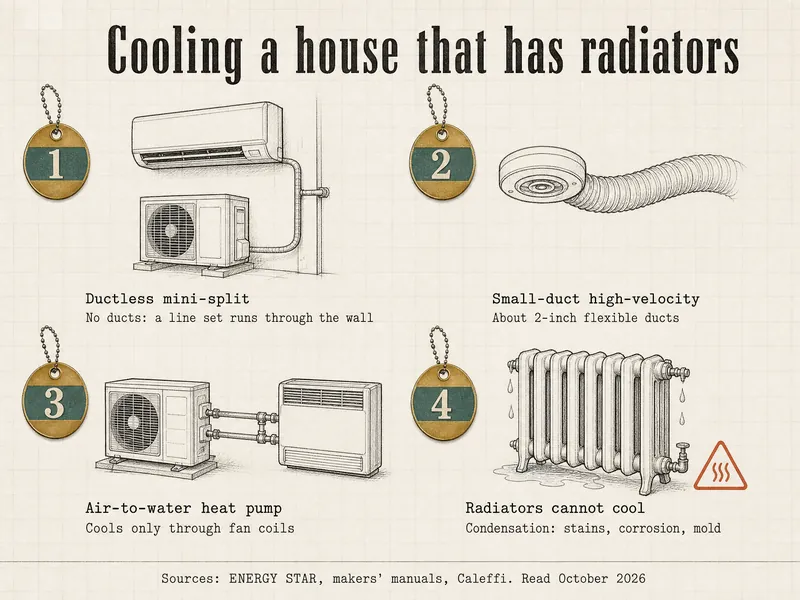
Air conditioning for radiator homes comes in three main forms: ductless mini-splits, small-duct high-velocity systems and air-to-water heat pumps with fan coils, since the radiators themselves cannot cool.
Compiled by the Wet Return bench from makers' manuals and federal pages · how pages are checked · Checked again
On the tag
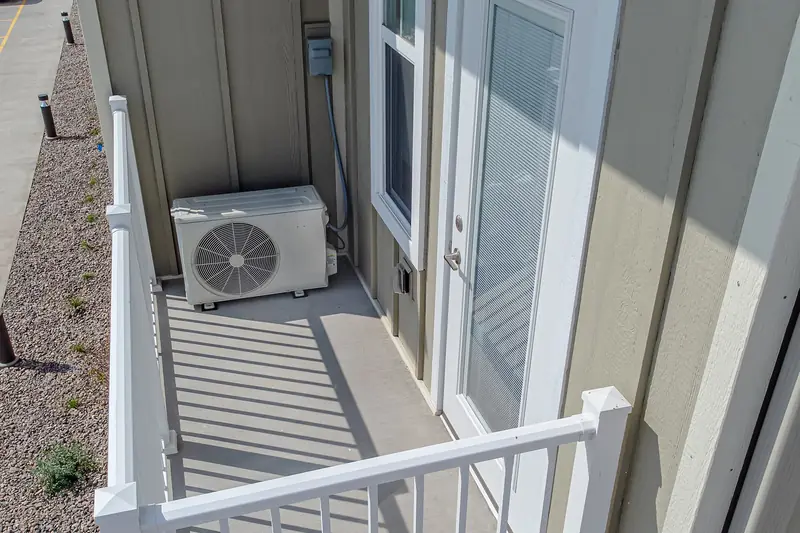
- Houses heated by radiators or baseboard that never had central air are one of the uses ENERGY STAR lists for ductless mini-splits.
- Small-duct high-velocity systems have their own federal minimum, 12 SEER2, against 13.4 SEER2 for ordinary split air conditioners (10 CFR 430.32, read October 2026).
- Caleffi warns that radiators and baseboard must not carry chilled water, because condensation causes stains, corrosion and mold (Caleffi idronics, 2020).
- EPA caps the global warming potential of refrigerant at 700 for home cooling equipment built in 2025 or later (EPA).
- The federal 25C credit ended for equipment placed in service after December 31, 2025 (IRS, read October 2026).
How do you add air conditioning to a house with radiators and no ducts?
You add a separate system that brings its own way of moving cool air, because steam and hot-water radiators only heat. ENERGY STAR describes ductless units as "a replacement for window units for cooling" with "no duct work" needed, and the other two routes are small flexible ducts or a heat pump that makes chilled water for fan coils.
The boiler and radiators can stay exactly as they are with any of the three. What changes is how much of the house gets opened up, what shows on the walls and ceilings, and whether the new equipment also takes on some heating.
When do ductless mini-splits fit?
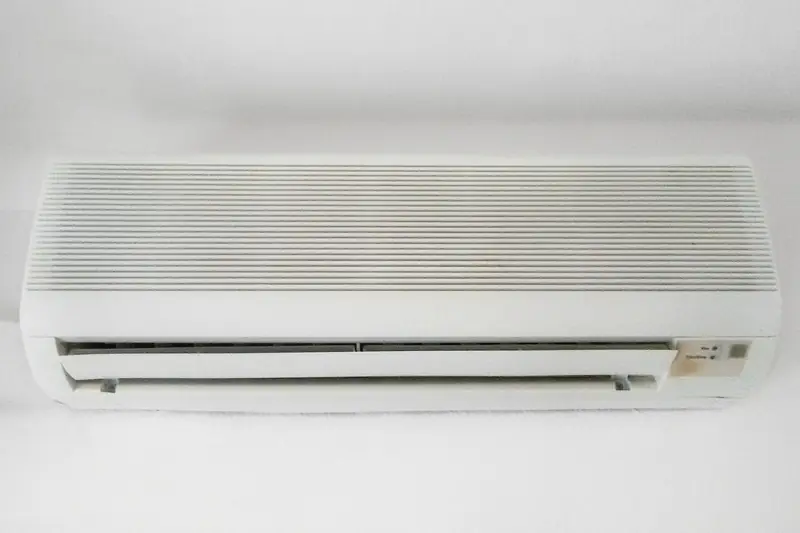
Mini-splits fit when you want cooling room by room with the least work inside walls: a head on the wall, a small line set out through it, and an outdoor unit. ENERGY STAR says they can heat the whole house "but are also a great fit to supplement your existing HVAC system," so the heads can share spring and fall heating with the boiler.
The limits are visible heads, one per room or open area, and line sets that each model's manual restricts in length and height. Refrigerant work stays with Section 608 certified technicians.
What is small-duct high-velocity air conditioning?
Small-duct high-velocity air conditioning is central air that runs through insulated tubes about 2 inches across, ending in small round outlets. Unico gives 2 or 2.5 inches inside diameter and SpacePak 2-inch flexible ducts, both feeding 5-inch round outlets (Unico FAQ, read October 2026).
It suits houses where the owner wants no wall heads and can accept opening some ceilings and closets for the air handler and tube runs. SpacePak lists homes "heated by hot water, steam, or radiant heat" among its ideal applications, a maker claim.

Can a heat pump feed the radiators too?
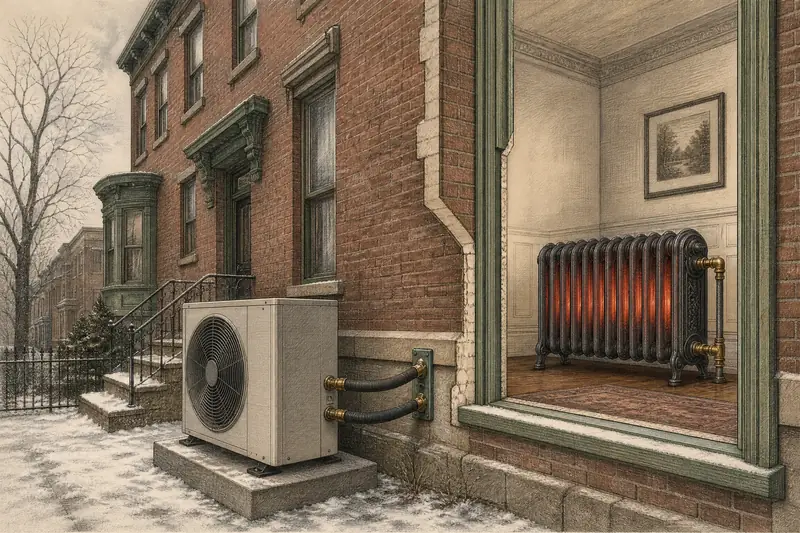
An air-to-water heat pump can heat a hot-water radiator loop if the radiators deliver enough heat at lower water temperatures, and it cools only through fan coils. Caleffi's 2020 article names 120°F supply water at design conditions as the level where most such units still do reasonably well.
This route is for hot-water (hydronic) systems only; no source used on this site covers steam. One maker's published table shows the efficiency (COP) dropping from 4.86 to 1.99 as the water goes from 95°F to 158°F, which is why radiator size matters so much.
Which air conditioning add-on costs the least disruption?
Ductless mini-splits usually mean the least work inside the house, because each head needs only a small wall opening for its line set; ENERGY STAR suggests routing line sets through closets, stairways, basements or attics to limit patching. High-velocity systems hide more but open more, and air-to-water systems change the heating plant itself.
| Option | What shows inside | Federal minimum | Also heats? |
|---|---|---|---|
| Ductless mini-split | Wall head in each room | 13.4 SEER2 split AC; 14.3 SEER2 and 7.5 HSPF2 split heat pump | Yes, if a heat pump model |
| Small-duct high-velocity | 5-inch round outlets | 12 SEER2 (6.1 HSPF2 heat pump) | Yes, by hot-water coil, heat pump or electric heater (Unico) |
| Air-to-water heat pump | Fan coils for cooling; radiators stay for heat | Model-specific maker data | Yes, through the radiator loop |
Cooling numbers for radiator homes
- 13.4 SEER2Federal floor for split air conditionerseCFR, 10 CFR 430.32
- 12 SEER2Federal floor for the small-duct classeCFR, 10 CFR 430.32
- 700Refrigerant GWP limit for home units built from 2025EPA, HFC restrictions by sector
- 120°FWater target for good air-to-water performanceCaleffi idronics, 2020
What rules apply to air conditioning in radiator homes in 2026?
Three sets of rules apply: DOE efficiency minimums, EPA refrigerant limits and EPA's technician certification. Equipment made from January 1, 2025 uses refrigerant under a global warming potential of 700, such as R-454B or R-32, though EPA's final rule of May 26, 2026 lets leftover R-410A equipment made before 2025 still be installed (as of October 2026).
Under Section 608, only certified technicians work on refrigerant circuits, and only they can buy the refrigerant. Money also changed: the 25C credit is gone for 2026 installs, and the state-run Home Energy Rebates are open only in some states, per DOE's rebate program page (read October 2026).
Your own part with any of these is light: clean filters when they look dirty, keep outdoor units clear of shrubs and snow, and keep thermostat settings steady, per ENERGY STAR's tips. If unsure, call a licensed heating technician; this page is general information.
Proof stamp: where these figures come from
This hub summarizes its three articles. Sources, all read October 2026: ENERGY STAR (ductless page), the federal efficiency table in 10 CFR 430.32, EPA (HFC restrictions, Section 608), the IRS and DOE on credits and rebates, Unico, SpacePak, makers' manuals, and Caleffi's 2020 article on heat emitters. Left out: window and portable units, prices, and energy.gov Energy Saver figures, whose pages returned errors in October 2026.
Questions from the boiler room
Can cast-iron radiators be used for air conditioning?
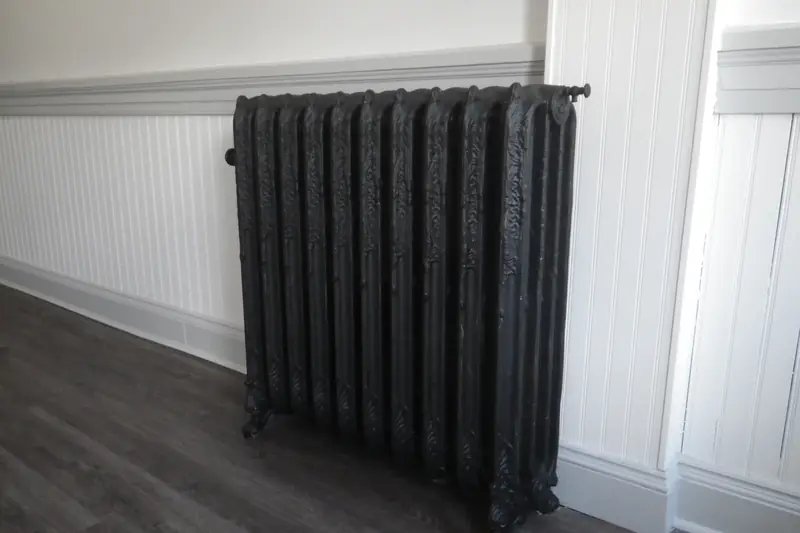
No. Caleffi explains that chilled water at 45 to 60°F sits below a humid room's dewpoint, so water condenses on radiators and baseboard and causes stains, corrosion and mold.
Is central air with regular ducts possible in a radiator house?
It can be, but it means running full-size ducts through finished rooms. ENERGY STAR names homes with no existing ductwork as a fit for ductless systems instead.
Do the radiators have to come out for any of these?
No. Mini-splits and high-velocity systems run alongside the radiators, and an air-to-water heat pump uses the same radiator loop for heat.
Which option also heats in winter?
Heat pump mini-splits and heat pump high-velocity systems can heat, and an air-to-water heat pump heats through the radiators. A cooling-only unit leaves all heating to the boiler.
Can I keep using window air conditioners?
Yes; they are outside this site's scope. ENERGY STAR describes ductless heads as a replacement for window units.
Does a steam-heated house have fewer options?
Mini-splits and high-velocity systems work the same in a steam house. Air-to-water heat pumps are for hot-water systems, so steam rules that route out.


Back up the riser: radiator heat in old houses, system by system