How Steam Heat Works
Steam heat works by boiling water at a pressure well under 2 psi; the steam pushes air out through vents, condenses in the radiators, and the water drains back to the boiler.
Compiled by the Wet Return bench from makers' manuals and federal pages · how pages are checked · Checked again
On the tag
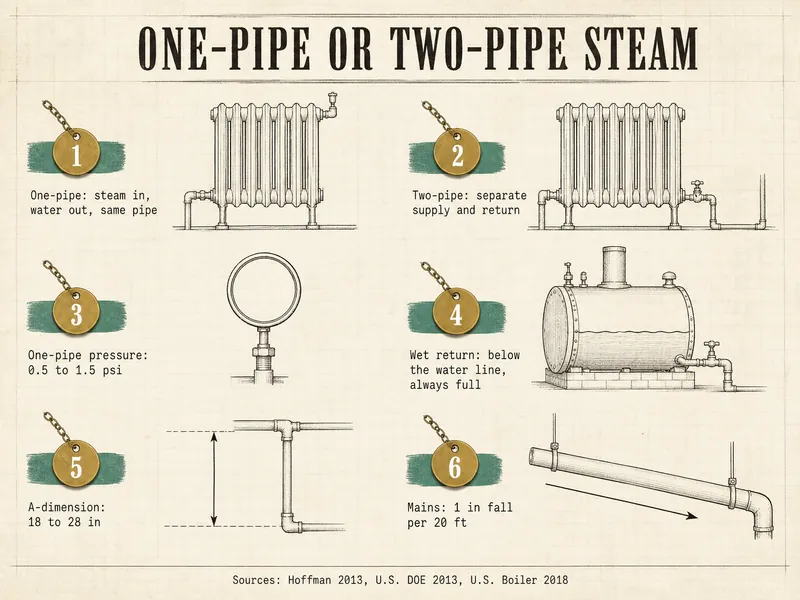
- One-pipe steam radiators take steam in and send condensate out through the same pipe (Hoffman HS-901A).
- A 2013 U.S. DOE Building America report says one-pipe systems typically run at 0.5 to 1.5 psi.
- Weil-McLain's 2025 SGO manual says typical one- and two-pipe systems need less than 2 psi, and its limit control is never set above 10 psi.
- A wet return sits below the boiler water line and is always full of water (Hoffman TES-375A, 2013).
- Makers ask for 18 to 28 inches between the boiler water line and the lowest steam main; U.S. Boiler's rule is 28 inches.
- One-pipe mains fall at least 1 inch per 20 feet in the direction the condensate flows (away from the boiler, toward the end of the main), or 1 inch in 10 feet where steam and water move in opposite directions (Hoffman, 2013).
How does steam heat work?
Steam heat works as a loop of boiling and condensing. The boiler turns water into steam, the steam travels up through pipes called mains and risers, and inside each radiator it turns back into water, giving up its heat to the iron and then the room. Hoffman's technical manual TES-375A explains that the highest pressure in the system is at the boiler, and the pressure drop in the radiators as steam condenses is what draws more steam along.
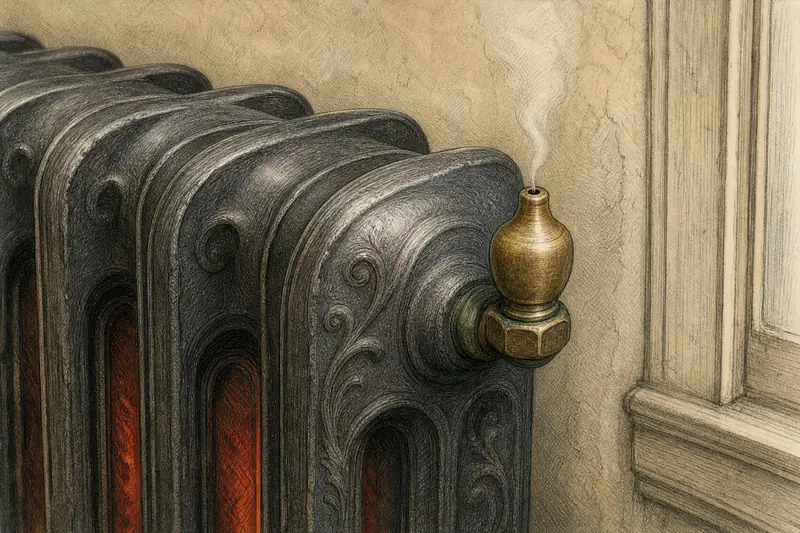
Before any of that can happen, the air already in the pipes has to leave. TES-375A says it plainly: "Steam cannot circulate or radiators heat until air has been vented from the system." That is the job of the air vents on one-pipe radiators and mains, and of the traps on two-pipe radiators. The U.S. Department of Energy's 2011 renovation handbook for contractors adds that steam "moves itself through piping without the use of pumps."
What is the difference between one-pipe and two-pipe steam?
One-pipe steam uses a single pipe per radiator for both steam in and water out; two-pipe steam gives each radiator a supply pipe and a separate return. The Hoffman Basic Steam Heating System booklet defines both and notes that on one-pipe systems the radiators sit "sufficiently above the boiler water line so that condensate flows back to the boiler by gravity."
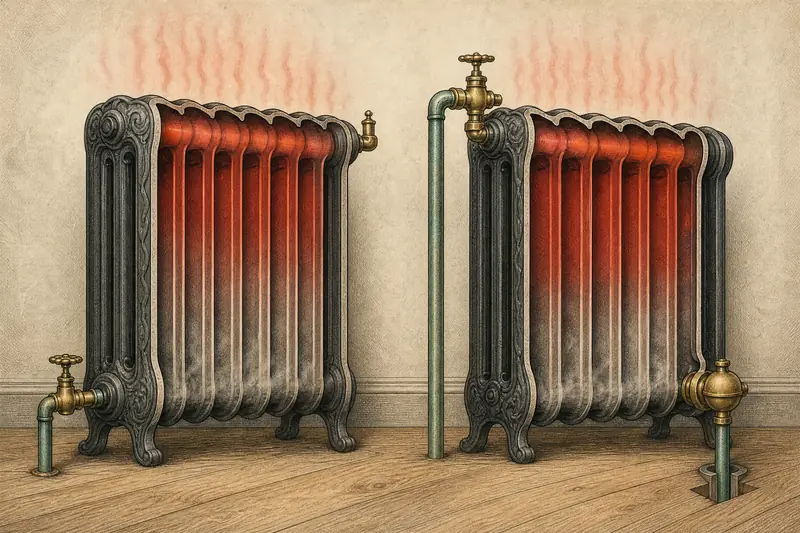
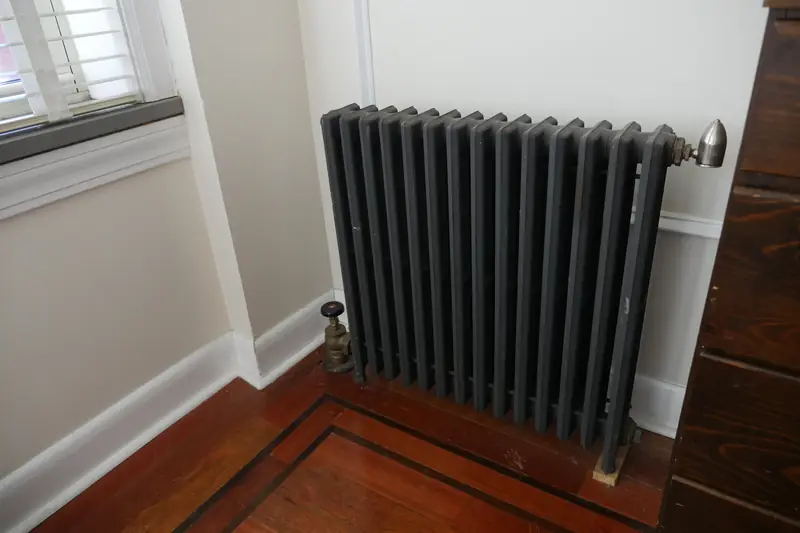
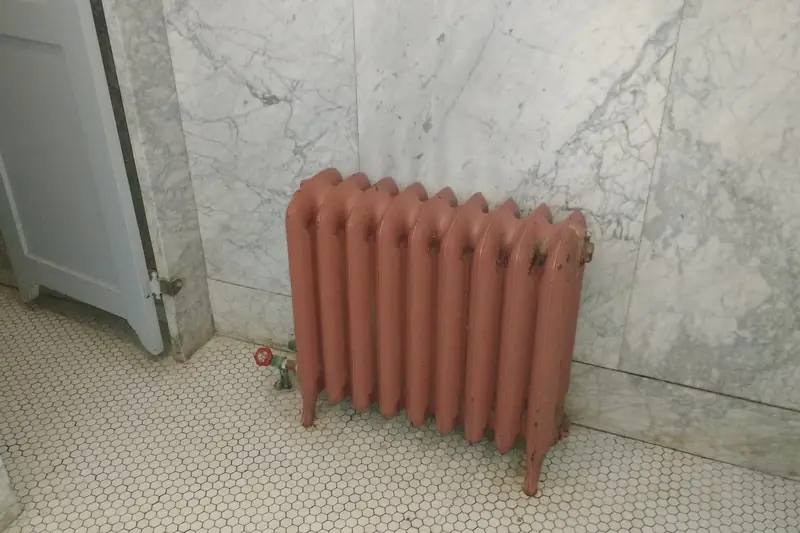
On a one-pipe radiator you see one valve at the floor and a small vent screwed into the far end. A two-pipe radiator has a supply valve and, at its bottom outlet, a thermostatic trap that holds steam in while letting air and water out. On two-pipe systems the air passes through those traps into the returns and leaves through a vent at the end of the return line, on the condensate receiver where there is one.
| Feature | One-pipe steam | Two-pipe steam |
|---|---|---|
| Pipes per radiator | One: steam in, condensate out | Two: supply and return |
| Air leaves through | Radiator vent and main vents | Radiator trap, then the return vent |
| At the radiator outlet | Nothing: water leaves by the inlet | Thermostatic trap |
| One-pipe radiator valve | Fully open or fully closed | Not applicable |
| Radiator position | Slopes back toward the valve | Level or draining toward its outlet |
| Typical pressure | 0.5 to 1.5 psi (DOE, 2013) | Under 2 psi (Weil-McLain, 2025) |
Why does steam heat run at such low pressure?
House steam runs at very low pressure because venting, not pressure, is what gets steam to the radiators. The DOE Building America steam balancing report (2013) says one-pipe systems "should typically operate at ½–1½ psig," and warns that when main vents are missing, operators tend to raise the pressure, which short-cycles the boiler. Weil-McLain's SGO steam boiler manual gives the same picture: typical systems "need less than 2 psig."
Some older controls read in ounces rather than pounds, as U.S. Boiler's replacement tips note. Weil-McLain's EG manual says the limit control "should never be set with a pressure above 10 PSIG," and residential steam boilers carry a 15 psi relief valve. Those numbers are ceilings, not targets. Pressure settings are a job for a heating technician, never something to turn up on a cold morning.
Steam pressure and piping, in numbers
- 0.5–1.5 psiTypical one-pipe operating pressureU.S. DOE Building America, 2013
- 10 psiLimit control never set above thisWeil-McLain EG manual, 2025
- 28 inU.S. Boiler's minimum A-dimensionU.S. Boiler, 2018
- 1 in per 20 ftMinimum slope of one-pipe parallel-flow mainsHoffman TES-375A, 2013
- 0.5 gpmWater turned to steam each minute per 1,000 sq ft EDR while firingMcDonnell & Miller MM-825B, 2011
What is a wet return?
A wet return is the part of the return pipe that runs below the boiler's water line, so it is always full of water. TES-375A defines it as the section "located below the boiler water level" and says it carries no air or steam; a dry return runs above the water line and carries both condensate and air. This site takes its name from that pipe.
Wet returns are usually the low pipes along the basement floor, and some are buried. Most systems also have a Hartford loop, a piping arrangement near the boiler that joins the return a couple of inches below the water line so a leak in the wet return cannot empty the boiler; TES-375A says the water level would drop at most about 2 inches. These are piping details a technician checks, not things to open.
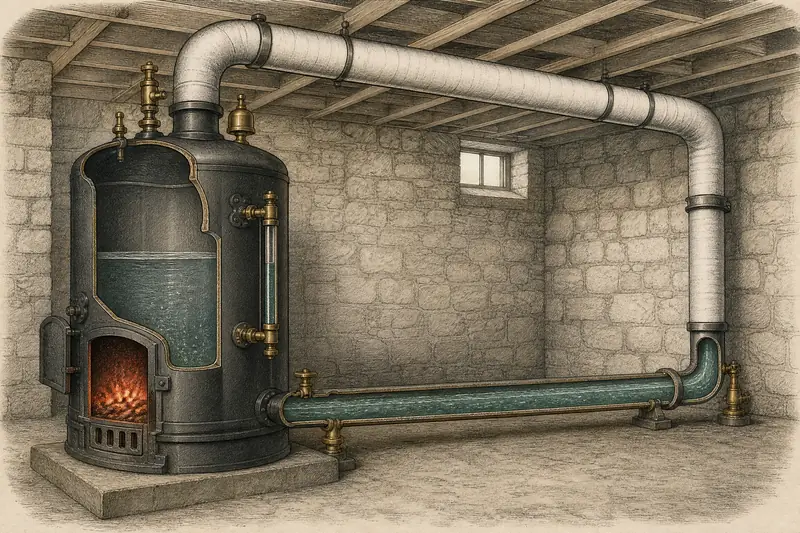
The height between the water line and the lowest steam main matters too. Makers ask for roughly 18 to 28 inches, depending on the system's pressure drop, and U.S. Boiler's rule is "a minimum of 28 inches"; with less, the boiler "could have operational problems and noises." A technician checks this A-dimension when a boiler is replaced.
How can you tell which steam system you have?
Look at one radiator, then the boiler. A single pipe with a valve at one end and a vent on the other is one-pipe steam. Two pipes and no vent, with a small trap body on the outlet, is two-pipe steam. A hot-water radiator has supply and return pipes plus a bleed valve near the top, and its boiler gauge sits around 12 psi when cold, far above anything a house steam boiler runs at.
A steam boiler also has a glass tube on its side showing the water level, called the sight glass or gauge glass. McDonnell & Miller's catalog MM-825B says code requires one on every steam boiler. While the burner runs, McDonnell & Miller says a boiler turns about half a gallon of water a minute into steam for every 1,000 sq ft EDR, which is why the level in that glass drops during a cycle. If you see one, you have steam; the sight glass and low-water cutoff page explains how to read it.
What wears out in an old steam system?
Vents, traps and buried pipes wear out first, and each shows up as cold radiators, noise or a boiler that keeps needing water. According to TES-375A, dirt clogging the vent is the likely reason a one-pipe radiator stays cold, and a vent that fails is swapped out whole rather than repaired. Two-pipe traps fail open or closed; the two-pipe steam trap page covers the signs.
McDonnell & Miller lists the common causes of water loss as vents passing steam, leaking wet returns ("Always suspect any buried pipe"), poor pitch and a boiler leaking at the water line. Steam systems are open to the air, so a small amount of evaporation is expected. Frequent top-ups are a different story, and Weil-McLain's SGO manual sends leak repairs to a qualified service technician. Uninsulated mains are another drag: U.S. Boiler says steam mains should carry at least 1 inch of pipe insulation.
Your part is to notice and report. Banging pipes, a vent that hisses or spits, a radiator that stays cold or a sight glass that is empty, full or keeps needing water all mean a call to a heating technician who works on steam. If unsure what you are seeing, call a licensed heating technician. For the knocking in particular, see why steam radiators bang.
Next on steam
 Steam heat: Steam radiator air vents and what they do
 Folder: All steam heat pages
 Radiators: Why a radiator stays cold
Proof stamp: where these figures come from
Written from three Hoffman Specialty documents (the 2013 technical manual, the 1999 basic-systems booklet and the 1997 two-pipe definitions), McDonnell & Miller's 2011 catalog, two 2025 Weil-McLain steam boiler manuals, U.S. Boiler's 2018 replacement tips, and two Department of Energy publications from 2011 and 2013, each read in October 2026. Pressure figures are there to show why low pressure is normal, not as settings. Left out: vacuum and vapor system details, efficiency claims for steam boilers, and anything about adding water, draining or adjusting controls.
Questions from the boiler room
Why does steam heat cycle on and off so much?
Steam heat comes in bursts because the boiler has to build steam, push air out and fill the radiators before the room warms. Missing or clogged main vents make it worse: the DOE report says operators then raise pressure, which short-cycles the boiler.
Do steam systems have a pump?
One-pipe systems do not: Hoffman describes the condensate falling back by gravity, and DOE notes that steam moves itself through the pipes. Some two-pipe systems add a condensate pump with a receiver tank, and its vent is where the system's air escapes.
What is the Hartford loop on my boiler?
It is a loop of pipe near the boiler where the return joins just below the water line. Hoffman says it keeps the boiler from draining if the wet return leaks. It is a technician's piping detail.
Can old steam radiators be used for hot water instead?
Some can. A 2024 guest post on U.S. Boiler's blog explains that a radiator with no connection across the top sections was designed for steam only. A heating contractor checks each radiator before any conversion.
Why are steam pipes in the basement wrapped?
Insulation keeps steam from condensing in the basement before it reaches the rooms. U.S. Boiler says an uninsulated steam main acts like an extra radiator and must be counted when sizing a boiler.
Is a one-pipe steam system less efficient than hot water?
Older high-mass steam boilers carry a lag before heat reaches the radiators, DOE's 2011 handbook notes. Federal rules set lower minimum AFUE ratings for steam boilers than for hot-water ones; the boiler types and AFUE page lists them.
Back up the riser: every steam and hot-water page on Wet Return