Steam Radiator Banging and Pitch
Steam radiator banging usually means water is lying where steam has to pass, in a radiator tipped the wrong way, a half-open valve or a sagging pipe, and the steam slams it.
Compiled by the Wet Return bench from makers' manuals and federal pages · how pages are checked · Checked again
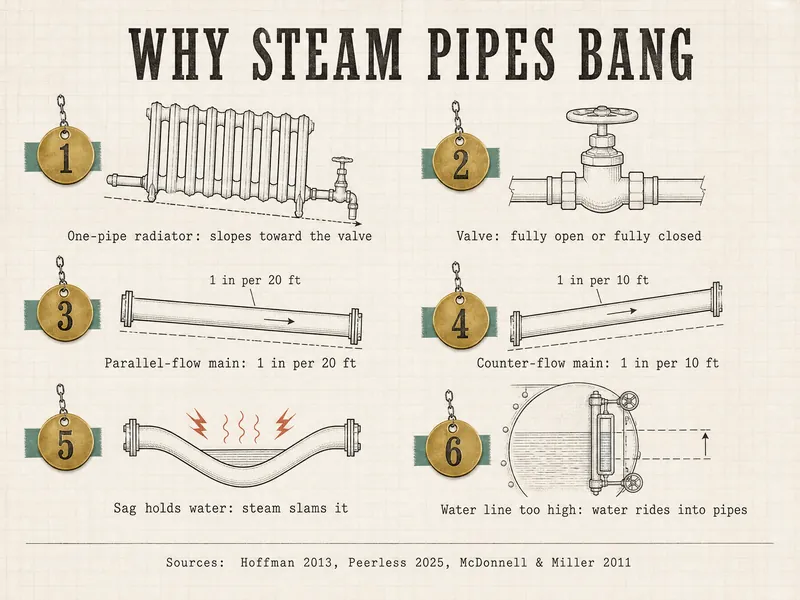
On the tag
- Hoffman's FHD-205 sheet (1997) calls water hammer "one of the chief causes of noise in steam heating systems."
- A one-pipe radiator valve must be "wide open or closed," never throttled, because a part-open valve holds condensate in the radiator (Hoffman TES-375A, 2013).
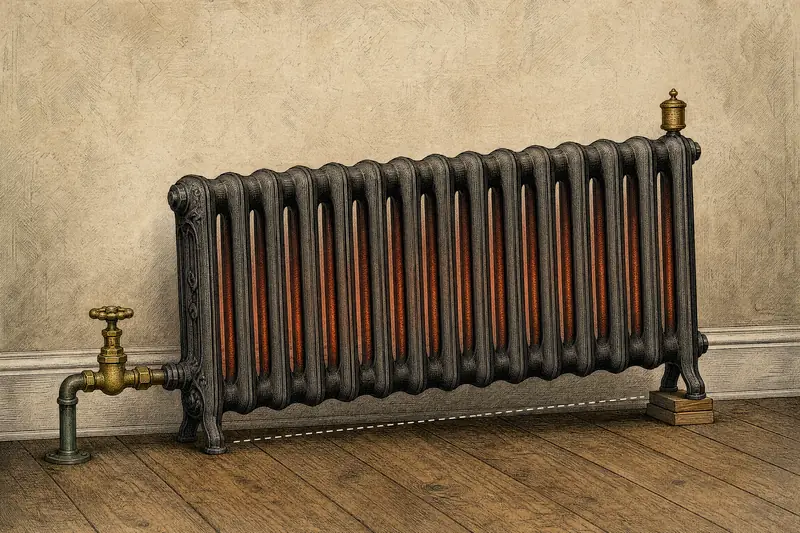
- One-pipe radiators are pitched toward the riser, the supply-valve end; no maker source gives a numeric slope for the radiator itself.
- One-pipe steam mains need at least 1 inch of fall in 20 feet, or 1 inch in 10 feet for counter-flow mains (TES-375A).
- Peerless's 2025 steam manual lists pipe sags, failed traps and a large radiator vented too quickly among causes of water hammer.
- A water line set too high carries water up into the pipes, leading to water hammer and uneven heat (McDonnell & Miller, 2011).
Why does a steam radiator bang?
A steam radiator bangs when fast-moving steam meets a pool of condensate and slams it against the iron. Hoffman's FHD-205 equipment and definitions sheet (1997) explains the mechanism: steam racing over water raises a wave, the steam condenses suddenly, and slugs of water crash together. The same sheet calls water hammer "the major cause of damage to thermostats and floats in traps," so the noise is a warning as well as a nuisance.
In a one-pipe system, the steam goes up and the water comes down the same pipe. Anything that stops condensate draining back, such as a radiator tilted away from its valve, a valve left half open or a pipe that sags, leaves water in the steam's path.
How should a one-pipe steam radiator be pitched?
A one-pipe steam radiator should slope back toward its supply valve, so condensate runs out through the same pipe the steam came in. Hoffman's technical manual TES-375A (2013) refers to "the need for pitching the radiators in one-pipe systems to the riser," and the pipe from the main to that riser also has to slope up toward the radiator.
No maker or government source read for this page gives a number for how much a radiator should tilt, so this site gives none. U.S. Boiler's steam replacement tips asks contractors to verify radiators "are level or have a slight slope to the drain side," and the Department of Energy's 2011 renovation handbook lists "Check that radiator is level and drains fully when cool" as a tune-up item. A small shim under the feet at the vent end is a common sight on old one-pipe radiators. If a radiator tips toward the vent instead, or floors have settled, ask a technician to re-pitch it.
Two-pipe radiators are different: they drain through a trap at the outlet, so they sit level or draining toward that outlet. See the two-pipe steam trap page.
Why must a one-pipe radiator valve be fully open?
A one-pipe radiator valve must be fully open because condensate drains out through it; a half-closed valve traps water in the radiator and the steam hammers it. TES-375A is direct: "The valve cannot be throttled as this would restrict condensate drainage. It must either be wide open or closed." A 2013 Building America study for the Department of Energy agrees that radiator valves "should always be completely open or completely closed and were not designed to be frequently throttled."
That makes the valve useless for turning a room down. On one-pipe steam, room-by-room control comes from vent sizing or from a thermostatic valve fitted at the air vent, which a technician installs. If a radiator valve is stiff or leaks at the stem when you check it, leave it for a technician.
| Where you hear it | Usual cause named by the source | Who checks it |
|---|---|---|
| One radiator, every cycle | Radiator sloped away from the valve, or valve part-closed | You look; technician re-pitches |
| Basement mains | Condensate pooled at low points or sags | Heating technician |
| Near the boiler at start-up | Water line too high, or a near-boiler piping fault | Heating technician |
| A large radiator as it fills | Radiator vented too quickly | Heating technician |
| Return lines | A trap failed open, letting steam into the return | Heating technician |
| After a new boiler goes in | Dry returns flooded because the new boiler's water line sits higher | Installing contractor |
What causes banging in the steam mains?
Banging in the steam mains usually comes from condensate lying in low spots, where steam collapses into it. TES-375A says, "Banging in the steam mains is usually caused by steam 'imploding' in condensate lying in low points in lines," and names the fixes as dripping those low points, supporting the pipe and increasing its pitch, all piping work.
The pitch rules are specific. TES-375A says one-pipe supply mains and dry returns "must be pitched at least one inch in 20 feet in the direction of condensate flow," and counter-flow mains, where steam and water move in opposite directions, need at least 1 inch in 10 feet upward and away from the boiler. Wet returns need no pitch, since they are always full of water.
The Peerless 211A steam boiler manual (2025) lists more causes: "Sags in Steam Piping or not enough Pitch," concentric reducers that pool water, failed drip traps, a trap "failed open, allowing steam to enter returns," a large radiator "vented too quickly," a long nipple at the Hartford loop, and uninsulated pipe. After a boiler replacement, it adds, banging can come from "Dry returns wetted due to new boiler water line higher than old boiler."
Pitch and water hammer in numbers
- 1 in per 20 ftMinimum fall of one-pipe parallel-flow mains and dry returnsHoffman TES-375A, 2013
- 1 in per 10 ftMinimum rise of counter-flow mains, away from the boilerHoffman TES-375A, 2013
- 100 ftLongest counter-flow main shown in Hoffman's diagramsHoffman HS-901A
- 28 inU.S. Boiler's minimum from water line to lowest steam mainU.S. Boiler, 2018
What can a homeowner check about banging?
You can check three things without tools: whether the radiator valve is fully open, whether the radiator slopes back toward that valve, and whether the sight glass on the boiler looks overfull. A marble or a short level laid on top of the radiator, once it is cool, shows which way it tips. Note when the noise comes (at start-up, mid-cycle or at the end) and where (one radiator, the basement, the boiler), because that is what a technician will ask.
The water level matters more than it looks. McDonnell & Miller's catalog MM-825B (2011) says that in an overfilled boiler "the steam will now carry water up into the system piping," leading to "higher fuel bills, uneven heating, water hammer." Weil-McLain's SGO manual lists "Waterline too high" as a cause of surging. If the glass looks full, call a technician; do not try to lower the water yourself. The sight glass page shows what a normal level looks like.
Two more things are worth mentioning to the technician. A main vent crowded against the end elbow of the main is one: the DOE report says water hammer can surge up the tee and crush the vent's float, and wants the vent at least 15 inches back. And a vent that spits water is often a sign of the same trapped condensate; the steam air vent page covers what that means. If unsure what you are looking at, ask a licensed heating technician who works on steam.
When does banging need a steam technician?
Banging needs a steam technician when it comes from the mains or the boiler, keeps happening after you have confirmed the radiator valves are fully open, or started after a new boiler went in. Re-pitching pipes and radiators, adding pipe supports, dripping low points, fixing near-boiler piping and setting the water line are all technician jobs. So is checking whether a large radiator is being vented too fast: Peerless suggests a smaller vent, or two small vents with one higher, which is balancing work.
Banging that damages trap elements or vent floats can also leave rooms cold, so it is worth dealing with before the next season. If the radiator itself is cold rather than noisy, the cold radiator page lists other causes.
Keep reading
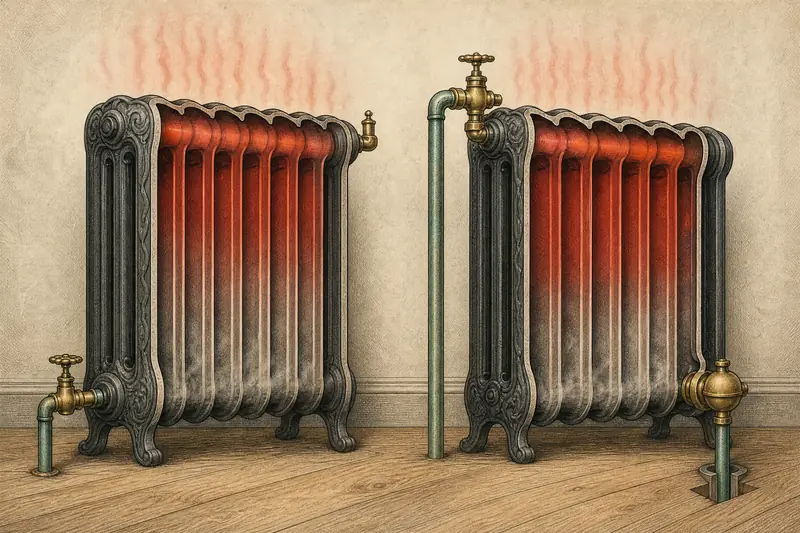 Steam heat: How steam heat works, start to finish
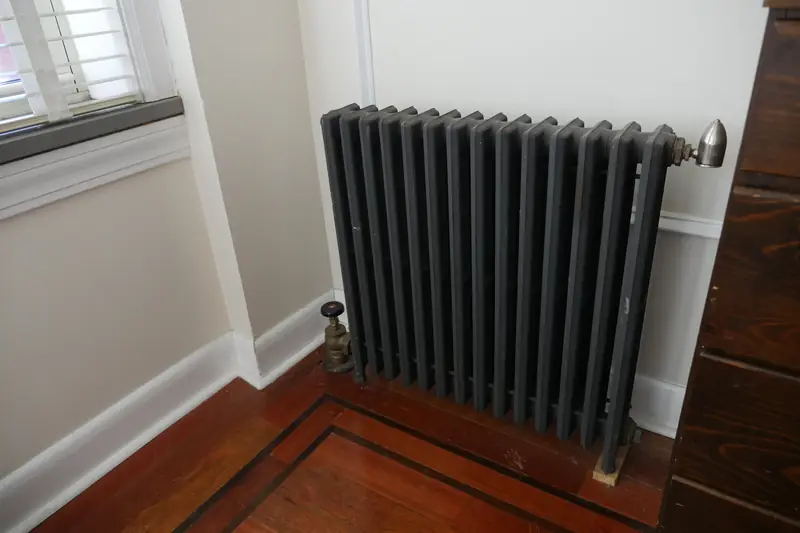 Folder: Steam heat in old houses: all the steam pages
 Radiator heat in old houses
Proof stamp: where these figures come from
What this page rests on: Hoffman's FHD-205 definitions (1997), TES-375A technical manual (2013) and HS-901A system diagrams; the Peerless 211A steam manual (2025); McDonnell & Miller's MM-825B catalog (2011); Weil-McLain's SGO manual (2025); U.S. Boiler's advice for contractors replacing steam boilers (2018); and the DOE's 2011 renovation handbook and 2013 steam balancing study, all read October 2026. Left out: any numeric slope for the radiator itself, since no maker gives one, and any step for changing pitch, water level or pressure settings.
Questions from the boiler room
Why does my radiator bang only when the heat first comes on?
Hoffman's FHD-205 ties water hammer to fast steam passing over pooled condensate. Peerless lists sags, too little pitch and a large radiator vented too quickly as causes; a technician can tell which applies to your system.
Can I turn a one-pipe radiator down by half-closing its valve?
No. Hoffman says the valve must be wide open or closed, and a half-closed valve keeps water in the radiator, which causes the banging. Room control on one-pipe steam comes from vent sizing or a thermostatic valve at the vent.
Can water hammer damage a steam system?
Yes. Hoffman's FHD-205 calls it the major cause of damage to the floats and thermostatic elements in traps, and the DOE report says it can crush a main vent's float. Damaged vents and traps then leave radiators cold or let steam into the returns.
Why did banging start after my boiler was replaced?
Peerless's manual names one cause: a new water line set higher than the old boiler's, which floods returns meant to stay dry. U.S. Boiler also stresses the A-dimension, at least 28 inches from water line to the lowest main. Ask the installer to check both.
Does pipe insulation help with banging?
It can. Peerless lists uninsulated pipe as a water-hammer cause, and U.S. Boiler says uninsulated mains add water to the system and noise. Insulating mains is work for a heating contractor.
Does a two-pipe radiator need to tilt?
Not toward the supply. A two-pipe radiator sits level or draining toward its outlet, where the trap is. On two-pipe systems, Peerless lists a trap that has failed open among the causes of banging.
Back up the riser: the start page for radiator homes