Reading the Boiler Pressure Gauge
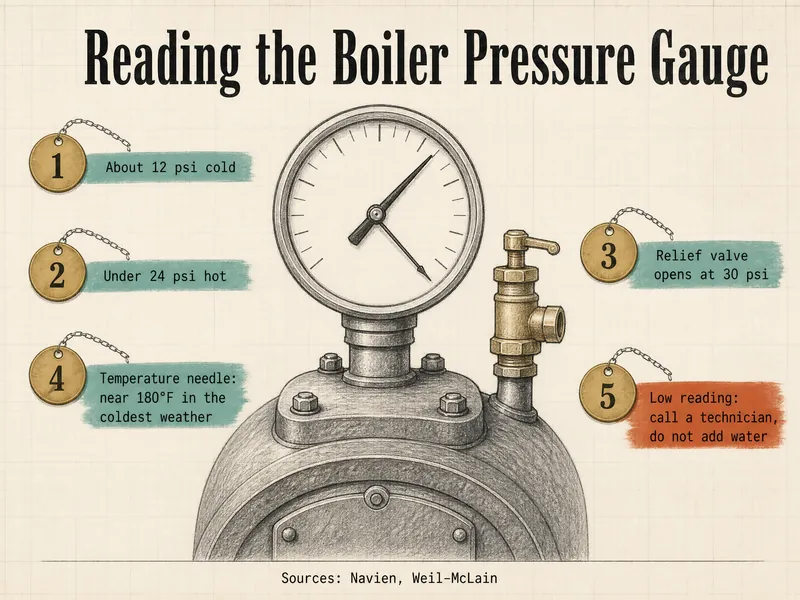
A boiler pressure gauge on a hot-water system should read about 12 psi when cold and stay under about 24 psi when hot, well below the 30 psi relief valve setting.
Compiled by the Wet Return bench from makers' manuals and federal pages · how pages are checked · Checked again
Who owns what: Wet Return is run by the same people who own PlumbingSupplyAndMore, Central Plumbing & HVAC, SoftPro Water Systems and Quality Water Treatment, the businesses linked on this page. The text is written from boiler and vent makers' manuals and federal pages read in October 2026; what a business says about its own products is that business's claim. How these links are handled
On the tag
- Navien's NCB-E installation manual (2019) calls 12 psi the typical cold fill for a home system.
- Weil-McLain's 2025 user manual tells owners a water boiler's gauge should not exceed 24 psig; steam boilers stop at 15 psig.
- Residential cast-iron water boilers ship with a 30 psig ASME relief valve, and the CGa boiler is rated for 50 psig (Weil-McLain, 2019).
- The temperature needle on a classic radiator system tops out near 180°F in the coldest weather, per Weil-McLain's 2024 ECO Tec manual.
- Weil-McLain and Amtrol both want the relief valve inspected by a licensed professional at least once every 3 years.
- A low reading is never a reason to add water yourself; the makers tie frequent makeup water to leaks and cracked sections.
What should a boiler pressure gauge read?
On a typical home hot-water system, the gauge should read about 12 psi with the water cold and rise as the water heats, staying under about 24 psi. Navien's NCB-E installation manual (2019) notes that "the pressure will rise when the boiler is turned on and the system water temperature increases," and "the operating pressure must never exceed the relief valve pressure setting." Weil-McLain's ECO Tec manual (2024) uses the same 12 psig cold figure and says pressure after heating "should not exceed 24 PSIG to avoid weeping of relieve valve."
Each system settles at its own normal, set by its fill pressure and its expansion tank. The useful habit is to learn yours: read the gauge on a cold morning and again after the boiler has run a while, and note both numbers. A change from your usual readings tells you more than any single figure.
These numbers are for hot-water boilers only. Steam boilers in houses are built to work below about 2 psi and carry a different gauge; Weil-McLain's 2025 user manual gives 15 psig as the most a steam boiler's gauge should ever show. For steam, see the sight glass and low-water cutoff page.
What does the temperature side of the gauge show?
The second needle, or the second scale on the dial, shows the temperature of the boiler water in °F. Weil-McLain calls it a "pressure/temperature gauge," fitted to water boilers. In design weather, a classic radiator loop expects water near 180°F; Weil-McLain's ECO Tec control pegs its maximum target to the temperature needed at design heat loss, "typically 180°F."
In milder weather the reading can be much lower. A boiler with outdoor reset lowers the water temperature as it warms outside; in the example from DOE's condensing boiler guideline (2014), a 50°F day brings the supply down to 120°F. Older cast-iron boilers without reset tend to run hotter, since Weil-McLain's CGa manual wants their return water kept at 130°F or more to avoid corrosion. The federal definition in 10 CFR 430.2 caps a hot-water boiler at 250°F, a ceiling no house system should approach.
Gauge numbers
- 12 psiTypical cold fill pressureNavien NCB-E installation manual, 2019
- 24 psigUpper reading for water boilers in operationWeil-McLain user manual, 2025
- 30 psigRelief valve setting on residential water boilersWeil-McLain CGa boiler manual, 2019
- 180°FClassic supply temperature at design coldWeil-McLain ECO Tec manual, 2024
- 3 yearsLongest gap between relief valve inspectionsWeil-McLain CGa boiler manual, 2019
What does high boiler pressure mean?
High pressure on a running hot-water boiler most often means the expansion tank is no longer absorbing the swell of heated water. Weil-McLain's user manual says that if the relief valve often weeps on a water boiler, "the expansion tank may not be working properly," and tells the owner to "immediately contact your qualified service technician." Its troubleshooting table lists two causes for frequent relief-valve discharge: a tank sized too small and a flooded tank.
A gauge that climbs toward 30 psi as the boiler runs, or a relief valve that drips, is a call to a technician the same day. The boiler expansion tanks page explains how tanks fail and who checks them.
If the relief valve is spraying hot water or steam, or the boiler is plainly overheating, keep everyone away from it, leave the house, and call 911 from outside, then the gas utility. Weil-McLain's manual warns responders not to cut power to the pump during overheating and to shut the gas off at a point outside the boiler; that is a job for the fire department, the gas utility or a technician, not the homeowner.
What does low boiler pressure mean?
Low pressure means water has left the loop, through bleeding, a leak, or a relief valve that has been discharging. A small drop right after bleeding radiators is expected, since a little water comes out with the air. A reading well below your usual cold figure, or one that keeps sinking, needs a technician.
Do not add water yourself. Weil-McLain's user manual says to "have leaks fixed at once by a qualified service technician," because "continual fresh makeup water reduces boiler life. Minerals can build up, reducing heat transfer, overheating cast iron, and causing section failure." The same manual links black water to oxygen corrosion from leaks, and popping or percolating noises to mineral deposits from constant makeup water. Low pressure can also leave air in the top radiators, so the cold radiators page may help you describe what you see.
| Reading | What it usually means | What to do |
|---|---|---|
| About 12 psi cold, rising while hot but under about 24 psi | Normal for a typical home system | Note it as your baseline |
| Well below your usual cold reading | Water has left the loop: bleeding, a leak or relief discharge | Call a heating technician; do not add water |
| Climbing toward 30 psi while running | Expansion tank waterlogged, flooded or undersized | Call a technician the same day |
| Relief valve dripping or its pipe wet | Pressure reaching the valve, or the valve itself failing | Call a technician; never cap the pipe |
| Relief valve spraying, or boiler overheating | Emergency | Leave the house, call 911, then the gas utility |
Why does the relief valve matter?
The relief valve is the boiler's last protection against too much pressure: if everything else fails, it opens and lets water out. Weil-McLain's CGa boiler manual (2019) lists a "pressure relief valve, ASME, 30 PSIG" for its residential cast-iron boilers, which are "ASME rated for 50 psig working pressure." Navien supplies a 30 psi valve with its combi boilers.
The manual also says "no shutoff valve shall be installed between the relief valve and boiler," and that a discharge line must be connected to the valve's outlet so any release goes somewhere safe. It asks for the valve to be "reinspected AT LEAST ONCE EVERY THREE YEARS, by a licensed plumbing contractor or authorized inspection agency." Amtrol's Extrol Pro instructions (2025) agree: a licensed professional inspects it at least every 3 years, or whenever it has discharged, and replaces it if it is corroded or does not work.
Some owner's manuals list operating the relief valve as an owner task. This site does not: Weil-McLain and Amtrol want a licensed person inspecting it, and what comes out is hot boiler water, so testing and replacing it is technician work. PlumbingSupplyAndMore's boiler parts and accessories (run by Wet Return's owners) category shows gauges and relief valves of the kind a technician fits, if you want to see one before a service visit.
What can a homeowner do about boiler pressure?
You can read the gauge, keep a note of your normal readings, look for leaks, and call a technician; you should not adjust it. Weil-McLain's daily owner checks include making sure the pressure/temperature gauge does not exceed 24 psig on a water boiler and looking at the boiler area. A homeowner's list, within this site's rules:
- Read the gauge cold, then again after the boiler has run, and write both down with the date.
- Look at the relief valve's discharge pipe and the floor below it for drips or a wet patch.
- Look along visible pipes and radiator valves for leaks or staining.
- Bleed radiators only with the system off and cooled, then read the gauge again.
The fill (pressure-reducing) valve, the expansion tank's air charge and the relief valve are all set and serviced by a technician during the yearly visit the makers call for; the annual boiler service page lists what that visit covers. If unsure, call a licensed heating technician.
Proof stamp: where these figures come from
Written from Navien's NCB-E installation manual (2019), Weil-McLain's CGa boiler manual (2019), its 2025 owner's manual and its ECO Tec manual (2024), Amtrol's Extrol Pro instructions (2025), DOE's Building America condensing boiler guideline (2014) and 10 CFR 430.2, read October 2026. Left out: pressure figures in bar from UK sources, any step for adding water or adjusting the fill valve, and relief valve testing, which the makers' owner lists include but this site leaves to technicians.
Questions from the boiler room
Why does my boiler pressure go up when the heat comes on?
Water expands as it heats, and in a sealed loop that raises pressure. A working expansion tank keeps the rise small, under about 24 psi on Weil-McLain's figures.
Is 20 psi too high for a boiler?
On a hot, running system, 20 psi is under Weil-McLain's 24 psig limit. The same 20 psi on a cold system is well above the typical 12 psi fill and is worth asking a technician about; Taco's circulator sheet sets a 20 psi minimum fill only for homes higher than 5,000 feet.
Why does my gauge read 0 psi?
A zero reading on a hot-water boiler means the loop has lost its pressure or the gauge has failed. Either way it is a call to a heating technician, not a reason to add water.
How often should I look at the gauge?
Weil-McLain's owner checks put a look at the pressure/temperature gauge on the daily list during the heating season. A quick glance when you pass the boiler, plus a written note now and then, is enough to spot a change.
Does a steam boiler gauge read the same way?
No. Steam boilers use a pressure gauge with a far lower working range; Weil-McLain puts 15 psig as the absolute maximum for a steam boiler, but house steam runs below about 2 psi, so a reading anywhere near 10 psi is already a reason to call a technician. Steam owners read the sight glass for water level instead.
Is a dripping relief valve dangerous?
It is a warning, not a safe normal. Weil-McLain tells owners to contact a qualified technician immediately when a relief valve weeps often.
Back up the riser: the five valve tags on the Wet Return home page