Steam Radiator Air Vents
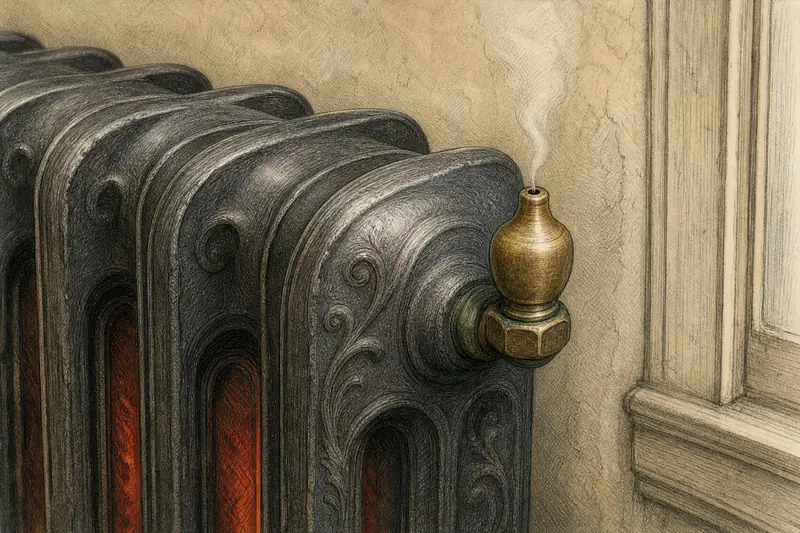
A steam radiator air vent lets the air inside a one-pipe radiator escape so steam can fill it, then closes tight once hot steam reaches it.
Compiled by the Wet Return bench from makers' manuals and federal pages · how pages are checked · Checked again
Who owns what: Wet Return is run by the same people who own PlumbingSupplyAndMore, Central Plumbing & HVAC, SoftPro Water Systems and Quality Water Treatment, the businesses linked on this page. The text is written from boiler and vent makers' manuals and federal pages read in October 2026; what a business says about its own products is that business's claim. How these links are handled
On the tag
- Hoffman's 2013 technical manual says air vents belong on every one-pipe radiator and at the end of every steam main.
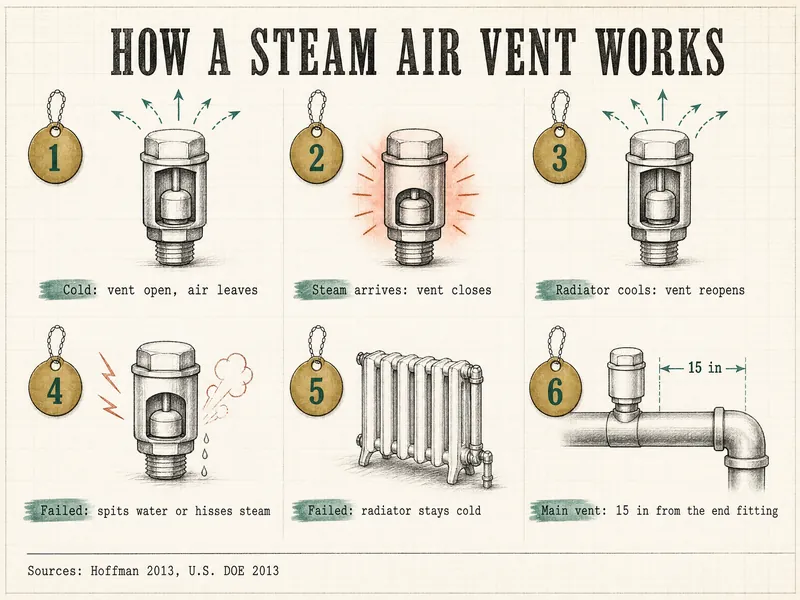
- Radiator vents stay open while cold and close when steam, or water, reaches them (Hoffman TES-375A).
- A cold radiator is most often a dirt-plugged vent; a vent that keeps blowing steam has a collapsed float or a pinhole leak (Hoffman, 2013).
- Gorton's fixed vents run from No. 4, the smallest opening, to D, the largest, according to a 2013 U.S. DOE Building America report.
- Main vents sit at least 15 inches back from the end fitting of the main (DOE 2013; Hoffman HS-901A).
- Weil-McLain's 2025 owner troubleshooting table sends vent repair and replacement to a service technician.
What does a steam radiator air vent do?
A steam radiator air vent lets air out of a one-pipe radiator and then shuts so steam cannot escape. Between heating cycles the radiator fills with air, and steam cannot enter until that air leaves; the step-by-step on how steam heat works follows the whole loop. Hoffman's technical manual TES-375A (Xylem, 2013) says the vents "are normally open and close off as the hot steam reaches them," and that they must be fitted "on each radiator and at the end of each steam main."
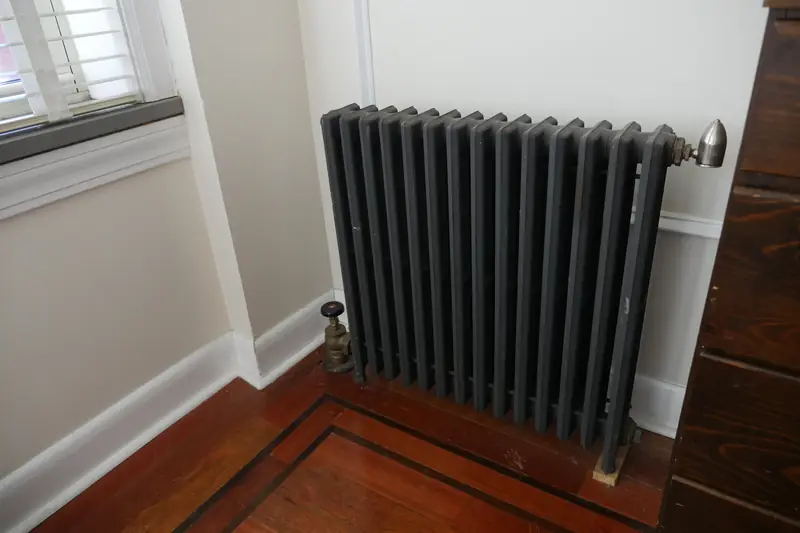
The cycle reverses as the boiler stops. The DOE Building America steam balancing report (2013) describes it: as steam reaches each vent, the vent closes so no steam escapes, and "as the radiators cool, the air vents open and allow air to re-enter the system." Most vents are the angle type, screwed into a tapping on the end of the radiator opposite the supply valve.
TES-375A also notes that the vents close if water gets into them, which is why a vent mounted on a radiator that tips the wrong way can stay shut and leave the radiator cold. On two-pipe systems there is usually no vent on each radiator: a trap at the outlet does the air-handling instead (see the two-pipe steam trap page).
How do you tell a steam radiator air vent has failed?
A failed steam radiator air vent shows itself in one of two ways: the radiator stays cold, or the vent keeps hissing steam or spitting water. TES-375A's troubleshooting section says, "When a radiator doesn't heat, it is probably due to a dirt plugged vent," and that vents "may continually discharge steam due to a collapsed float or a pinhole leak."
A vent that whistles loudly is a third sign. The DOE report says whistling can mean the opening is too small for the radiator, debris in the opening, or a boiler running at higher pressure than it needs. A vent that leaks steam also costs water: McDonnell & Miller's general catalog MM-825B (2011) lists vents "passing steam to the atmosphere" first among the causes of a steam boiler losing water.
| What you notice | Likely cause named by the source | Who deals with it |
|---|---|---|
| Radiator stays cold, no air leaves the vent | Dirt-plugged vent | Heating technician |
| Vent hisses steam all through the cycle | Collapsed float or pinhole leak | Heating technician |
| Vent spits water | A failing vent, or condensate held in the radiator by a half-closed valve or poor slope | You check the valve and slope; technician fixes |
| Loud whistle | Opening too small, debris, or pressure higher than needed | Heating technician |
| Vent covered in paint | Painted shut | Heating technician |
Why do vents come in different sizes?
Steam radiator air vents come in sizes so that rooms near the boiler and rooms far away heat at about the same time. The DOE report explains that big radiators hold more air than small ones, "so big radiators need larger air vents," and that Gorton's fixed vents range "from 4 with the smallest orifice (for warm apartments) to D with the largest (for cool apartments)."
Hoffman makes the same point about adjustable vents: the venting rate of the first radiators "can be set lower than that of the far end radiators resulting in better heat distribution." A Heat-Timer data sheet for its Varivalve adjustable vent sums up a Center for Energy and Environment study the same way: fill time rises with a radiator's heat capacity and falls as the vent's capacity rises. Choosing and swapping vent sizes is balancing work for a technician who has surveyed every radiator in the house. This site gives no airflow figures for particular vent models, because no maker table could be read directly.
Radiator and main vents in numbers
- 15 inMinimum distance from the end-of-main fitting to the main ventDOE Building America, 2013
- 6–10 inLength of the nipple that raises a main vent as a cooling legHoffman TES-375A, 2013
- 1Main vents needed per steam line, at minimumDOE Building America, 2013
- 2–3 psiUpper pressure for open-type radiator vents on one-pipe systemsHoffman TES-375A, 2013
What are main vents?
Main vents are the large vents at the ends of the steam pipes in the basement, and they clear the air out of the mains before the radiators start venting. The DOE report says there should be "at least one main line air vent per steam line," kept separate from radiator venting, so steam reaches all the risers at about the same time. Hoffman adds that main vents have "a much larger venting rate than radiator vents" and are always the non-adjustable type.
Where they sit matters. The DOE report and Hoffman's HS-901A booklet put the main vent at least 15 inches back from the last fitting, raised on a short nipple; too close to the elbow and water hammer can surge up the tee and crush the float. The DOE report also notes that the small main vents of the coal era, when boilers fired steadily, are often too small for today's cycling gas and oil burners. A plugged main vent leaves that whole main short of heat, so if every radiator on one side of the house is slow, the main vent is a likely suspect (more causes on the cold radiator page). Placement and sizing are things a technician checks.
Can you replace a steam radiator air vent yourself?
This site's answer is no: a technician replaces vents, and your job is spotting a bad one. Vents unscrew from the radiator and are replaced, not repaired; TES-375A says a failed vent "must be replaced since it can't be dismantled for repair." Weil-McLain's SGO steam boiler manual (2025), in the troubleshooting table written for owners, says: "Contact service technician to check, repair or replace air vents and traps."
No maker or government source read for this page describes a homeowner vent swap. There are other reasons to leave it to a technician: the vent has to match the radiator's size and the system's pressure, U.S. Boiler's replacement tips say radiators on one system should all carry the same style of vent, and the radiator and its vent run hot enough to burn while the system is steaming. If unsure whether a vent has failed, ask a licensed heating technician to look.
PlumbingSupplyAndMore's steam vents and traps (run by Wet Return's owners) show what these parts look like: the kind of part a technician fits.
Why must vents never be painted over?
A vent covered in paint stops working, and the radiator under it goes cold. The DOE report's photo caption puts it bluntly: "Painting over radiator vents is a common oversight that can have a serious effect on the heating in an apartment." The paint seals the tiny opening, so air stays trapped and steam cannot enter.
When you repaint a room, leave the vent bare and keep paint off its tip. If a vent has already been painted, a technician cleans or replaces it. Checking that your vents are clear is one of the few vent jobs that is yours, along with making sure each one-pipe radiator valve is fully open (see why steam radiators bang).
More on steam heat
- Folder: Steam heat in old houses: the full overview
 Steam heat: Reading the sight glass and the low-water cutoff
 Radiators: Why a radiator is not getting hot
Proof stamp: where these figures come from
Sources: the Hoffman Specialty technical manual TES-375A (Xylem, 2013) and HS-901A booklet, the U.S. DOE Building America report on steam system balancing (2013), the 2011 McDonnell & Miller catalog, Weil-McLain's 2025 SGO manual, U.S. Boiler's 2018 advice on steam boiler replacement and a Heat-Timer Varivalve data sheet (about 2008, read from a mirror copy, named here but not linked), all read October 2026. Left out: airflow ratings for named vent models, which appear only in forum or third-party charts, and any homeowner vent-replacement steps, because no source supports them.
Questions from the boiler room
Should a steam radiator vent hiss at all?
A short hiss of air at the start of a cycle is the vent doing its job. Steam or water coming out after the radiator is hot is not: Hoffman's TES-375A links that to a collapsed float or a pinhole leak.
Why is my radiator vent spitting water?
It can mean condensate is being held in the radiator; the DOE report says a partly closed valve keeps water inside. Check that the one-pipe valve is fully open and the radiator slopes back toward it; if it still spits, a technician checks the vent, the pitch and the boiler water level.
Can a thermostatic radiator valve work on one-pipe steam?
Yes, as a device fitted between the radiator and its air vent. The DOE report says these valves work by closing off the vent and "cannot draw more heat to radiators, only prevent them from overheating."
Do all radiators in the house need the same vent?
Not the same size. Larger radiators and those far from the boiler usually get faster vents. U.S. Boiler does recommend that radiators on one system share the same style of vent.
What happens if a main vent is missing?
Air has to leave through the radiator vents, so far radiators heat late. The DOE report warns that operators then tend to raise the boiler pressure, which makes the boiler short-cycle.
Can I clean a clogged vent?
Hoffman's TES-375A says vents cannot be taken apart for repair. A technician either cleans the outside of a painted vent or replaces it.
Back up the riser: every steam and hot-water page on Wet Return