Radiator Not Getting Hot
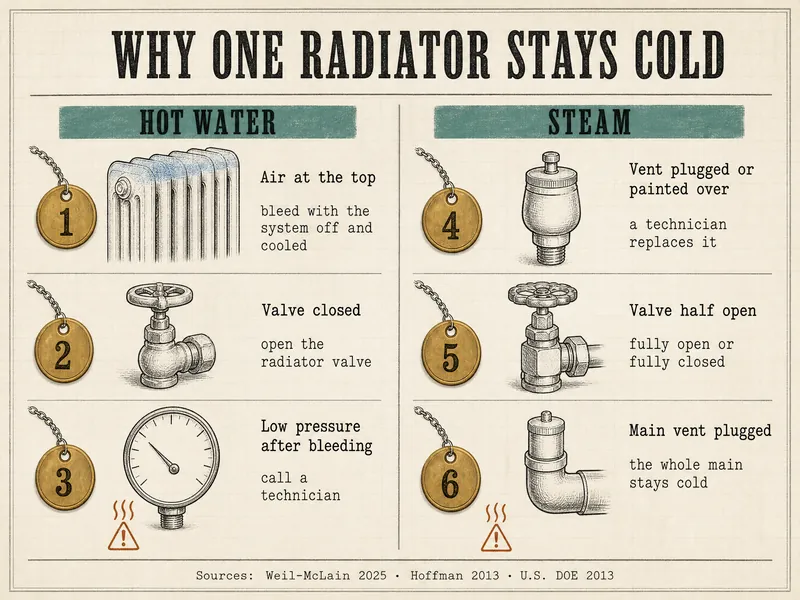
Radiator not getting hot? On hot water it is usually trapped air or a closed valve; on steam it is usually a plugged or painted-over air vent, a half-open valve or a cold main.
Compiled by the Wet Return bench from makers' manuals and federal pages · how pages are checked · Checked again
Who owns what: Wet Return is run by the same people who own PlumbingSupplyAndMore, Central Plumbing & HVAC, SoftPro Water Systems and Quality Water Treatment, the businesses linked on this page. The text is written from boiler and vent makers' manuals and federal pages read in October 2026; what a business says about its own products is that business's claim. How these links are handled
On the tag
- Weil-McLain's owner manual matches radiators that stay cold or noisy on a water boiler with trapped air (Weil-McLain, 2025).
- DOE advises removing trapped air from hot-water radiators once or twice a season, and calling a professional if unsure (Energy Saver booklet, 2022).
- Hoffman's troubleshooting pages tie an unheated steam radiator to a vent clogged with dirt, and a clogged main vent to a whole cold main (Hoffman TES-375A, 2013).
- One-pipe steam radiator valves must be completely open or completely closed; a partly closed valve holds water in the radiator (DOE steam study, 2013).
- After bleeding, the gauge on a typical home hot-water system should read about 12 psi cold (Navien manual, 2019); pressure below that calls for a technician.
- A two-pipe radiator whose trap has failed closed stays cold because condensate cannot leave (Hoffman TES-375A, 2013).
Why is a radiator not getting hot?
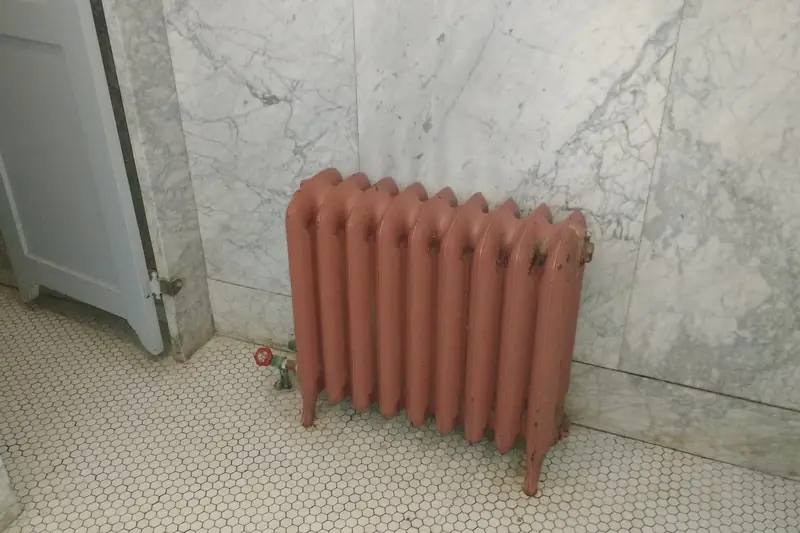
A radiator is not getting hot when something stops heat from filling it: air that cannot escape, a valve that is shut, or a supply that never reaches it. Which one depends on the system, so first tell steam from hot water. Steam radiators of the one-pipe kind show one pipe and a vent; water-filled ones show two pipes plus a small top bleed screw. The radiators section shows the differences.
Next, ask whether it is one radiator or many. If every radiator is cold, look at the thermostat (setting and batteries), the breaker and the boiler's service switch before anything else. If one radiator, or one end of the house, stays cold while the rest heat, the cause is usually local to that radiator or its pipe.
What makes a hot-water radiator stay cold?
Trapped air is the most common cause. Weil-McLain's user manual (2025) pairs "some radiators or baseboard units do not heat or are noisy" with "air in system", and the remedy is bleeding through the radiator vents. Vaillant, a boiler maker, describes the tell: the radiator feels cooler in places, often near the top, and may rattle or clank as it warms.
A closed or stuck radiator valve does the same thing, and so can a zone that never opens. On zoned systems, each zone valve or circulator answers its own thermostat, so a cold room may be a zone problem, explained in the zone valves and circulators article. When water barely moves through the boiler, Weil-McLain's troubleshooting starts with "check all valves to and from boiler" and confirming the circulator size; that is technician work.
If one radiator needs bleeding again and again, treat that as a symptom rather than a chore. Vaillant tells owners to raise repeated bleeding with the installer "as there may be an underlying problem." Caleffi's video on this page explains how air gets into hot-water loops.
What makes a steam radiator stay cold?
On one-pipe steam, a cold radiator usually means air cannot get out. Steam can't enter until the air leaves through the vent, and Hoffman's steam manual (TES-375A, 2013) names a dirt-clogged vent as the likeliest reason a radiator stays cold. A vent that has been painted over fails the same way. Vents cannot be repaired, only replaced, and Weil-McLain's owner troubleshooting sends that to a service technician.
The valve comes next. The DOE steam balancing study (2013) says that if no steam ever reaches a radiator, check that its valve is open; one-pipe valves must be fully open or fully closed, because a partly closed valve keeps condensate in the radiator and blocks steam.
When a whole run of radiators is cold, look upstream. Hoffman says plugged end-of-main vents leave "little or no heating in the entire main." Radiators nearest the boiler also fill first, so the far ones lag unless main vents and radiator vents are balanced, as the DOE study describes. On two-pipe steam, a trap that has failed closed holds condensate in the radiator; Hoffman calls this "a cold trap which doesn't discharge condensate." The two-pipe steam traps article covers the signs.
Why is a radiator hot at the top and cold at the bottom?
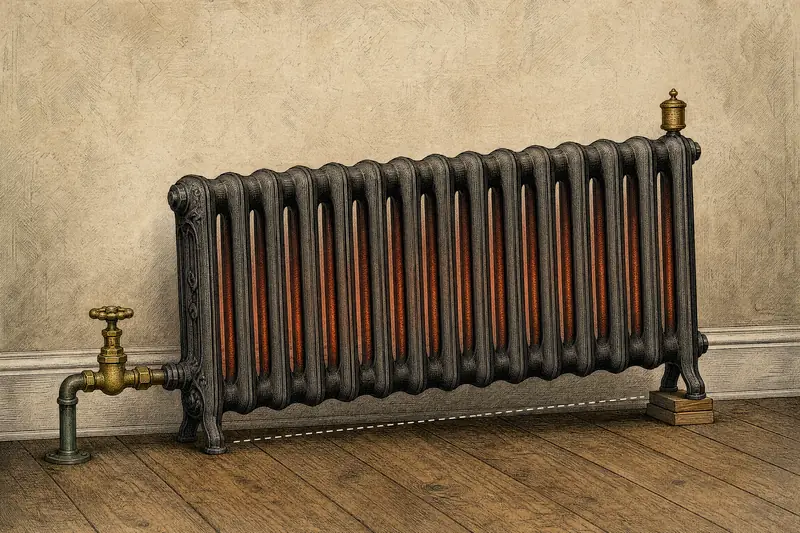
On one-pipe steam, a radiator that heats only near the top is usually holding water at the bottom. Condensate has to drain back out through the same valve the steam came in, so the radiator must slope toward that valve and the valve must be fully open (Hoffman TES-375A; DOE study). A radiator that has settled the wrong way, or a valve left half open, traps water that steam cannot heat through, and that pooled water is also behind much of the banging covered in the banging and pitch article.
On hot water, the usual pattern is the reverse: air collects at the top, so the top runs cooler than the bottom, which is the bleeding sign Vaillant describes. A hot-water radiator that stays cool lower down, after bleeding, points to slow flow through it. Weil-McLain's troubleshooting puts flow problems at the valves and circulator, and its "black water" entry (corrosion from leaks) goes to a technician as well.
| Cause | System | What you notice | Who handles it |
|---|---|---|---|
| Trapped air | Hot water | Cooler at the top, gurgling or clanking | Homeowner may bleed with the system off and cooled |
| Closed or half-open radiator valve | Both | Radiator cold, or warm only partway | Homeowner opens it fully; a technician if it is stuck |
| Plugged or painted-over air vent | One-pipe steam | Cold radiator, silent vent at the start of a cycle | Technician replaces the vent |
| Plugged main vent | One-pipe steam | Every radiator on one main stays cold | Technician |
| Trap failed closed | Two-pipe steam | Radiator cold, trap cold | Technician replaces the element or trap |
| Radiator sloping the wrong way | One-pipe steam | Banging, cold lower sections | Ask a technician to re-pitch it |
What can a homeowner check safely?
You can check settings, valves and vents, and bleed hot-water radiators; you cannot add water, change pressure controls or replace vents. Work through these:
- Thermostat set to heat, set above room temperature, with fresh batteries; breaker on; boiler service switch on.
- The radiator valve: fully open. On one-pipe steam, fully open or fully closed only.
- On steam: the air vent is not painted over or blocked, and the radiator slopes back toward its valve. Look for a vent that spits water or hisses steam and report it.
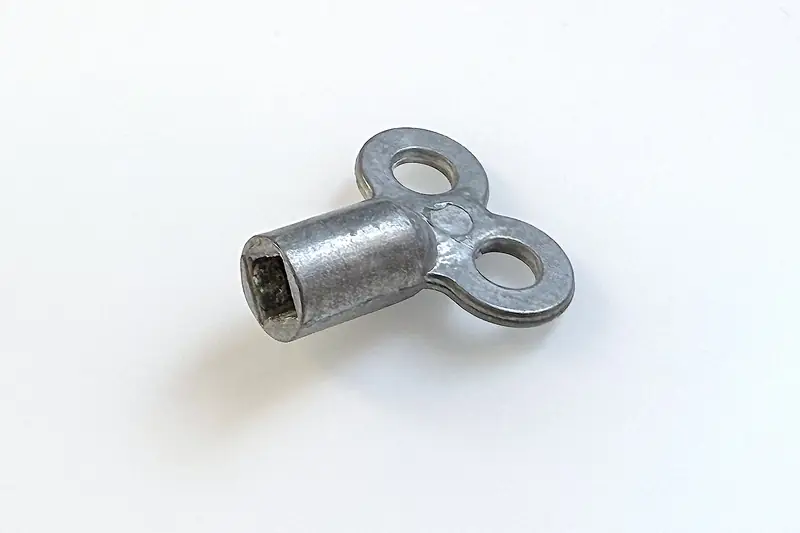
- On hot water: bleed the radiator with the system off and cooled. Vaillant says to wait about an hour (two to be safe), turn the bleed screw a quarter to half a turn with a radiator key over a rag and small container, and close it when water comes out. In a house with radiators upstairs and down, Vaillant begins at the lowest floor.
- After bleeding, look at the boiler gauge. About 12 psi cold is typical; if pressure is low, call a technician rather than adding water.
- Keep furniture and drapes off the front of the radiator.
Full bleeding steps are in the bleeding radiators article, and steam radiators are never bled: the vent does that job. If you are unsure at any step, call a licensed heating technician.
Cold radiator numbers
- 12 psitypical cold fill pressure on a home hot-water systemNavien NCB-E manual, 2019
- 1 to 2 hourswait after switching the heating off before bleedingVaillant bleeding advice
- 2times a season DOE suggests clearing air from hot-water radiatorsDOE Energy Saver booklet, 2022
- 15 inminimum distance of a main vent back from the end-of-main fittingDOE steam study, 2013
When does a cold radiator need a technician?
Call a heating technician when your checks don't bring the heat back, or when the fix involves water, pressure or replacing a part. That includes a gauge that reads low after bleeding, radiators that need bleeding again and again, a steam vent or trap that has failed, a whole main that stays cold, and a radiator that needs re-pitching. Weil-McLain's steam manual lists "clogged piping, valves or radiator" and closed radiator valves among the causes, each a technician fix.
On hot-water systems, uneven heat between radiators is sometimes a balancing job: a technician sets flow so near radiators don't take all the water. PlumbingSupplyAndMore's flow-control valves (run by Wet Return's owners) show the kind of part a technician fits for that work. On steam, balancing is done with main vents and sized radiator vents instead, and the steam radiator air vents article explains how.
Proof stamp: where these figures come from
Based on Weil-McLain's gas boiler user manual (2025) and SGO steam boiler manual (2025), Hoffman's steam heating technical manual TES-375A (2013), the DOE Building America steam balancing study (2013), DOE's Energy Saver booklet (2022), Navien's NCB-E installation manual (2019) and Vaillant's bleeding advice page, all read October 2026. Vaillant's UK pressure figures in bar were left out in favor of US psi figures. Left out: any step that adds water, adjusts pressure controls or replaces vents and traps, and numeric radiator slopes, which no maker source gives.
Questions from the boiler room
Why is only the top floor cold?
On hot water, check the upstairs radiators for trapped air; Vaillant's order is to bleed the lowest floor first and then work upward. On steam, upper radiators sit at the end of long risers and depend on good main and radiator venting. If bleeding or vent checks don't help, a technician should look at the system.
Why is the radiator farthest from the boiler always last to heat?
On steam, the radiators closest to the boiler vent and fill first. The DOE steam study describes balancing with main vents and sized radiator vents so the far ones keep up.
Can a thermostatic radiator valve make a radiator cold?
Yes, if it is set low. The DOE steam study notes that on one-pipe steam these valves can only stop a radiator from overheating; they cannot draw more heat to it.
Is a cold radiator after bleeding a bad sign?
It can be. If the gauge reads low after bleeding, the system may need water, which is a technician's job. Repeated bleeding also points to an underlying problem, according to Vaillant.
Why does a steam radiator get warm on one end only?
Steam enters at the valve end and pushes air toward the vent. If the vent is slow or plugged, the far end stays cool. A technician can replace or resize the vent.
Should a radiator valve be used to turn down the heat?
Not on one-pipe steam: the valve must be fully open or fully closed. On hot water, a valve can be closed to shut a radiator off, but balancing is better left to a technician.
Does one cold radiator mean the boiler is too small?
Rarely. If the other radiators heat, the cause is usually local: air, a valve, a vent or a trap. Steam boilers are sized to the total radiation they serve, which the radiator sizing page explains, so a boiler question starts with a radiator count, not one cold room.
Back up the riser: every steam and hot-water page on Wet Return