Tag No. 4 · 3 pages
Radiators in Old Houses
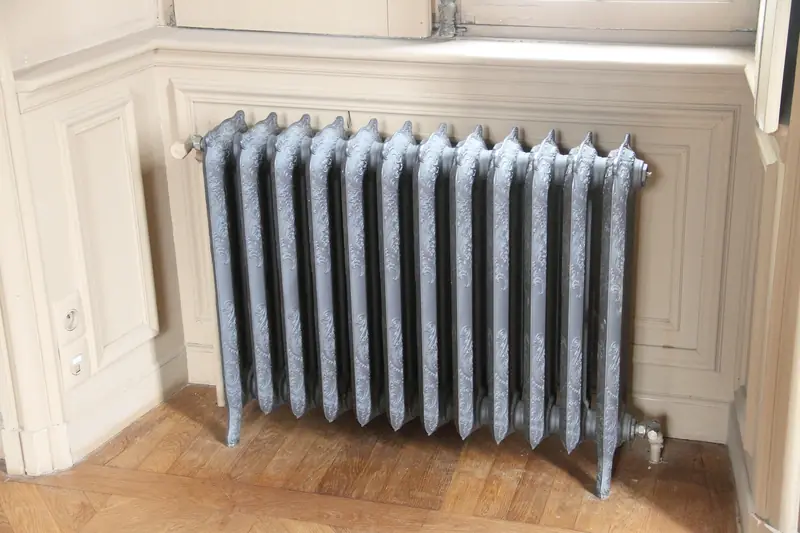
Radiators in old houses work best uncovered, fully vented and sized in EDR, the square-foot rating that still decides which boiler fits them.
Compiled by the Wet Return bench from makers' manuals and federal pages · how pages are checked · Checked again
On the tag
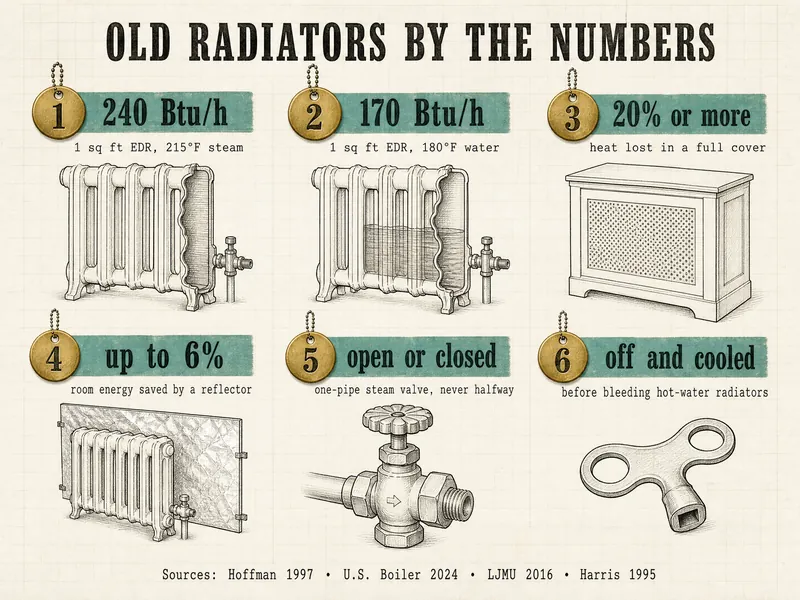
- Each square foot of EDR is rated at 240 Btu/h, the heat it releases full of 215°F steam in 70°F air (Hoffman FHD-205, 1997).
- Fed with hot water instead, that square foot drops to 170 Btu/h when the loop averages 180°F, and to 150 Btu/h at a 170°F average, per U.S. Boiler's emission chart (2024).
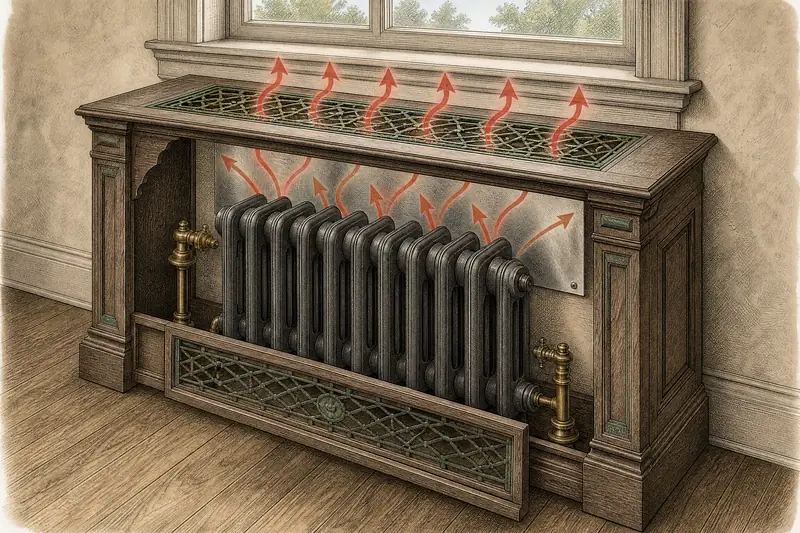
- Boxing a radiator in costs 20% or more of its output, and a timber casing cost up to 40% in one lab test (LJMU study, 2016).
- Leave each one-pipe steam radiator valve all the way open or all the way shut, never in between (DOE steam study, 2013).
- U.S. Boiler tells installers to size a steam boiler to the connected radiation, not a heat-loss figure or the old boiler (U.S. Boiler, 2018).
- DOE's booklet advises getting trapped air out of water-filled radiators once or twice each heating season (Energy Saver booklet, 2022).
What makes radiators in old houses work well?
Old radiators work well when heat can leave them freely and the system can fill them completely. Air has to get out, through the vent on a one-pipe steam radiator or the bleed screw on a hot-water one, and water has to drain or circulate. The DOE's Energy Saver booklet (2022) adds a simple rule: keep radiators clear of furniture, carpeting and drapes.
Cast iron holds heat for a long time, which is why these radiators feel steady once they are warm. The National Park Service's preservation brief on heating historic buildings (1991) favors keeping decorative radiators in the main rooms and reusing radiator systems with new boilers.
Old radiators, measured
- 240 Btu/hone square foot of EDR on 215°F steamHoffman FHD-205, 1997
- 170 Btu/hone square foot of EDR when water averages 180°FU.S. Boiler emission chart (2024)
- 20% or moreoutput lost when a radiator is fully encasedLJMU study citing CIBSE, 2016
- up to 6%room heating energy saved by foil behind a radiator, one chamber testHarris, Applied Energy, 1995
Do radiator covers cost heat?
Yes: a full cover costs a radiator a fifth or more of its heat. The UK engineers' design handbook (CIBSE, as cited by a 2016 Liverpool John Moores University study) puts the loss from encasing at 20% or more and from a shelf at about 10%. The same study measured up to 40% with a traditional timber casing on a hot-water panel radiator. Foil reflectors work the other way, saving up to 6% of a room's heating energy in a 1995 chamber test.
Why does one radiator stay cold?
A single cold radiator usually has air it can't get rid of, a closed or half-closed valve, or, on steam, a vent that has stopped working. On hot water, Weil-McLain's 2025 owner manual blames trapped air first; on steam, Hoffman's 2013 troubleshooting pages point to dirt clogging the radiator's vent. Homeowners may check valves, look at vents and bleed hot-water radiators with the system off and cooled; if unsure, call a licensed heating technician.
How is the size of old radiators measured?
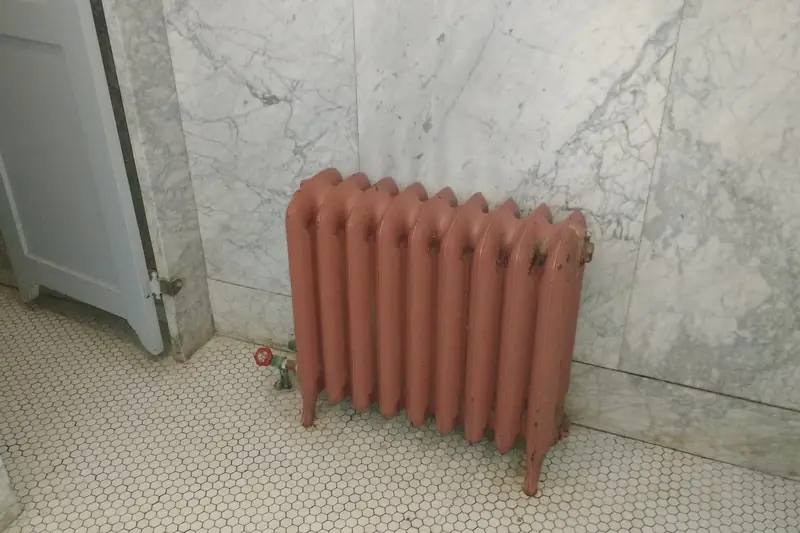
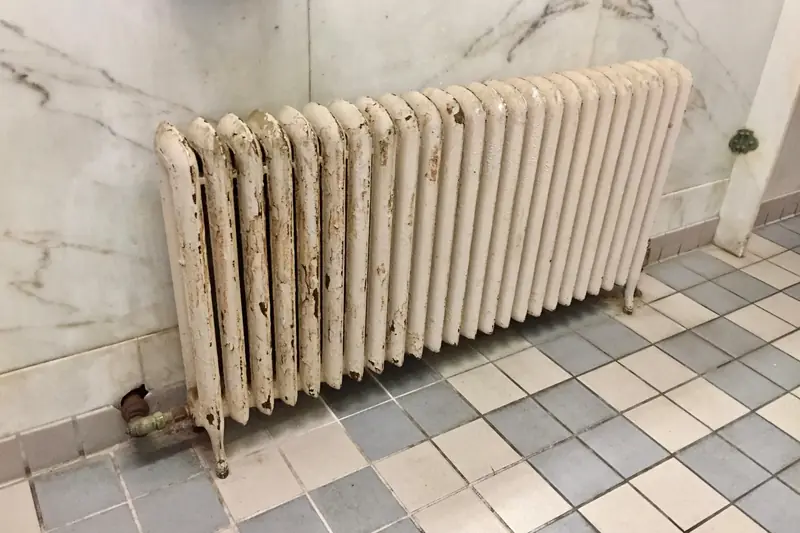
Old radiators are measured in square feet of EDR (equivalent direct radiation), a heat rating rather than a surface you could measure with a tape. U.S. Boiler's sizing page (2017) gives the method: decide whether it is a column or tube radiator, measure its height from the floor, count the columns or tubes in a section, read the per-section rating off a radiation chart, and multiply by the number of sections. Add every radiator and you have the house's connected load.
| Heat source | Temperature | Output per sq ft EDR |
|---|---|---|
| Steam (the EDR definition) | 215°F | 240 Btu/h |
| Hot water, classic design | 180°F average | 170 Btu/h |
| Hot water, cooler loop | 170°F average | 150 Btu/h |
| Hot water, mild weather | 150°F average | 110 Btu/h |
Can old radiators work with a new boiler?
Yes, and the radiators decide how the new boiler is chosen. For steam, U.S. Boiler says to size the boiler to the connected radiation and not to "simply match the old boiler size." A hot-water boiler, by contrast, starts from a heat-loss calculation, and the radiators' EDR shows what water temperature they need on the coldest day. Some condensing boilers are built with old radiators in mind: Weil-McLain's ECO Tec manual (2024) includes a preset for cast-iron radiator systems.
The boilers section covers boiler types and AFUE, and the hot-water heat section explains how the loop carries that water.
How can you tell a steam radiator from a hot-water one?
Count the pipes and look at the top. Single-pipe steam radiators carry one supply pipe plus an air vent; a hot-water radiator has two pipes and a vent at the top, and U.S. Boiler's conversion article (2024) warns that one without a top tube between its sections is a steam-only design. The steam heat section explains vents, traps and pitch.
Proof stamp: where these figures come from
Built from Hoffman steam manuals (FHD-205, 1997; TES-375A, 2013), U.S. Boiler's sizing and replacement pages (2017-2024), a DOE's Energy Saver booklet (2022), a DOE Building America study on balancing steam systems (2013), the National Park Service's Preservation Brief 24 (1991), Weil-McLain manuals (2024-2025) and two lab studies on covers and reflectors (2016, 1995), all read October 2026. The cover and reflector figures come from UK and lab tests on hot-water radiators, not American cast iron. Left out: paint-loss figures and child-safety claims, for which no measured source was found.
Questions from the boiler room
Are old cast-iron radiators worth keeping?
For most houses, yes. They are sized for the house, hold heat well and can run on a new boiler. The National Park Service's preservation brief recommends keeping decorative radiators in major rooms.
Can a steam radiator be used on a hot-water system?
Only if it has connected top sections that let air reach a vent. U.S. Boiler's conversion article says a radiator with no top connection was built for steam only. A technician also changes the valve and deals with any trap.
Why are some radiators much bigger than the room seems to need?
Many old systems were sized generously, and a guest author on U.S. Boiler's blog notes that after the 1918 flu, designers allowed for windows left partly open. U.S. Boiler also says older boilers are often oversized.
Does a bigger radiator heat a room faster?
A bigger radiator gives more heat once it is full, but on steam it also holds more air, so it needs a larger vent. The DOE steam study says big radiators need bigger vents to fill in time.
Should radiators in old houses be painted?
No source read for this site measured how paint changes cast-iron output, so Wet Return gives no figure. Keep vents and bleed screws free of paint, since a painted-over steam vent stops working.
What is a radiator census?
It is a room-by-room list of every radiator with its EDR. The DOE steam study uses one to size vents and to find the total EDR for a boiler replacement.
Back up the riser: the start page for radiator homes