Zone Valves and Circulators
Zone valves open one branch of a hot-water loop when that area's thermostat calls for heat; circulators are the pumps that push the water, and some houses use one circulator per zone instead of valves.
Compiled by the Wet Return bench from makers' manuals and federal pages · how pages are checked · Checked again
Who owns what: Wet Return is run by the same people who own PlumbingSupplyAndMore, Central Plumbing & HVAC, SoftPro Water Systems and Quality Water Treatment, the businesses linked on this page. The text is written from boiler and vent makers' manuals and federal pages read in October 2026; what a business says about its own products is that business's claim. How these links are handled
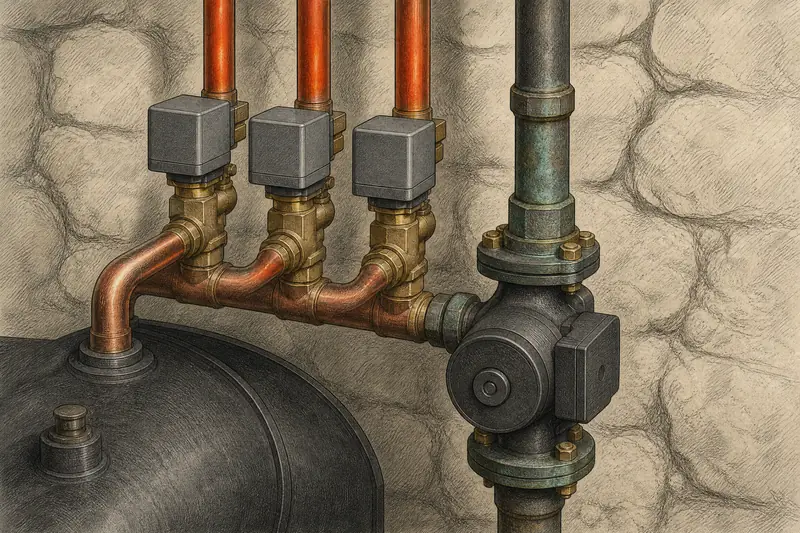
On the tag
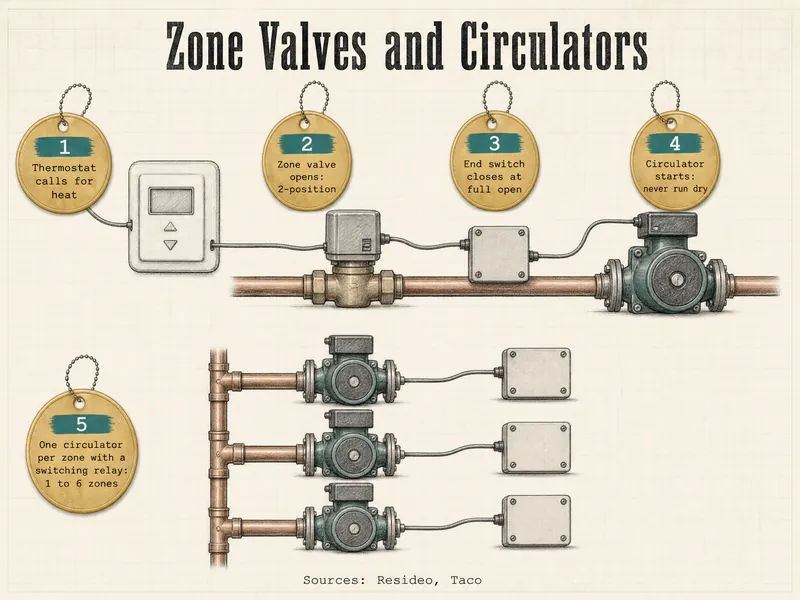
- Resideo's V8043 is a 2-position, motor-driven zone valve; normally closed models spring shut when power drops (Resideo installation instructions, 2019).
- At the end of its opening stroke, the valve's end switch starts the circulator or boiler, per the same Resideo document.
- Opened by its manual lever, a Resideo zone valve does not energize its end switch, so it will not call the boiler.
- Water lubricates a circulator's bearings, so Taco warns it must never run dry (instruction sheet 102-054, 2015).
- Taco's switching relays run one circulator per zone, in models for 1 to 6 zones (catalog 100-88, 2020).
- Resideo says its zone valves should be serviced by a trained, experienced service technician.
What do zone valves and circulators do?
Zone valves and circulators let one boiler heat different parts of the house at different times. The circulator is the pump that moves water around the loop; a zone valve is a motorized gate on one branch of that loop, opened by its own thermostat. Together they mean the bedrooms can stay cool while the living room heats, without a second boiler.
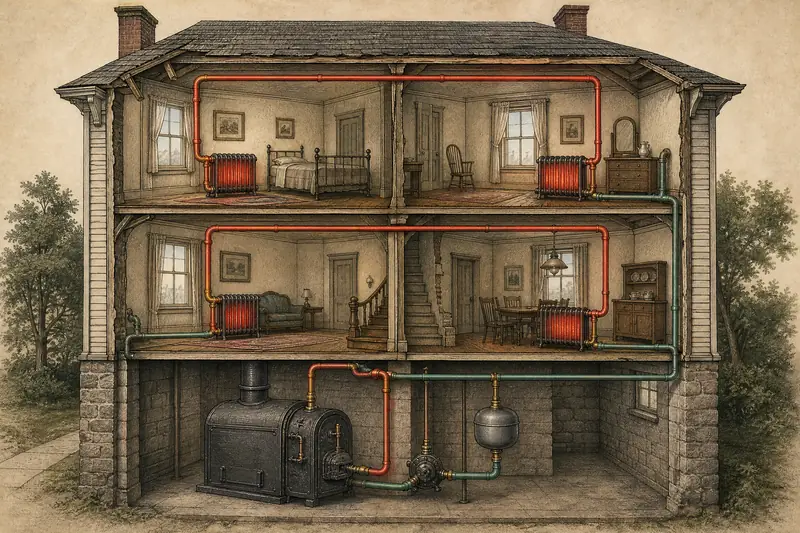
There are two common layouts. In one, a single circulator serves the whole house and each zone has a valve. In the other, every zone has its own small circulator and no zone valve, and a switching relay turns the right pump on. Either way, each thermostat controls only its own area. The hot-water heat overview shows where these parts sit in the full loop.
How does a zone valve work?
A zone valve is a small electric motor, called a powerhead, sitting on a valve body in the pipe. Resideo's V8043 product data (2020) calls it a valve that gives "2-position, straight-through control of water": it is either open or shut, never halfway. When the thermostat calls, the powerhead opens the valve; on normally closed models, a spring drives it shut again "when the powerhead is de-energized," according to Resideo's installation instructions (2019).
Many zone valves carry an end switch. Resideo's checkout steps say the valve "should open and the auxiliary switch should make the circuit to the circulator or other valve at the end of the opening stroke." In plain terms, the valve tells the boiler and pump to start only once the path for water is open. When the thermostat is satisfied, the valve closes and the circulator stops.
Resideo valves also have a manual opening lever for power failures. The instructions note that the end switch "is not energized when the valve is manually opened," so a valve propped open by hand will not start the boiler, and it returns to automatic once power comes back.
How does a circulator pump move the water?
A circulator is a small electric pump that spins an impeller to push water through the closed loop; it does not lift water up to the radiators so much as keep it moving round. Taco's cartridge circulator sheet (2015) says its bearings "are water lubricated and should not be allowed to operate dry," and "never run the circulator dry or permanent damage will result." Cast-iron circulators are for closed heating loops; bronze or stainless are for fresh or drinking water.
Newer circulators are variable-speed. Taco's 007e instructions (2024) list an indicator light and a troubleshooting table: loud water noise or a building that does not warm can mean the pump is air-bound, and a pump with no light may have lost power or tripped a breaker. The fixes in that table, from purging air to opening the motor, are written for installers.
Zone valves or one circulator per zone: what is the difference?
Both split the house into zones; the difference is whether each zone gets a valve or a pump. With zone valves, one circulator runs whenever any zone calls, and the valves choose where the water goes. With circulator zoning, each zone has its own pump, and a switching relay starts the right one. Taco's zone control catalog (2007) describes it this way: when a thermostat calls for heat, "both the appropriate circulator and red indicating light are energized."
Taco's switching relay catalog (2020) lists relays for 1, 2, 3, 4 and 6 zones, and expandable models that can be linked for larger systems. Zone valve controls do the same wiring job for valves. A technician chooses between them when replacing parts or adding a zone.
| Feature | Zone valves with one circulator | One circulator per zone |
|---|---|---|
| What opens a zone | Motorized valve on that branch | That zone's own pump starts |
| What starts the boiler | Valve end switch at full open | Switching relay on a thermostat call |
| Typical repair part | Powerhead (motor) or valve cartridge | Circulator or its cartridge |
| Power failure | Valve has a manual lever; end switch stays off | Pumps stop with no power |
| Who repairs it | Trained heating technician | Trained heating technician |
What are common zone valve faults?
The usual faults are a powerhead that no longer opens the valve, a leak at the valve stem, and a zone that never calls the boiler. Resideo's service notes list three: "If the valve is leaking, drain the system and check to see if the O-ring needs replacing"; "If the gear train is damaged, replace the entire powerhead assembly"; and "If the motor is burned out, replace the motor." Those steps are written for a trained technician, and draining belongs to that visit.
Resideo's 2020 product data says the motor "can be replaced by removing one screw, without disturbing the valve body or draining the system," which keeps the repair short. Noise is another clue: Resideo says water noise can come from "excessive water velocity," and its valves "are not for use in systems containing dissolved oxygen." When water flow is low across the whole boiler, Weil-McLain's user manual (2025) tells the technician to check all valves to and from the boiler, then confirm the circulator size.
What you can check before calling:
- The zone's thermostat is set above room temperature, in heat mode, with fresh batteries.
- The breaker for the boiler and the boiler's service switch are on.
- Which zones are cold and which are fine, and whether the problem started after a power cut.
If one room in a warm zone is cold, the cause is more likely air or a closed radiator valve; see bleeding a radiator and cold radiators. If unsure, call a licensed heating technician.
Zoning figures
- 2-positionZone valve action: fully open or fully closedResideo V8043 product data, 2020
- 1-6 zonesRange of Taco switching relay modelsTaco catalog 100-88, 2020
- 1 screwHolds a Resideo powerhead motor in placeResideo V8043 product data, 2020
- 5,000 ftElevation above which Taco wants at least 20 psi fillTaco instruction sheet 102-054, 2015
Which zone work belongs to a technician?
Everything inside the valve, the pump and the wiring belongs to a technician: replacing a powerhead or motor, swapping an O-ring, changing or resizing a circulator, rewiring a relay, and draining or refilling a zone. Resideo states the valve "should be serviced by a trained, experienced service technician," and warns that on 24-volt systems the valve coil terminals must never be jumpered, "even temporarily," because it can burn out the thermostat's heat anticipator.
The homeowner's part is the thermostat, the breaker and service switch, and a clear description of the symptom. Note whether a manual lever on a zone valve has been left in the open position, and tell the technician rather than moving it. PlumbingSupplyAndMore's zone valves (run by Wet Return's owners) category shows the kind of part a technician fits, if you want to see what a replacement powerhead or valve looks like. Adding a new zone also means re-checking the expansion tank and the pressure gauge readings.
Proof stamp: where these figures come from
Written from Resideo's V8043 product data 60-2133 (2020) and installation instructions 95-6983EF (2019), Taco's cartridge circulator sheet 102-054 (2015), its 007e instructions 102-563 (2024), its zone control catalog 100-5.0 (2007) and switching relay catalog 100-88 (2020), plus the troubleshooting table in Weil-McLain's 2025 owner's manual. Each was opened and read in October 2026. Left out: wiring diagrams, removal and draining steps, and brand-by-brand fault codes, all of which are technician material.
Questions from the boiler room
Why is one zone cold while the others are warm?
Start with that zone's thermostat setting and batteries. If those are fine, the zone valve's powerhead or the zone's own circulator is a common suspect, and Resideo's service notes send both to a trained technician.
Why does the boiler fire but the house stays cold?
Taco's 007e troubleshooting table lists an air-bound system as one cause of a building that does not warm. A technician purges the air; a homeowner can bleed radiators with the system off and cooled.
Can a zone valve stick open?
A valve left in its manual open position stays open until power returns, per Resideo. Other open-position faults need a technician to look at the powerhead and valve body.
Does a zone valve make a humming sound?
The powerhead motor runs while the valve opens. Resideo says its valves are designed for silent operation, and water noise points to excessive water velocity, which is a piping matter for a technician.
What happens to zone valves in a power cut?
Normally closed valves spring shut and the circulators stop. Resideo's manual lever can hold a valve open, but its end switch stays off, so the boiler will not start from it.
Do zone valves work on steam systems?
Resideo's product data says the V4043 and V8043 family includes valves for steam as well as hot or cold water, but the right model depends on the system. This page covers hot-water loops only.
How many zones can a house have?
There is no fixed number. Taco's switching relays come in 1- to 6-zone models, and its expandable relays link together for more.
Back up the riser: every steam and hot-water page on Wet Return