Boiler Expansion Tanks
A boiler expansion tank gives heated water room to grow: it takes in water as the loop warms and pushes it back as it cools, keeping pressure below the 30 psi relief valve.
Compiled by the Wet Return bench from makers' manuals and federal pages · how pages are checked · Checked again
Who owns what: Wet Return is run by the same people who own PlumbingSupplyAndMore, Central Plumbing & HVAC, SoftPro Water Systems and Quality Water Treatment, the businesses linked on this page. The text is written from boiler and vent makers' manuals and federal pages read in October 2026; what a business says about its own products is that business's claim. How these links are handled
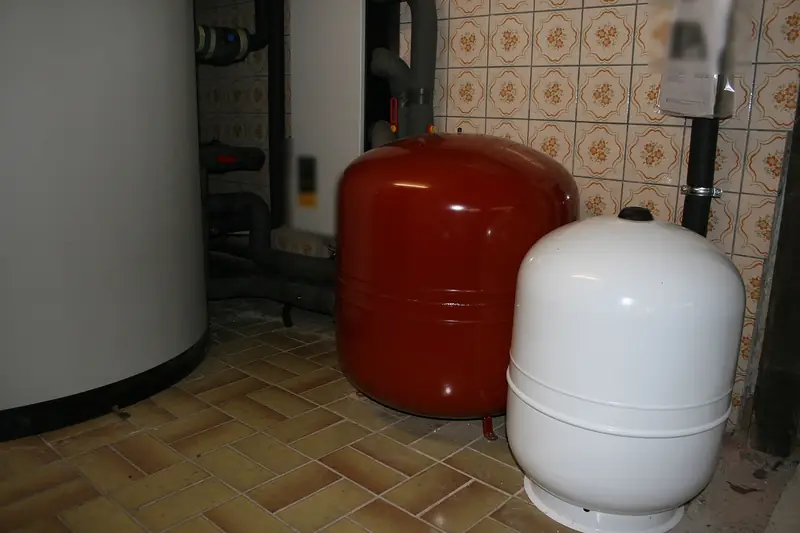
On the tag
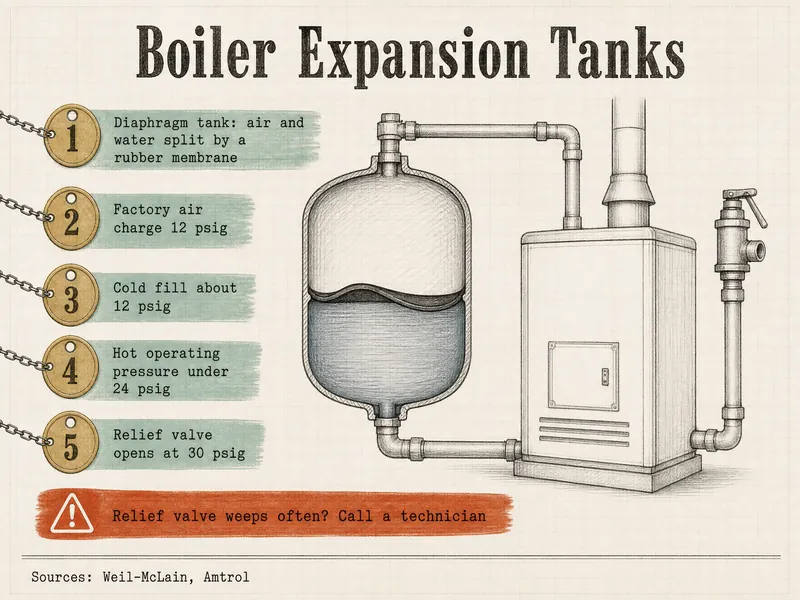
- Amtrol says its tanks accept expanded water as system temperature rises and return it as temperature drops (Amtrol Extrol page, read October 2026).
- Weil-McLain sizes for about 12 psig cold, a 30 psig relief valve, and under 24 psig when hot (ECO Tec manual, 2024).
- A relief valve that weeps often is the classic sign of a waterlogged or undersized tank (Weil-McLain CGa manual, 2019).
- Amtrol's factory air charge is 12 psig unless the tank label says otherwise (Extrol AX instructions, 2019).
- Amtrol says only a licensed professional should install, inspect, service or re-pressurize a tank, and a corroded tank is replaced, not recharged (2025).
- Amtrol's sizing table assumes 15 psig fill, a 30 psig relief valve and 120°F average water (Extrol Pro instructions, 2025).
What does a boiler expansion tank do?
A boiler expansion tank holds the extra volume water takes up when it is heated, so pressure in a sealed loop rises only a little. Amtrol's Extrol product page puts it plainly: the tank "accepts expanded water as system temperature rises and returns it to the system as the temperature drops." Without that cushion, heated water in a closed loop has nowhere to go but out of the relief valve.
Weil-McLain's ECO Tec manual (2024) gives the numbers the tank is meant to hold: about 12 psig when the system is filled and cold, and no more than 24 psig after the water has heated, "to avoid weeping of relief valve," which is set for 30 psig. The tank's job is to keep the gauge inside that window. The boiler pressure gauge page explains how to read it.
The Caleffi video on this page answers the questions people most often ask about these tanks, from a hydronics maker's point of view.
How does a diaphragm expansion tank work?
A diaphragm tank is a steel shell split inside by a rubber membrane, with a cushion of pressurized air on one side and system water on the other. Weil-McLain's CGa boiler manual (2019) describes it as "welded gas tight with a rubber membrane to separate the tank pressurizing air and the water," and notes it may sit anywhere in the system but is most often near the boiler. As the water warms, it pushes into the tank and squeezes the air; as it cools, the air pushes it back out.
Because the air is sealed away from the water, it cannot dissolve into the loop, so the cushion lasts. Amtrol's Extrol AX instructions (2019) say tanks leave the factory with a 12 psig air charge unless the label says otherwise. Amtrol's Extrol Pro instructions (2025) tell the installer to match that charge to the boiler's fill pressure with the tank empty of water, and to mount the tank on the supply side of the boiler, on the suction side of the circulator, never on a dead-end pipe.
What about the old steel tank in the rafters?
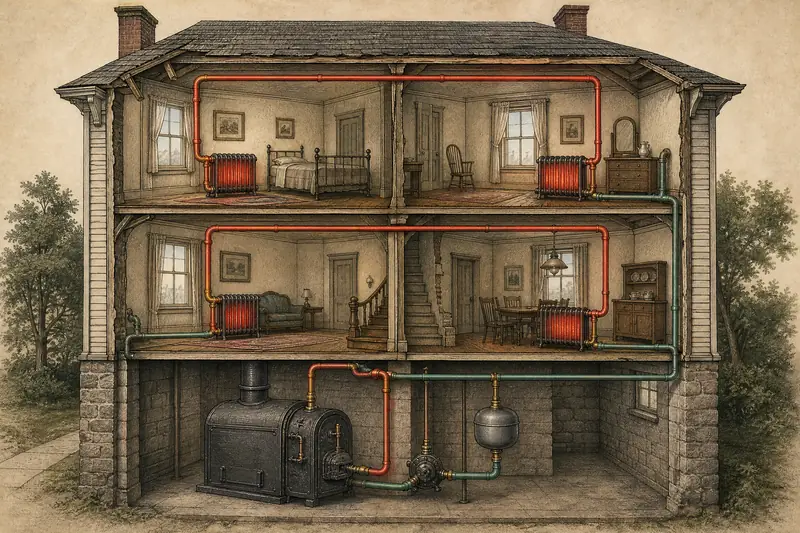
Many older hot-water houses have a plain steel tank hung overhead near the boiler, with no membrane inside. Weil-McLain calls this a closed-type tank: air and water share the same space, and the air at the top is the cushion. Over time, air dissolves into the water and the tank slowly fills, or "waterlogs."
The CGa manual adds a rule that matters for these houses: "Do not use automatic air vents in systems with closed-type tanks. The air will escape from the system instead of returning to the tank. Eventually, the tank will waterlog and no longer control pressurization. The boiler relief valve will weep frequently." So if someone fits an automatic vent to an old system, the tank can stop working. Restoring the air in a closed tank, or replacing it with a diaphragm tank, is a heating technician's job. Air trapped at the top of radiators is a different problem, handled by bleeding a radiator.
What are the signs of a failed boiler expansion tank?
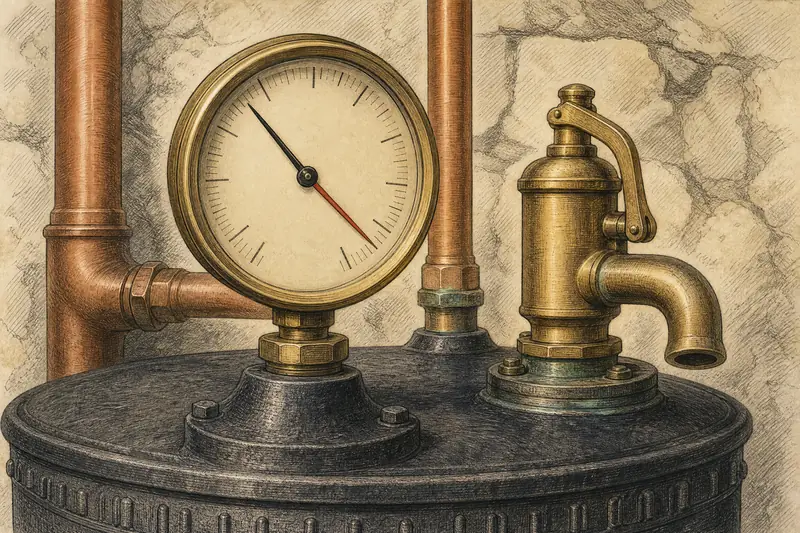
The main sign is pressure that climbs too high when the boiler is running, often with a relief valve that drips or weeps. Weil-McLain's CGa manual says: "If relief valve has tended to weep frequently, the expansion tank may be waterlogged or undersized." Its 2025 user manual lists "frequent release of water through relief valve" with two causes, a tank sized too small and a flooded tank, and the same remedy for both: call a qualified service technician.
Things a homeowner can notice without touching anything:
- The gauge rises well past its usual hot reading, toward 30 psi, on each heating cycle.
- Water drips from the relief valve's discharge pipe, or there is a wet patch below it.
Amtrol's Extrol Pro sheet says that "if the relief valve drips, the tank may be improperly charged or undersized." Any of these signs means calling a technician. Do not cap, plug or tighten the relief valve discharge; it is the boiler's last line of protection. If unsure, call a licensed heating technician.
Expansion tank figures
- 12 psigTypical factory air chargeAmtrol Extrol AX instructions, 2019
- 24 psigHighest operating pressure before relief valves weepWeil-McLain ECO Tec manual, 2024
- 30 psigResidential boiler relief valve settingWeil-McLain ECO Tec manual, 2024
- 3 yearsLongest gap between licensed relief valve inspectionsAmtrol Extrol Pro instructions, 2025
- 120°FAverage water temperature behind Amtrol's sizing tableAmtrol Extrol Pro instructions, 2025
How is a boiler expansion tank checked?
A technician checks that the tank's air charge matches the system's fill pressure, at room temperature, as part of the yearly start-up. Weil-McLain's annual schedule lists the expansion tank alongside cold fill and operating pressures and the relief valve; the annual boiler service page covers the rest of that visit. Its CGa manual says that if a diaphragm tank "won't hold pressure, membrane has been damaged. Replace tank."
Amtrol is firm about who does this. Its 2025 instructions say "a licensed professional must install and periodically inspect and service the Product," that the charge should not be adjusted "except during installation or regular inspection," and that a corroded or damaged tank is replaced rather than recharged. Amtrol also warns that tanks under pressure "may over time corrode, weaken and burst or explode." That is why this site does not describe charging a tank: leave the air valve on the tank alone.
PlumbingSupplyAndMore's hydronic expansion tanks (run by Wet Return's owners) show the kind of part a technician fits, if you want to see what the shapes and sizes look like before a service visit.
How is a boiler expansion tank sized?
A technician sizes the tank from the system's water volume, its fill pressure, its relief valve setting and its average water temperature, using the maker's table. Amtrol's Extrol Pro table is "based on: 15 PSIG fill; 30 PSIG relief valve; 120° F average temperature," so a system with different numbers needs a different tank. Weil-McLain's typical sizing aims for about 12 psig cold.
Weil-McLain describes old gravity systems as large-volume systems, and more water means more expansion for the tank to absorb. Height matters too: Taco's cartridge circulator sheet (2015) says installations above 5,000 feet need at least 20 psi fill pressure, with the tank charge matched to it, and that a larger tank may be required. This site gives no gallons-per-Btu rule, because the makers' tables do the work.
| Tank type | Where air sits | Usual location | Main failure | Who fixes it |
|---|---|---|---|---|
| Diaphragm or bladder | Behind a rubber membrane | Near the boiler, on the circulator's suction side | Membrane fails or charge is lost | Technician replaces the tank |
| Closed steel (no membrane) | In direct contact with the water | Overhead near the boiler | Waterlogs as air dissolves | Technician restores air or swaps the tank |
| Undersized tank of either type | Either | Either | Relief valve weeps on each heat cycle | Technician resizes from the maker's table |
Proof stamp: where these figures come from
Written from Amtrol's Extrol product page and Extrol Pro instructions (2025), Amtrol's Extrol AX instructions (2019, read on Amtrol's document host), three Weil-McLain documents (the 2019 CGa manual, the 2025 owner's manual and the 2024 ECO Tec manual), and Taco's cartridge circulator sheet (2015), all read October 2026. Left out: any steps for checking or charging a tank, gallons-per-Btu sizing rules, and service-life figures, which no maker states.
More on hot-water heat
Questions from the boiler room
Can a boiler expansion tank be on the floor instead of hanging?
Yes. Weil-McLain says a diaphragm tank may sit at any point in the system, and Amtrol's rule is about the pipe it joins: the supply side of the boiler, on the suction side of the circulator, never a dead end.
What pressure should the tank's air charge be?
It should match the boiler's fill pressure, which Amtrol's instructions say is checked with the tank empty of water. Amtrol ships Extrol AX tanks at 12 psig unless the label says otherwise; a technician confirms it.
Why would a relief valve drip right after a new tank goes in?
Amtrol's Extrol Pro sheet says a dripping relief valve after installation can mean the tank is improperly charged or undersized. The installer should come back and check both.
Does an expansion tank make noise when it fails?
The makers list no noise as a sign. The signs they name are a weeping relief valve and pressure that climbs on heating cycles.
Can a waterlogged steel tank be fixed?
A closed-type steel tank can have its air cushion restored by a technician, or be replaced with a diaphragm tank. Weil-McLain warns not to fit automatic air vents on such systems, or the tank waterlogs again.
Do I need a bigger tank with a new boiler?
Possibly. The tank is sized from the whole system's water volume and temperatures, so a technician re-checks it against the maker's table whenever the boiler or radiators change.
Back up the riser: the start page for radiator homes