Replacing an Old Boiler
Replacing an old boiler starts with the radiators, not the old nameplate: steam boilers are sized to connected radiation, hot-water boilers to the house's heat loss, and the chimney gets rechecked.
Compiled by the Wet Return bench from makers' manuals and federal pages · how pages are checked · Checked again
Who owns what: Wet Return is run by the same people who own PlumbingSupplyAndMore, Central Plumbing & HVAC, SoftPro Water Systems and Quality Water Treatment, the businesses linked on this page. The text is written from boiler and vent makers' manuals and federal pages read in October 2026; what a business says about its own products is that business's claim. How these links are handled
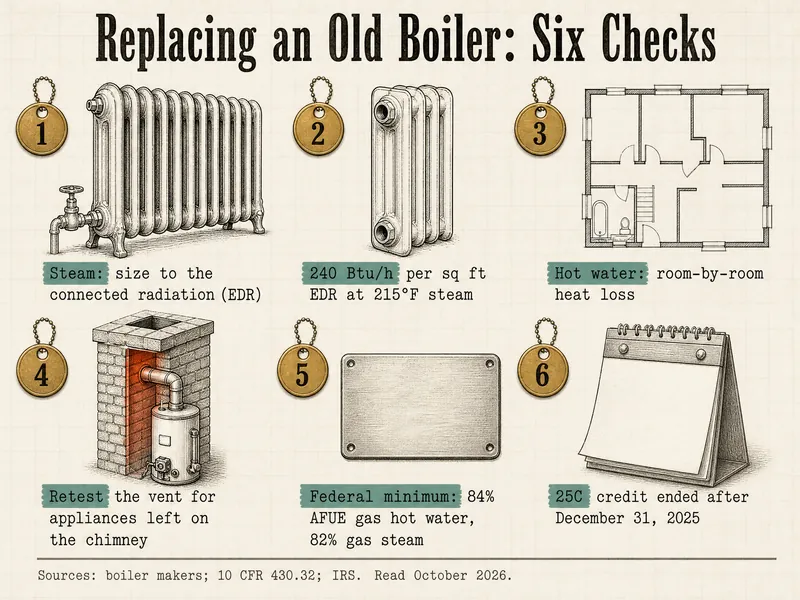
On the tag
- U.S. Boiler says a new steam boiler follows the radiators it feeds (their EDR total), never a heat-loss figure or the old boiler's size (Tips for a Successful Steam Boiler Replacement).
- Each square foot of EDR stands for 240 Btu/h of output with 215°F steam inside (Hoffman, 1997).
- Weil-McLain's 2025 net ratings carry a factor of 1.333 for steam piping and pick-up and 1.15 for water.
- New gas boilers must reach 84% AFUE (hot water) or 82% (steam) under 10 CFR 430.32(e), eCFR read October 2026.
- No 25C credit for a boiler put into service once 2025 ended, according to the IRS's FAQ on Public Law 119-21 (read October 2026).
- When an old boiler leaves a shared chimney, the installer must retest every appliance still vented into it (Weil-McLain, NFPA 54).
When should you replace an old boiler?
Replace an old boiler when it leaks, keeps needing makeup water, or fails in ways a technician says are not worth repairing; age alone is not a rule in any maker's manual. Weil-McLain's 2025 gas boiler user manual explains why leaks matter: continual fresh makeup water brings in minerals that build up, overheat cast iron and cause section failure.
The same manual's troubleshooting table lists black water, a sign of oxygen corrosion from leaks, and popping or percolating noises from mineral deposits, both as calls for a qualified technician.
Efficiency is the other reason. Boilers made before September 1, 2012 only had to reach 80% AFUE, or 75% for gas steam, under 10 CFR 430.32(e). Today's floor is 84% for gas hot water and 82% for gas steam, and U.S. Boiler notes that older boilers are often oversized for the homes they serve. The boiler types and AFUE page compares the classes.
How should a replacement boiler be sized?
A replacement boiler should be sized from the house, not copied from the old boiler: steam from the total radiation it feeds, hot water from the heat each room loses. U.S. Boiler's steam replacement tips are blunt about steam: skip the heat-loss math and do not just match the old nameplate.
For steam, the contractor measures every radiator, looks up its square feet of EDR (equivalent direct radiation) and totals them. By the standard definition in Hoffman's two-pipe steam reference (1997), a square foot of EDR puts out 240 Btu/h with 215°F steam inside. U.S. Boiler adds that bare steam mains count as radiation too, which raises the total. Measuring radiators is covered on radiator sizing and EDR.
The maker's net rating then covers the piping. In its EG Series 7 manual (2025), Weil-McLain builds a factor of 1.333 into steam ratings and 1.15 into water ratings, adding more only where piping is unusual. U.S. Boiler's steam sizing page adds: do not install a larger boiler than the system requires.
| System | Sized by | Built-in allowance | Source |
|---|---|---|---|
| One-pipe or two-pipe steam | Total connected radiation (sq ft EDR) plus uninsulated mains | Factor 1.333 | U.S. Boiler, 2017-2018; Weil-McLain, 2025 |
| Hot water with radiators | Room-by-room heat loss (Manual J), then radiator EDR to set water temperature | Factor 1.15 | U.S. Boiler, 2019 and 2024; Weil-McLain, 2025 |
| Combi (hot water plus taps) | Heat loss for heating; simultaneous hot-water flow for taps | Per maker | Navien, 2019 |
For hot water, the radiators still matter after the heat loss is known. U.S. Boiler's 2024 blog post on steam-to-water conversion describes a connected load survey of the radiators, then a hot-water EDR chart to find the supply temperature needed: about 150 Btu/h per sq ft at 170°F average water and 170 at 180°F. That number decides whether a condensing boiler can run cool enough to condense.
Should a steam boiler be replaced with another steam boiler?
In most steam houses, yes: the simplest replacement for a steam boiler is a new steam boiler, keeping the radiators and piping. The National Park Service's Preservation Brief 24 (1991) recommends retaining or upgrading existing systems where possible, including reusing radiator systems with new boilers.
A steam-to-hot-water conversion is possible but is a different job. U.S. Boiler's conversion post (2024) lists what each radiator needs, an air vent, a hot-water radiator valve and removal or gutting of the steam trap on two-pipe systems, and says old return piping below the water line should be replaced. One-pipe steam radiators may also lack the top connection that hot water needs.
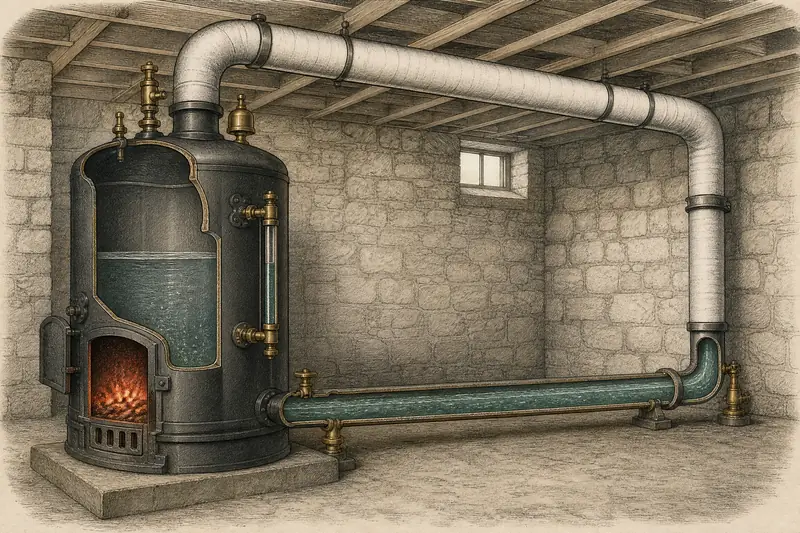
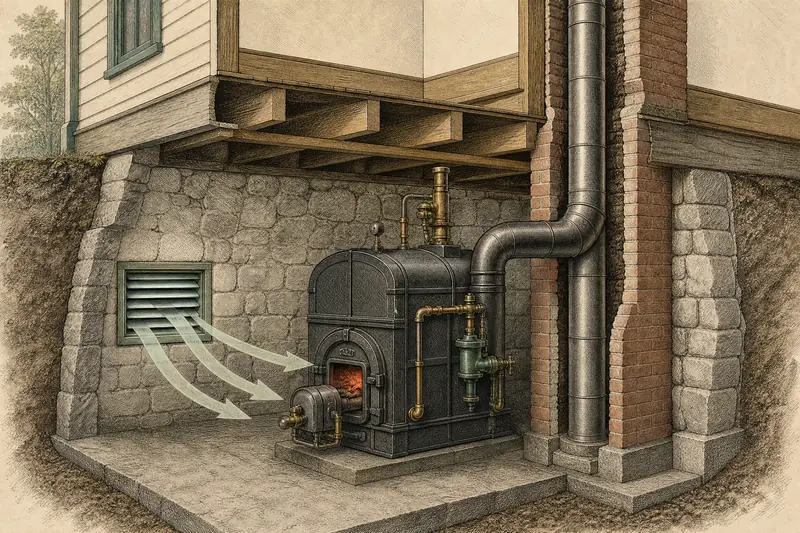
A new steam boiler has its own rules. Makers ask for roughly 18 to 28 inches from the boiler water line up to the lowest steam main (U.S. Boiler's figure is 28 inches), and Peerless lists dry returns wetted by a new water line higher than the old one as a cause of water hammer after a swap. A new steam boiler also has to be skimmed to remove oil. These are checks for a heating technician who works on steam. The drawing at the top shows a wet return, which how steam heat works describes.
What changes with venting and the chimney?
Venting usually changes more than the boiler room expects. Weil-McLain's CGa boiler manual (2019) requires that, when an existing boiler is removed, each appliance left on the common vent be checked for size, pitch, blockage, leakage and corrosion, with problems corrected under NFPA 54, the National Fuel Gas Code.
The usual case is a gas water heater left alone in a big masonry flue after a new boiler vents out through a wall. The same manual says a lined chimney is the preferred choice and a code requirement in many places, and warns that cold outside chimneys can collect condensation that damages masonry. The chimney liner page covers liners and combustion air.
Weil-McLain's manual also warns that skipping these steps can cause flue gas spillage and carbon monoxide. Its user manual requires the installer to confirm a CO alarm in the living space before start-up. NFPA's 2026 placement goes further: a CO alarm in each bedroom, one outside every separate sleeping area, and one on each level, the basement among them. An alarm means everyone out to fresh air, then a 911 call. A gas smell means leaving with no switches, phones or flames used inside, then phoning 911 or the gas utility once outdoors.
Are boiler tax credits or rebates available in 2026?
No federal tax credit covers a boiler installed in 2026. The IRS's FAQ on the 2025 law (Public Law 119-21, read October 2026) says the 25C Energy Efficient Home Improvement Credit is unavailable for anything put in service once December 31, 2025 had passed.
For history only: for boilers installed in 2023 through 2025, the IRS 25C page (read October 2026) allowed up to $600 for a gas, propane or oil hot-water boiler meeting the top CEE efficiency tier. Steam boilers were not named. The separate 25D credit covered solar, wind, geothermal, fuel cells and batteries, never fuel-burning boilers, and it has ended too.
The Home Energy Rebates are different: they are run by states. The DOE's Home Energy Rebates page (read October 2026) says they are available in select states and tells readers to contact their state energy office. HEEHR pays for electric heating and cooling, such as heat pumps, not gas or oil boilers. HOMES pays by modeled whole-home savings of at least 20%, with heating equipment among its pathways.
Replacement numbers
- 240 Btu/hHeat from 1 sq ft of EDR filled with 215°F steamHoffman FHD-205, 1997
- 1.333Factor in net steam ratings that covers piping and warm-up loadWeil-McLain EG Series 7 manual, 2025
- $0Federal 25C credit for a boiler installed in 2026IRS, read October 2026
- 20%Minimum modeled energy savings for a HOMES rebateDOE, read October 2026
What should a boiler replacement quote include?
A boiler replacement quote should show how the new boiler was sized, what venting work is included, and what happens to the old boiler and any appliance left on the chimney. Ask for these lines in writing:
- Sizing method: the radiator EDR total (steam) or the room-by-room heat loss (hot water), with the figure written down.
- The boiler: make, model, AFUE and net rating.
- Venting: chimney inspection, any liner, and the common-vent retest for a water heater left behind.
- Near-boiler piping: for steam, the water-line height, Hartford loop and skimming; for hot water, circulator, expansion tank and air removal.
- Safety items: a new relief valve, a low-water cutoff on steam, and confirmation of CO alarms.
- Codes and permits: who arranges any permit and inspection your town requires.
Domestic hot water often changes at the same time, through a combi or a boiler-fed tank. Hard water can scale the domestic side of either; a salt-free SoftPro conditioner (Quality Water Treatment, run by Wet Return's owners) is one option some owners use on the domestic side, but check the boiler or water-heater maker's water requirements first: Weil-McLain's ECO Tec manual, for example, calls for a softener above 50 ppm hardness, and a salt-free conditioner is not a softener. Central Plumbing & HVAC, a company in Bucks and Montgomery counties, Pennsylvania, with the same owners, lists on its heating page (Central Plumbing & HVAC, run by Wet Return's owners) the heating work a full-service shop handles; elsewhere, look for a licensed local contractor offering the same.
Proof stamp: where these figures come from
This page is based on U.S. Boiler's steam replacement, steam sizing, "what size boiler" and steam-to-water conversion pages (2017-2024), Weil-McLain's CGa (2019), EG Series 7 (2025) and gas boiler user (2025) manuals, Hoffman's two-pipe steam reference FHD-205 (1997), the Peerless 211A steam manual (2025), NPS Preservation Brief 24 (1991), 10 CFR 430.32 (eCFR), the IRS FAQ on Public Law 119-21 and the IRS 25C page, and the DOE Home Energy Rebates page, all read October 2026. Left out: installed prices, boiler life spans in years, and any state's rebate status, which no source read here confirmed.
Questions from the boiler room
Can a new boiler be smaller than the old one?
Often, yes. U.S. Boiler says older boilers are commonly oversized for the homes they serve, and that steam boilers follow the radiators they serve. The radiator survey, not the old nameplate, sets the size.
Do I need to insulate steam mains before replacing the boiler?
U.S. Boiler says steam boilers should never operate without main pipe insulation, and that an uninsulated main counts as radiation that must be added to the boiler size. Insulating first can mean a smaller boiler.
Will a new steam boiler make the pipes bang?
It can if the near-boiler piping or water line is wrong. Peerless lists dry returns wetted by a new water line higher than the old one among the causes of water hammer after a swap. The installer checks the water-line height against the old one.
Does paying in 2025 save the credit for a 2026 install?
For 25D, the IRS says an installation completed after December 31, 2025 counts as made after that date. For 25C the test is the date the boiler is placed in service. A boiler installed in 2026 does not qualify for either.
Does a HEEHR rebate cover a gas boiler?
No. The DOE describes HEEHR as covering electric heating and cooling upgrades and efficient electric appliances. HOMES pays by modeled whole-house savings and is run by each state, so check with your state energy office.
Why does the water heater need attention when the boiler is replaced?
A water heater that shared the chimney may be left with a flue too big for it alone. Weil-McLain's manual requires the installer to check every remaining appliance on the common vent and correct problems under NFPA 54.
Can radiators stay if the system is converted from steam to hot water?
Many can. U.S. Boiler's 2024 conversion post says each radiator needs an air vent, a hot-water valve and the steam trap dealt with on two-pipe systems, and that old return piping below the water line should be replaced.
Related pages

Back up the riser: radiator heat in old houses, system by system