How Hot-Water Radiators Work
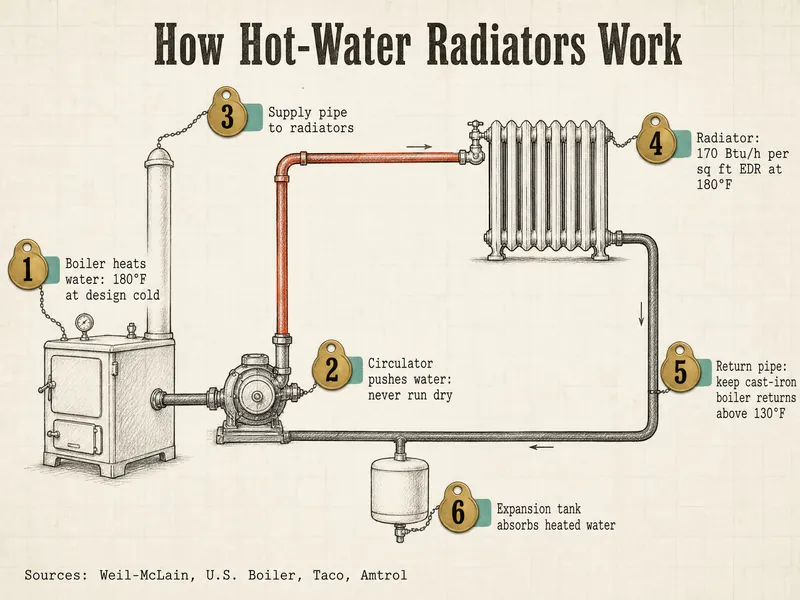
Hot-water radiators work as one sealed loop: a boiler warms water, a circulator pump sends it through supply pipes to each radiator, and the cooler water flows back on a return pipe to be reheated.
Compiled by the Wet Return bench from makers' manuals and federal pages · how pages are checked · Checked again
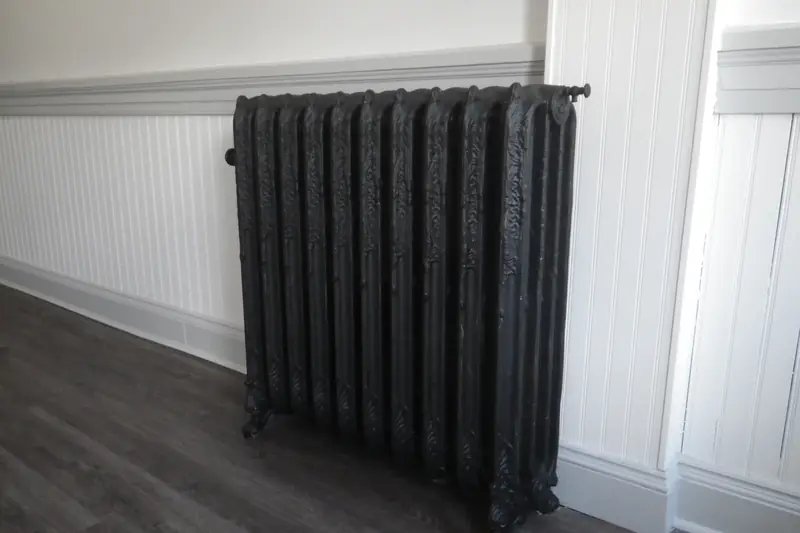
On the tag
- Federal rules define a hot-water boiler as one that operates at or below 160 psig and 250°F (10 CFR 430.2); homes run far below both.
- Weil-McLain's ECO Tec manual (2024) uses 180°F as the typical supply temperature at design maximum heat loss.
- A square foot of radiator (EDR) gives about 170 Btu/h at 180°F average water and 150 Btu/h at 170°F, per U.S. Boiler's data sheet.
- Gravity systems were built to circulate by natural convection; many now have a pump added (Weil-McLain, 2019).
- Non-condensing cast-iron boilers must be protected from return water below 130°F (Weil-McLain CGa manual, 2019).
- Taco says a circulator's bearings are water-lubricated, so it must never run dry.
How do hot-water radiators work?
Hot-water radiators work by passing heated water through cast iron, which then warms the room by radiation and by moving air across its surface. The boiler heats the water, a circulator pump moves it out along the supply pipe, and each radiator hands heat to the room before the cooler water returns to the boiler. The loop is closed, so the water is not used up; it simply goes round again.
The federal definition of a boiler in 10 CFR 430.2 is an appliance "designed to supply low pressure steam or hot water for space heating application." A hot-water boiler stays at or below 160 psig and 250°F under that rule. In a house, the gauge sits around 12 psi cold, as the boiler pressure gauge page explains.
Navien's short explainer video below walks through the same loop on a modern wall-hung boiler. An old cast-iron boiler does the same job with more water and more weight.
What is the difference between gravity and pumped hot-water heat?
A gravity system moves water with no pump at all: hot water is lighter, so it rises up wide pipes to the radiators, and cooler, heavier water sinks back to the boiler. Weil-McLain's CGa boiler manual (2019) describes these as "large-volume systems originally designed for circulation by natural convection rather than a pump." Their big pipes and large radiators hold a lot of water.
Most gravity systems have since had a circulator added. Weil-McLain calls these "converted gravity systems" and warns that their large water volume can send cold water back to a cast-iron boiler on start-up. Its manual says a non-condensing boiler must be protected from return water below 130°F, or the sections and burners can corrode. That protection is piping a technician designs; it is not something to adjust at home.
A pumped system built from the start, often with smaller pipes, relies on the circulator to move water at a set rate. Taco's circulator instruction sheet (2015) notes that cast-iron circulators belong on closed heating loops, while bronze or stainless ones are for fresh or drinking water.
How hot does the water in radiators get?
On the coldest days, classic hot-water systems were designed for about 180°F supply water. Weil-McLain's ECO Tec manual (2024) says the maximum target is set to the temperature needed "at design maximum heat loss", typically 180°F, and its "Cast Iron Radiators" preset pairs that 180°F maximum with a 120°F minimum target.
Boilers with outdoor reset lower the water temperature as the weather warms. DOE's Building America condensing boiler guideline (2014) gives the example of 180°F supply at 5°F outdoors and 120°F at 50°F outdoors. Cooler water means less output per square foot of radiator, which is why radiator size matters.
U.S. Boiler's radiator data sheet (2024) puts numbers on it: one square foot of equivalent direct radiation (EDR) gives about 170 Btu/h at 180°F average water and 150 Btu/h at 170°F, against 240 Btu/h on steam. The radiator sizing and EDR page shows how a radiator is measured.
Water, heat and pressure
- 180°FTypical supply temperature at design coldWeil-McLain ECO Tec manual, 2024
- 120°FSupply at 50°F outdoors in DOE's outdoor-reset exampleU.S. DOE Building America, 2014
- 170 Btu/hOutput per sq ft EDR at 180°F average waterU.S. Boiler radiator data sheet, 2024
- 130°FLowest safe return water for a non-condensing cast-iron boilerWeil-McLain CGa manual, 2019
- 24 psiWeil-McLain's upper pressure reading for a water boilerWeil-McLain user manual, 2025
How can you tell hot-water heat from steam?
Count the pipes and look for a small valve near the top of the radiator. U.S. Boiler's data sheet shows a hot-water radiator with a supply, a return and a vent at the top, a two-pipe steam radiator with a supply and a return, and a one-pipe steam radiator with one supply pipe and an air vent on the far end. U.S. Boiler's guest article on converting radiators (2024) adds that a radiator with no connection across its top sections "was designed for steam only."
The boiler is the second clue. Weil-McLain's 2025 user manual lists a pressure/temperature gauge on water boilers and a pressure gauge on steam boilers, with a 24 psig upper reading for water and 15 psig for steam. A steam boiler also has a glass water-level tube on its side. If you find steam parts, the how steam heat works page is the one to read.
| System | Pipes on each radiator | Small fitting on the radiator | Boiler gauge |
|---|---|---|---|
| Hot water | Supply and return | Bleed valve near the top | Pressure and temperature on one dial |
| One-pipe steam | One supply pipe | Air vent on the far end | Pressure gauge plus a sight glass |
| Two-pipe steam | Supply and return | Trap at the bottom outlet, no radiator vent | Pressure gauge plus a sight glass |
What parts keep a hot-water system running?
Six parts do most of the work: the boiler, the circulator, the expansion tank, the radiator bleed valves, the pressure/temperature gauge and the relief valve. Zoned houses add zone valves or one circulator per zone.
- Circulator. It pushes water round the loop. Taco says the bearings are lubricated by the system water and the pump must never run dry.
- Expansion tank. It takes in water as the system heats and returns it as it cools; see boiler expansion tanks.
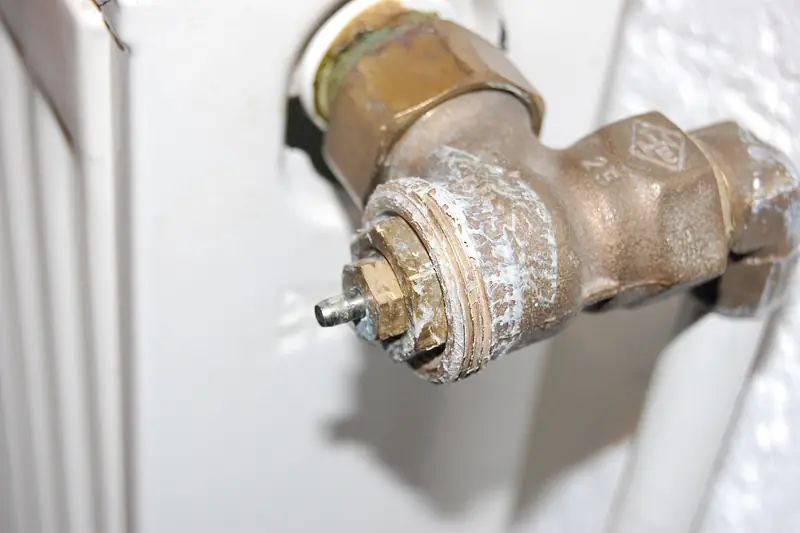
- Bleed valves. Air collects at the top of radiators and is let out with a key; see bleeding a radiator.
- Relief valve. On residential boilers it is set at 30 psi and protects the boiler if pressure climbs too far.
- Zone valves. Each one opens a branch of the loop when its thermostat calls; see zone valves and circulators.
The gauge and the bleed valves are the parts a homeowner deals with. The rest belong to a heating technician at the yearly start-up the makers require. If unsure, call a licensed heating technician.
Why do old hot-water radiators heat evenly?
Hot water reaches every open radiator at once, so rooms warm together instead of in turns. In a steam system, steam can only enter a radiator after the air has vented out, and Xylem's Hoffman steam heating manual TES-375A (2013) explains that the radiators nearest the boiler vent first. A pumped water loop has no such race.
Big cast-iron radiators and large gravity-era pipes also hold a lot of warm water, which keeps giving off heat after the burner stops. With outdoor reset, the boiler runs cooler water for longer in mild weather rather than short hot bursts, as DOE's guideline describes. When one radiator stays cool while others are warm, trapped air is the usual first suspect; the cold radiators page covers the other causes.
Proof stamp: where these figures come from
Written from Weil-McLain's CGa boiler manual (2019), gas boiler user manual (2025) and ECO Tec manual (2024), DOE's Building America condensing boiler guideline (2014), U.S. Boiler's radiator data sheet and its 2024 article on converting radiators, Xylem's Hoffman TES-375A steam manual (2013), Taco's circulator sheet (2015) and the eCFR boiler definition, all read October 2026. Left out: water temperatures for any particular house, output figures for one radiator model, and any piping changes, which belong to a heating technician.
Questions from the boiler room
Is hot water in radiators the same water that comes out of the tap?
No. The heating loop is closed and its water stays in the pipes. Taco notes that cast-iron circulators are only for closed loops, while drinking-water systems need bronze or stainless pumps.
What does outdoor reset do to radiator temperature?
It lowers the supply water temperature as the outdoor temperature rises. DOE's 2014 guideline gives 180°F at 5°F outdoors and 120°F at 50°F outdoors as an example of the curve.
Why does the boiler turn on when only one room is cold?
On a single-zone system, one thermostat runs the whole loop. Zoned houses split the loop so each area calls for heat on its own.
Does a hot-water system need water added every year?
It should not. Weil-McLain says continual fresh makeup water reduces boiler life and points to leaks that a qualified technician should fix.
Are baseboard heaters part of the same kind of system?
Yes, finned baseboard is another hot-water emitter. Weil-McLain cites 180°F as a typical design supply temperature for finned baseboard on new installations.
Can old radiators be switched from steam to hot water?
Only radiators with connections across the top sections can be. U.S. Boiler's 2024 article says a radiator without a top tube was designed for steam only.
Back up the riser: radiator heat in old houses, system by system