Radiator Sizing and EDR
Radiator sizing in old houses is measured in square feet of EDR, where one square foot gives off 240 Btu/h on 215°F steam, and the total sizes a steam boiler.
Compiled by the Wet Return bench from makers' manuals and federal pages · how pages are checked · Checked again
On the tag
- One square foot of EDR is the heating surface that gives off 240 Btu/h when filled with 215°F steam in 70°F air (Hoffman FHD-205, 1997).
- On hot water, output per square foot of EDR falls with water temperature: about 170 Btu/h at a 180°F average and 110 Btu/h at 150°F (U.S. Boiler emission chart, 2024).
- U.S. Boiler's method: column or tube, height from the floor, columns or tubes per section, chart value, times the number of sections (U.S. Boiler, 2017).
- A 38-inch, 5-tube radiator with 7 sections rates 35 sq ft EDR on Utica's radiation table.
- Weil-McLain's net steam ratings already include a 1.333 piping and pick-up allowance; water ratings use 1.15 (Weil-McLain EG manual, 2025).
- A steam boiler is sized to connected radiation, never by a heat-loss calculation or by copying the old boiler (U.S. Boiler, 2018).
How is radiator sizing measured?
Radiator sizing is measured in square feet of EDR, short for equivalent direct radiation. It is a heat rating printed in old radiator catalogs and charts, not the painted surface you could measure with a tape. Every radiator in a house can be given an EDR figure, and adding them up gives the connected load the boiler has to serve.
That total does two jobs. On steam, it is the number the boiler is sized to. On hot water, it tells a technician whether the radiators can still heat the house at the water temperature a new boiler would run. The DOE steam balancing study (2013) calls the room-by-room list a "radiator census" and uses it both for a boiler replacement and for sizing radiator air vents.
What is EDR?
EDR is the amount of heating surface that gives off 240 Btu per hour when filled with steam at 215°F and surrounded by 70°F air. That definition comes from Hoffman's two-pipe steam equipment bulletin (FHD-205, 1997), which adds that the rating "may have no direct relation to the actual surface area." McDonnell & Miller's catalog uses the same 240 figure.
On hot water, the same square foot gives less, because the water is cooler than steam. U.S. Boiler's radiator emission chart (2024, 70°F room) lists the output per square foot by average water temperature. These are general figures; one model's catalog table can differ by a few Btu/h, so a technician works from the standard chart.
| Average temperature in the radiator | Output per sq ft EDR | Typical use |
|---|---|---|
| Steam at 215°F | 240 Btu/h | The EDR definition |
| Water at 200°F | 210 Btu/h | Hot water near its upper range |
| Water at 180°F | 170 Btu/h | Classic hot-water design |
| Water at 170°F | 150 Btu/h | Slightly cooler loop |
| Water at 160°F | 130 Btu/h | Milder weather |
| Water at 150°F | 110 Btu/h | Low-temperature operation |
How do you measure a cast-iron radiator's EDR?
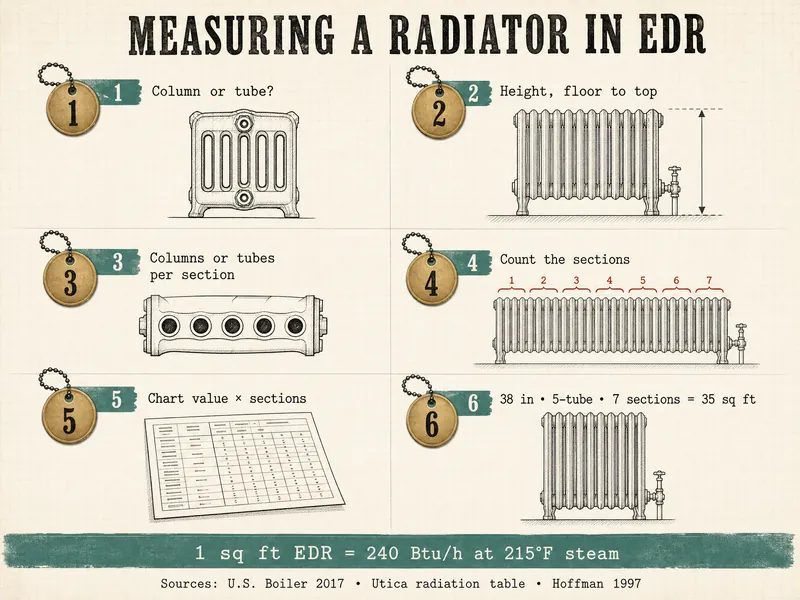
Measure its height, count its sections and columns, and look the figure up in a radiation chart. U.S. Boiler's sizing page (2017) sets out the steps:
- Decide whether the radiator is a column type (thick, separate columns) or a tube type (many slender tubes).
- Measure the height from the floor to the top of the radiator.
- Count the columns or tubes in one section.
- Count the sections.
- Find the square feet per section in a chart for that height and type, then multiply by the number of sections.
- Repeat for every radiator and add the totals.
U.S. Boiler's worked example is a 22-inch, three-column radiator at 3 sq ft per section. Utica's radiation table, a maker sheet read from a mirror copy, gives 38-inch column radiators at 3, 4, 5 and 8 sq ft per section for one, two, three and four columns, and 38-inch tube radiators at 3-1/2, 4-1/4, 5 and 6 sq ft for three-, four-, five- and six-tube sections. Its example is a 38-inch, 5-tube radiator with 7 sections: 35 sq ft EDR.
Measuring and counting is safe for a homeowner: it needs only a tape measure and a notepad, and nothing on the radiator is touched. Steam pipes and radiators get hot, so do it with the heat off. If unsure about the type or the chart, a licensed heating technician makes the same survey before quoting a boiler.
EDR in numbers
- 240 Btu/hthe steam rating behind every square foot of EDRHoffman bulletin FHD-205 (1997)
- 35 sq ftEDR of a 38 in, 5-tube, 7-section radiatorUtica radiation table (maker sheet)
- 1.333piping and pick-up allowance built into steam ratingsWeil-McLain EG manual, 2025
- x 4pounds of condensate per hour to sq ft EDRHoffman FHD-205 (1997)
Why does EDR size a steam boiler?
A steam boiler has to fill every radiator and pipe with steam each cycle, so it is sized to what is connected, not to how much heat the house loses. U.S. Boiler's replacement tips (2018) are blunt: do not complete a heat-loss calculation for a steam boiler, and do not simply match the old boiler size. Its 2019 article on boiler size says the same: the boiler "must be sized for the volume of radiation in the home."
Makers' ratings already allow for the pipes. Weil-McLain's EG manual (2025) says steam ratings are based on a piping and pick-up allowance of 1.333, against 1.15 for water ratings, and U.S. Boiler says a boiler makes about 33% more steam than its listed square feet for that reason. Extra allowance is only for unusual piping. Uninsulated mains are the exception people miss: U.S. Boiler says an uninsulated steam main "is equal to a radiator" and must be added to the load. Its advice is not to oversize. The steam heat section explains why pipes, vents and pressure matter as much as the boiler.
How does EDR help with a hot-water boiler?
On hot water, the boiler is sized from a room-by-room heat-loss calculation (Manual J), and EDR tells a technician what water temperature the radiators need. U.S. Boiler's conversion article (2024) describes a connected-load survey, then the emission chart to find the supply temperature that meets the heat loss.
That matters for condensing boilers, which need cool return water to condense flue vapor. If the radiators are large compared with the heat loss, they can heat the house with cooler water. The "Cast Iron Radiators" preset in Weil-McLain's condensing ECO Tec control targets 180°F at most and 120°F at least (Weil-McLain, 2024). The guest author of U.S. Boiler's conversion article goes further, saying cast-iron radiators can run with water as low as 75°F; that is his view as a contractor, not a maker rating. Boiler choices are covered in the boilers section, and the air-to-water heat pump article explains why radiator size decides whether a heat pump can feed them.
Were old radiators oversized?
Often, yes. The guest author of U.S. Boiler's conversion article writes that after the 1918 flu, systems were sized to heat rooms with windows partly open. U.S. Boiler's own sizing article adds that "in a lot of cases, older boilers are oversized for the homes they serve."
A heat-loss calculation shows how the house compares with its radiators today. On hot water, spare radiation is useful: the emission chart shows a bigger radiator can deliver the same heat from cooler water, so a new boiler can run at lower temperatures. On steam, the boiler still has to match the radiators, because U.S. Boiler sizes it to connected radiation either way. The radiators section and the radiator covers page cover the other things that change how much heat a radiator delivers.
Proof stamp: where these figures come from
Based on Hoffman's FHD-205 bulletin (1997), U.S. Boiler's steam sizing page (2017), replacement tips (2018), boiler size article (2019), radiator emission chart (2024) and conversion article (2024), Utica's radiation table (a maker sheet read from a mirror copy, created 2004), Weil-McLain's EG (2025) and ECO Tec (2024) manuals, plus the 2013 Building America study of steam balancing for DOE; every source was read in October 2026. Only the 38-inch rows of the Utica table are used, because other rows could not be read cleanly. Left out: Btu/h figures for any specific reader's radiator, and one maker's model table in place of the standard chart.
Questions from the boiler room
Is EDR the same as the radiator's surface area?
No. EDR is a heat rating, and Hoffman's definition notes it may have no direct relation to the actual surface area. Two radiators with the same footprint can rate quite differently.
How do you convert EDR to Btu per hour?
On steam, multiply square feet of EDR by 240 Btu/h. On hot water, use the emission chart for the average water temperature, for example 170 Btu/h per square foot at 180°F.
What if a radiator's height isn't in the chart?
Charts list standard heights, so use the row for the nearest catalog height and type, or ask a technician who has the full radiation tables. Utica's sheet shows 38-inch rows, and other tables cover other heights.
Does pipe count toward EDR?
On steam, uninsulated mains do. U.S. Boiler says an uninsulated main is equal to a radiator and must be added to the load, which pushes the boiler size up. Insulating mains avoids that.
Can you size a steam boiler from the old one's nameplate?
U.S. Boiler says not to. The old boiler may have been oversized or the radiators changed since, so the new boiler is sized to the connected radiation.
What is the condensate rule for EDR?
Hoffman's bulletins convert pounds of condensate or steam per hour to square feet of EDR by multiplying by 4. It is a technician's check on how much steam a system uses.
Does a bigger radiator need a bigger air vent?
On one-pipe steam, yes. The DOE steam study says big radiators hold more air and need larger vents, which is another use for the radiator census.
Back up the riser: the five valve tags on the Wet Return home page