Sight Glass and Low-Water Cutoff
A low water cutoff shuts off a steam boiler's burner when the water drops too low, and the sight glass beside it lets you see that water level without touching anything.
Compiled by the Wet Return bench from makers' manuals and federal pages · how pages are checked · Checked again
Who owns what: Wet Return is run by the same people who own PlumbingSupplyAndMore, Central Plumbing & HVAC, SoftPro Water Systems and Quality Water Treatment, the businesses linked on this page. The text is written from boiler and vent makers' manuals and federal pages read in October 2026; what a business says about its own products is that business's claim. How these links are handled
On the tag
- Code requires a gauge glass on every steam boiler and a low-water fuel cutoff on every automatically fired one (McDonnell & Miller catalog MM-825B, 2011).
- Weil-McLain's 2025 EG manual says the normal waterline is "halfway up gauge glass"; its SGO manual says the cold level should match the line stamped on the jacket.
- McDonnell & Miller's maintenance table calls for weekly blowdown of float-type cutoffs and replacement at most every 10 years; on this site both are technician work.
- A probe-type cutoff stops the burner when water leaves the probe for 10 seconds (MM-825B).
- Weil-McLain's owner troubleshooting table says frequent make-up water means leaks for a qualified service technician to repair.
What does a low-water cutoff do?
A low-water cutoff is a safety switch that stops the burner if the water in a steam boiler falls too low, so the boiler cannot fire dry. McDonnell & Miller's general catalog MM-825B (2011) quotes the code requirement: "Each automatically fired steam or vapor steam boiler shall be equipped with an automatic low water fuel cut-off."
There are two common kinds. A float-type cutoff has a float in a chamber, often piped to the same tappings as the gauge glass, which mirrors the boiler's level and trips a switch "wired in series with the burner," as the catalog puts it; this design dates to the 1920s. A probe-type cutoff uses a probe set just below the water line; the water completes a circuit, and when the water leaves the probe for a continuous 10 seconds the burner is stopped. The delay keeps normal surging from causing nuisance shutdowns.
Some steam boilers also carry a backup cutoff; Hydrolevel's Safgard instructions (2019) say its 500 and 700 models serve only as secondary cutoffs on steam.
How do you read a steam boiler sight glass?
Read the sight glass by looking at where the water surface sits in the glass tube on the side of the boiler, without opening or touching any of its valves. It is held between two brass fittings called gauge cocks. MM-825B's glossary says it shows the water level and that "by code, all steam boilers are required to have one."
Look once when the boiler is cold and once while it runs, so you know both levels for your boiler. A level you can clearly see, moving gently while the burner fires, is what you want. U.S. Boiler's replacement tips stress that nothing replaces a homeowner who checks the water level regularly. On this site, checking is yours; anything that changes the level belongs to a technician.
What water level is normal in the sight glass?
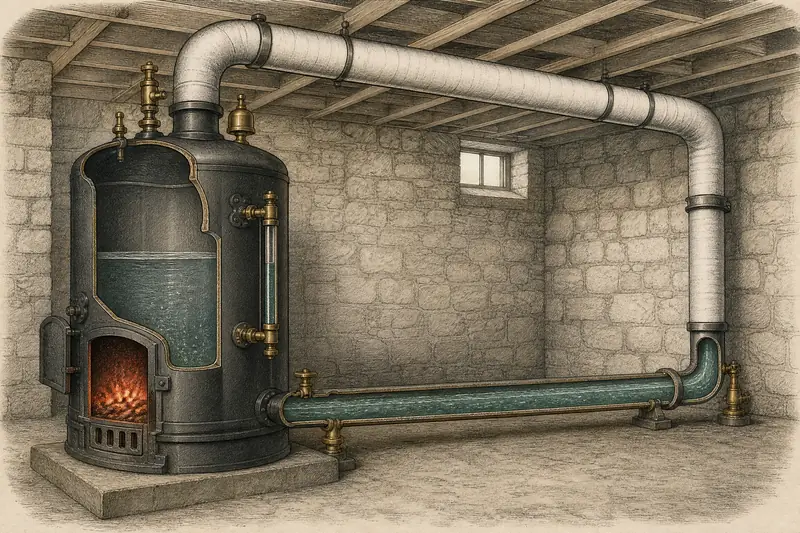
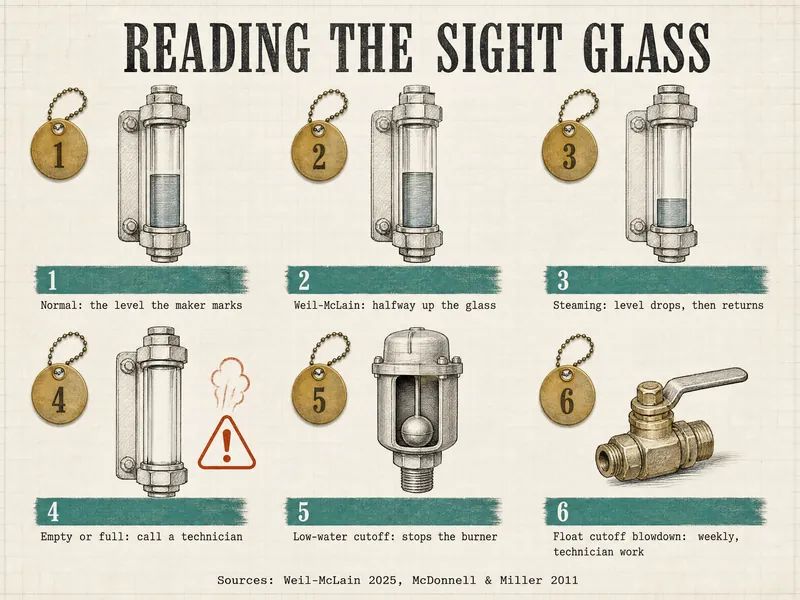
The normal level is the one your boiler's maker marks, on the jacket or in the manual, and it is often about half a glass when the boiler is cold. Weil-McLain's EG boiler manual (2025) says "Normal waterline is halfway up gauge glass," and its SGO steam boiler manual (2025) says the cold level "should correspond to line stamped on boiler jacket. When boiler operates, water level will fluctuate."
Makers do not all agree on a single fraction. McDonnell & Miller says the level "varies from manufacturer to manufacturer," describes a typical cold fill near two-thirds, and says that while steaming the level often sits in the lower third because water is out in the system as steam. The catalog adds that the minimum safe level is usually just below the bottom of the visible glass. A level that dips during a cycle and recovers is normal; an empty glass is not.
| What you see | What the makers say it means | Your next step |
|---|---|---|
| Water at the maker's mark when cold | Normal | Nothing |
| Level lower while steaming, back when cold | Normal: water is out in the pipes as steam | Nothing |
| No water visible in the glass | Below the safe range, or a fault | Call a heating technician now |
| Glass completely full | Overfilled: water can be carried into the pipes | Call a heating technician |
| Large, fast swings while firing | Foaming or surging from oil or dirt in the water | Call a heating technician |
| Dirty, cloudy glass | Dirt or sediment in the boiler water | Mention it at the next service |
What does a dirty or bouncing sight glass mean?
A bouncing water line usually means the water is foaming or surging, and a dirty glass usually means sediment, rust or oil in the boiler. MM-825B's glossary says foaming "generally is indicated in the gauge glass by large swings in water level." Weil-McLain's SGO troubleshooting table lists the causes of violent waterline swings as "dirt, oil or other impurities in water," a waterline that is too high, or incorrect piping, and the fix it names is "Have qualified service technician skim boiler."
Skimming is a technician procedure that cleans the water surface. MM-825B says it should be done on all new boiler installations and when there is foaming; Weil-McLain's EG manual warns that a boiler not properly cleaned can show violent water-level swings and pass water into the steam mains, and says skimming may take several hours. The Peerless 211A steam boiler manual (2025) adds vents or traps that are not letting air out to its list of causes of excess bounce.
A cracked glass is a technician job; Weil-McLain says to replace it with proper gauge glass, never thin tubing.
Sight glass and cutoff numbers
- 1/2 glassNormal waterline in Weil-McLain's EG manualWeil-McLain, 2025
- 10 secondsWater off the probe before a probe cutoff stops the burnerMcDonnell & Miller MM-825B, 2011
- WeeklyFloat-cutoff blowdown interval in the maker's table (technician work here)McDonnell & Miller MM-825B, 2011
- 10 yearsLongest replacement interval for residential float cutoffsMcDonnell & Miller MM-825B, 2011
Who tests and blows down a low-water cutoff?
A heating technician, or someone that technician has trained on that specific boiler, tests and blows down the low-water cutoff on this site. Makers call for weekly blowdown of float-type cutoffs during the heating season: MM-825B's maintenance table says of its 67 and 767 models, "Blow down weekly. Inspect and test annually." Slant/Fin's Galaxy steam manual asks for it three times in the first week after a new boiler goes in and at least weekly after that, and Hydrolevel's 2025 Steam Pro Kit instructions ask for weekly blowdown in season of its probe-based backup cutoff too, because sediment can stop it sensing low water.
Some of those manuals address the owner. This site still treats the job as technician work. Blowdown releases boiler water under pressure, and Weil-McLain's EG manual warns of "scald potential," saying boiler pressure "must be low to avoid the potential of severe burns from steam." The DOE's 2011 renovation handbook puts "Test low-water cutoff safety control" in the steam tune-up list for an HVAC technician. Probe-type cutoffs are inspected and cleaned at the yearly service; see what an annual boiler service covers.
PlumbingSupplyAndMore's low-water cutoffs (run by Wet Return's owners) show the float and probe types: the kind of part a technician fits.
What if the boiler keeps needing water?
A steam boiler that keeps needing water has a leak or a fault, and that is a call for a licensed heating technician. Weil-McLain's SGO manual tells owners to "have qualified service technician repair leaks at once to avoid constant use of makeup water," and its EG manual explains why it matters: fresh make-up water shortens a boiler's life through corrosion.
Some loss is expected, since a steam system is open to the air. MM-825B lists the usual culprits when it is more than that: vents passing steam, a blowdown valve left open, relief valve discharge, leaking wet returns ("Always suspect any buried pipe"), foaming, poor pipe pitch, a faulty automatic feeder, or the boiler itself leaking at the water line. Automatic feeders do not fix the problem: MM-825B says a feeder "will maintain a safe minimum water line only," and Weil-McLain says feeders are not recommended as primary control.
If the glass shows no water at all, do not try to fix it yourself; call a technician. U.S. Boiler suggests installing a water meter so make-up water can be tracked. For leaks in the return piping, the how steam heat works page explains the wet return. If unsure about any reading, call a licensed heating technician.
Related steam pages
 Folder: Steam heat in old houses, from the top
 Steam heat: Steam radiator air vents and how they fail
 Steam heat: Banging pipes, pitch and water level
Proof stamp: where these figures come from
Read in October 2026: the McDonnell & Miller MM-825B catalog (2011); two Weil-McLain boiler manuals (2025); Slant/Fin Galaxy steam instructions (2019); Hydrolevel's Safgard (2019) and Steam Pro Kit (2025) sheets; the Peerless 211A manual (2025); U.S. Boiler's steam replacement tips (2018); and DOE's 2011 renovation handbook. Where a maker manual speaks to owners about blowdown or filling, this page describes it as a technician's job. Left out: any step for blowing down, draining, filling or skimming a boiler, flushing a gauge glass or adjusting a feeder.
Questions from the boiler room
How often should I look at the sight glass?
The maker manuals read for this page set no fixed interval for owners, and U.S. Boiler simply says nothing replaces the homeowner checking the level. Looking regularly through the heating season, without touching anything, is enough. A level you cannot see, or one that keeps falling, is a reason to call a technician.
Why did my steam boiler shut off with water still in the glass?
More than one control can stop the burner, including the pressure control when the system reaches its cut-out pressure and the low-water cutoff. Repeated shutdowns, or a boiler that will not restart, are for a technician to diagnose; never reset or bypass a safety control yourself.
Is an automatic water feeder the same as a low-water cutoff?
No. The cutoff stops the burner; a feeder adds water. McDonnell & Miller says a feeder keeps only a safe minimum level, and Weil-McLain does not recommend feeders as primary control.
Why is the water in my sight glass rusty?
Weil-McLain's EG manual ties frequent make-up water to corrosion inside the boiler, and Hydrolevel warns that sediment can keep a cutoff from sensing low water. Point out a dirty glass at the next service so a technician can check the boiler water.
Can a low-water cutoff wear out?
Yes. McDonnell & Miller's table gives 10 years as the longest replacement interval for its residential float cutoffs, with annual inspection and testing.
Why does a brand-new steam boiler's water line jump around?
New boilers carry oil and grease from manufacture and installation. Weil-McLain's EG manual says a boiler that is not properly cleaned can show violent swings in water level, and McDonnell & Miller says skimming should be done on all new installations, a technician job that can take several hours.
Back up the riser: radiator heat in old houses, system by system