Tag No. 1 · 5 pages
Steam Heat in Old Houses
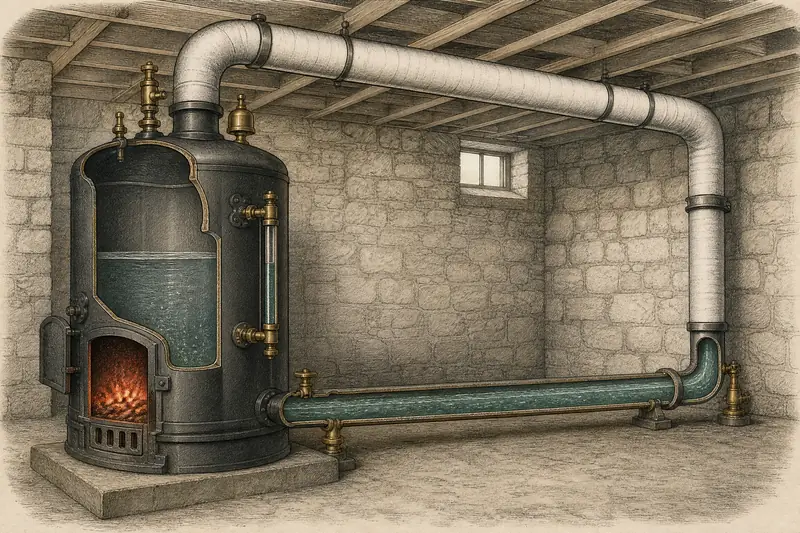
Steam heat in old houses boils water at very low pressure, usually under 2 psi, so steam rises to the radiators, gives up its heat and drains back as water.
Compiled by the Wet Return bench from makers' manuals and federal pages · how pages are checked · Checked again
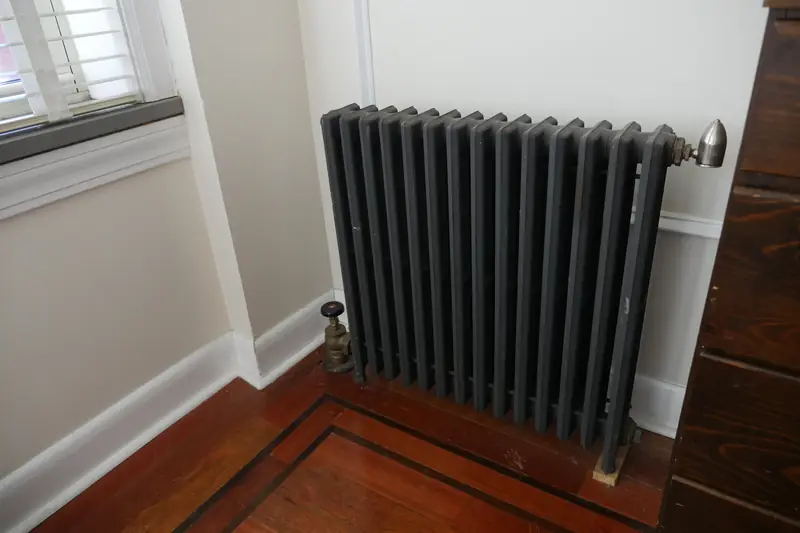
On the tag
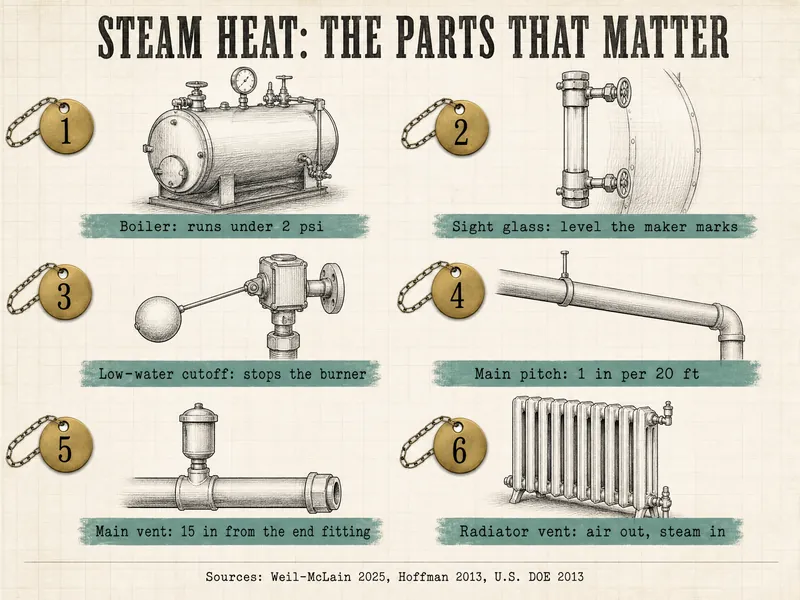
- Weil-McLain's 2025 steam boiler manual puts the working pressure of a typical house steam system below 2 psi; its limit control should never be set above 10 psi.
- One-pipe steam feeds each radiator through a single pipe that carries steam in and water out at the same time (Hoffman, 1999).
- Steam cannot heat a radiator until the air inside has been pushed out through a vent or trap (Hoffman TES-375A, 2013).
- Every steam boiler must have a gauge glass by code, and an automatically fired one needs a low-water cutoff (McDonnell & Miller catalog, 2011).
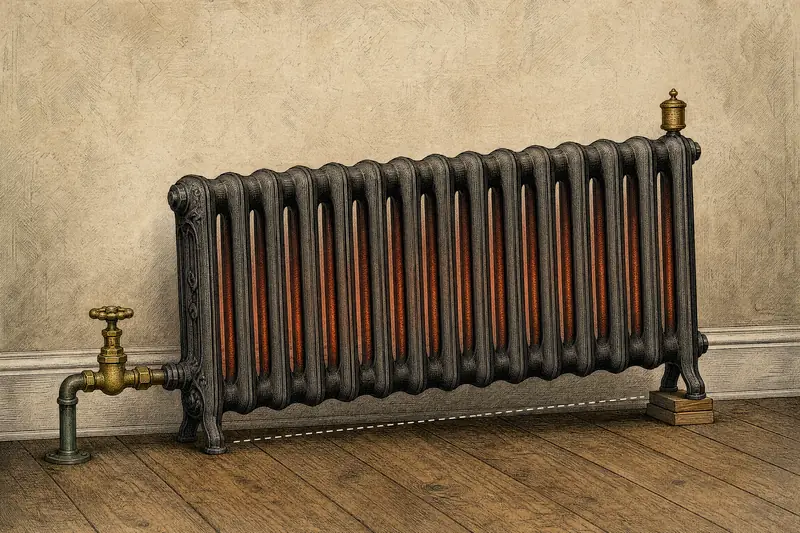
- Hoffman's 2013 manual has one-pipe mains pitched 1 inch or more per 20 feet so condensate can run back to the boiler.
- A U.S. DOE Building America report (2013) puts typical one-pipe operating pressure at 0.5 to 1.5 psi.
How does steam heat work in an old house?
Steam heat works by boiling water in a basement boiler and letting the steam push through pipes to cast-iron radiators, where it condenses and releases heat. The Hoffman technical manual TES-375A (Xylem, 2013) explains that pressure is highest at the boiler and falls in each radiator as steam turns back into water, and that difference is what moves the steam. No pump is involved; a 2011 Department of Energy handbook notes that steam "moves itself through piping."
The water that forms in the radiators, called condensate, runs downhill back to the boiler, which is why pipe slope matters so much.
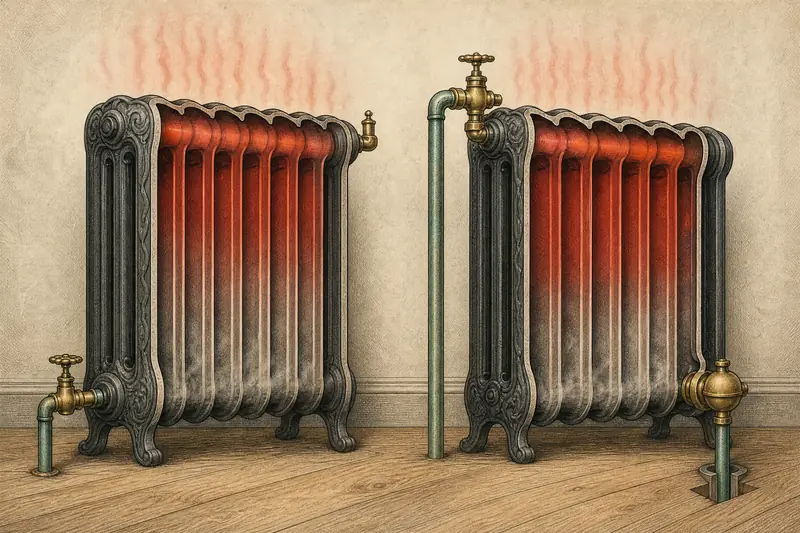

Is your system one-pipe or two-pipe steam?
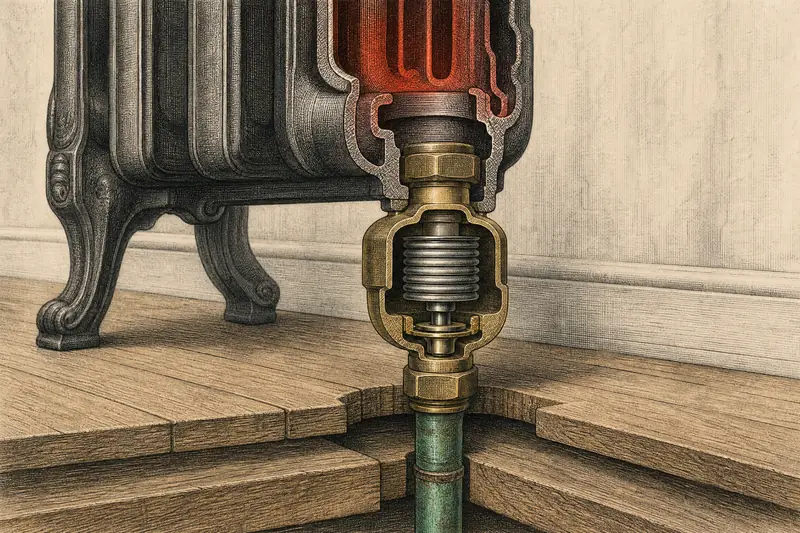
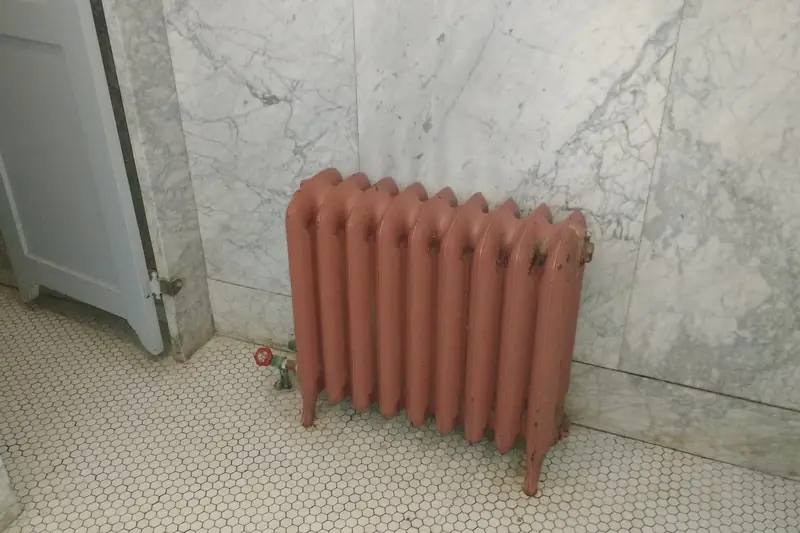
Count the pipes at a radiator: one pipe and a small vent on the far end means one-pipe steam; two pipes, one at the top and one at the bottom, means two-pipe steam. The Hoffman Basic Steam Heating System booklet defines one-pipe as a single connection that "receives steam and releases condensate at the same time," and two-pipe as separate supply and return pipes.
A hot-water radiator also has two pipes, but usually carries a small bleed screw near the top as well. If you are unsure which you have, the hot-water radiator explainer shows the differences side by side.
| System | Pipes at each radiator | What lets the air out | Where the water goes |
|---|---|---|---|
| One-pipe steam | One, with a valve at one end | Air vent on the opposite end | Back down the same pipe |
| Two-pipe steam | Two: supply at top, return at bottom | Trap at the outlet, then the return line | Through the trap into a separate return |
| Hot water | Two, plus a small bleed valve up high | Bleed valve or automatic air vent | Pumped round a closed loop |
What do steam air vents and traps do?
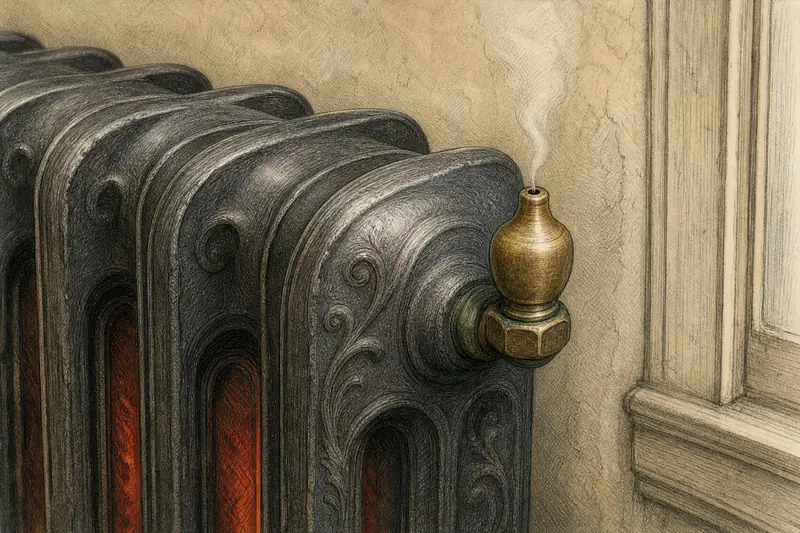
Vents and traps let air out so steam can get in. On one-pipe systems, a vent on each radiator stays open while cold and closes when hot steam reaches it (Hoffman TES-375A); larger main vents do the same job for the basement pipes. On two-pipe systems, a thermostatic trap at each radiator outlet passes air and condensate into the return but shuts against live steam.
Your part is noticing a vent that spits water, hisses steam or never lets a cold radiator warm up. Vents and traps are replaced by a heating technician who works on steam, not by the homeowner.
What can you check on a steam boiler?
You can look at the sight glass, the pressure gauge and the radiators, and leave everything else to a technician. The glass should show water near the line your boiler's maker stamps on the jacket or prints in its manual; Weil-McLain's EG manual calls the normal waterline "halfway up gauge glass." Expect it to drop while the boiler is steaming and come back as condensate returns.
A glass that is empty, completely full, or keeps needing water is a call for a licensed heating technician. So is anything to do with the low-water cutoff, the control that shuts the burner down when the boiler runs short of water. Float-type cutoffs are meant to be flushed out weekly in season, and this site leaves that to a technician because the discharge is scalding.
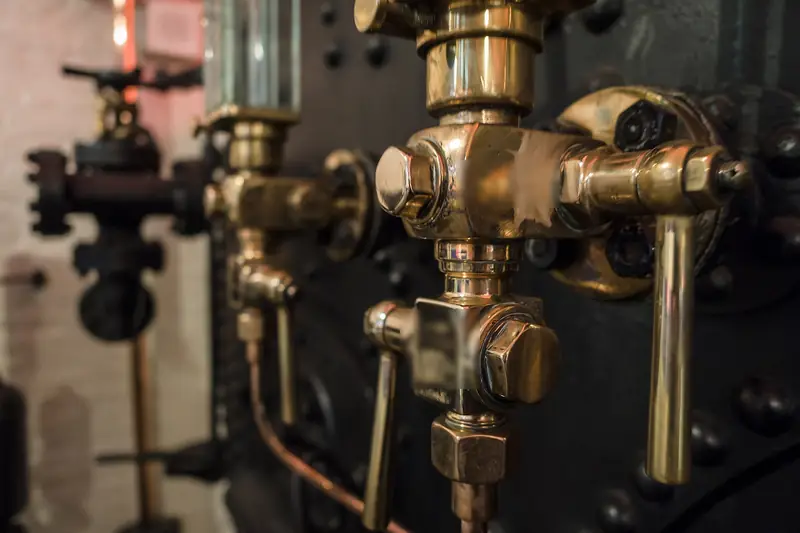 Steam heat: Sight glass and low-water cutoff, explained
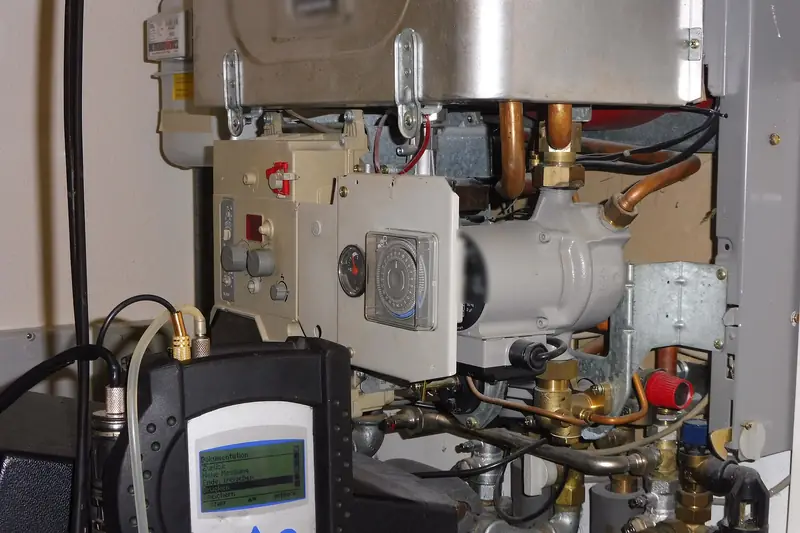 Boilers: What a yearly boiler service covers
 Boilers: Replacing an old boiler on a steam system
Steam heat by the numbers
- 2 psiCeiling for normal running pressure on typical house systemsWeil-McLain SGO manual, 2025
- 10 psiLimit control should never be set above thisWeil-McLain EG manual, 2025
- 1 in per 20 ftMinimum slope of one-pipe parallel-flow mains, falling in the direction of condensate flowHoffman TES-375A, 2013
- 15 inMain vent set at least this far back from the end fittingU.S. DOE Building America, 2013
- 240 Btu/hHeat from each square foot of EDR on 215°F steam, per Hoffman's definitionHoffman FHD-205, 1997
Why do steam pipes bang?
Banging, or water hammer, happens when fast steam meets water lying where it should not be, in a sag in a pipe or a radiator tilted the wrong way. Hoffman's two-pipe definitions sheet FHD-205 (1997) calls water hammer "one of the chief causes of noise in steam heating systems." A one-pipe radiator should slope back toward its valve, and its valve should be fully open or fully closed, never halfway.
Knocking from the basement mains, or knocking that continues once the radiator valves are checked, is a job for a technician who can check pipe pitch and water level.
Proof stamp: where these figures come from
This hub draws on Weil-McLain's EG and SGO boiler manuals (2025), Hoffman Specialty's steam documents from 1997 to 2013, McDonnell & Miller's general catalog (2011) and a Department of Energy Building America report on balancing steam systems (2013), all read October 2026. Pressure figures are explained, never given as settings to dial in. Left out: vent airflow ratings (no maker table could be read), vacuum and vapor system details, and any step for adding water to or draining a boiler.
Questions from the boiler room
Is steam heat the same as hot-water heat?
No. Steam systems boil water and send vapor to the radiators, while hot-water systems pump liquid water round a closed loop. Steam radiators have a vent or a trap; hot-water radiators usually have a small bleed valve near the top.
Why is my steam heat so slow to warm up after a cold night?
Each radiator has to push out its air before steam can enter, and the far radiators vent last. Hoffman's TES-375A notes that adjustable vents let near radiators vent slower than far ones to even this out, which is balancing work for a steam technician.
Can a steam system run on a modern boiler?
Yes, with a new steam boiler sized to the connected radiation. U.S. Boiler's sizing page says to size steam boilers from the radiators, not from a heat-loss calculation or the old boiler's label.
Do steam radiators need bleeding like hot-water ones?
No. A steam radiator has nothing to bleed: its air vent lets the air out every time the system starts. Opening anything on a hot steam radiator risks a burn.
Is it normal for a steam boiler to use some water?
A little, yes. McDonnell & Miller's catalog calls some evaporation normal on an open steam system. Frequent refilling points to leaks, which Weil-McLain's owner troubleshooting table hands to a service technician.
Who should I call about a steam system?
A licensed heating contractor with steam experience. If unsure about anything you see on the boiler, call a licensed heating technician rather than adjusting controls yourself.
Back up the riser: radiator heat in old houses, system by system